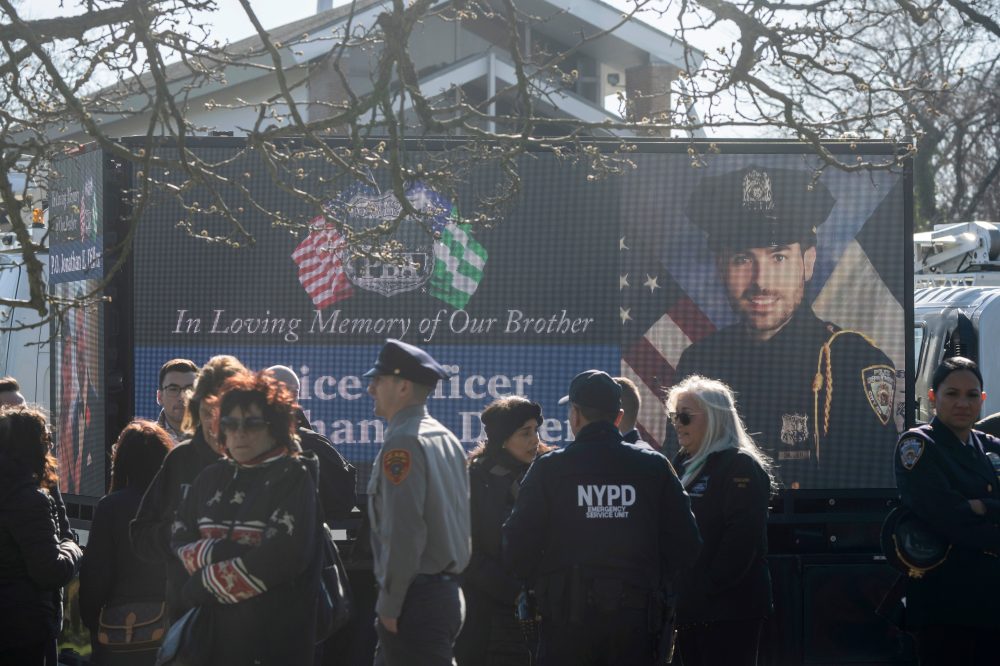

NEW YORK — Jurors are preparing to deliberate in the murder trial of a man accused of fatally shooting a New York City police officer in a case that drew national political attention during the 2024 presidential race.
The March 25, 2024 killing of Officer Jonathan Diller became a campaign talking point for Donald Trump, who was then seeking to return to the presidency. Trump attended Diller’s funeral services and used the tragedy to highlight what he characterized as rampant crime in the Democratic-controlled city.
Central to the case is whether Guy Rivera deliberately fired the shot that killed Diller during a routine traffic stop in Queens. Both prosecution and defense teams presented their final arguments Tuesday, offering starkly different interpretations of the events.
Prosecutor John Kosinski told jurors that video footage and witness testimony clearly demonstrated Rivera deliberately drew a hidden weapon and fired at Diller with intent.
Despite being wounded, Diller helped other officers subdue Rivera to prevent additional harm, Kosinski explained.
“Diller chose life. The defendant chose differently,” Kosinski stated while displaying the bullet recovered from Diller’s body. The officer received a posthumous promotion to detective.
Defense attorney Jamal Johnson countered that the state failed to establish intentional action, which is essential for a first-degree murder conviction. Johnson claimed the weapon fired accidentally while Rivera was being restrained by another officer.
“This is not intentional. This is not targeted,” Johnson told the court.
Johnson also challenged the reliability of officer testimony, claiming it conflicted with body camera recordings from the scene.
Addressing a courtroom filled with uniformed police and Diller’s relatives, Johnson encouraged jurors to “question everything” about the police account and suggested the testifying officers had “motive to lie.”
“They want you to disbelieve what the bodycam shows,” he argued.
Kosinski dismissed those claims, saying “William Shakespeare couldn’t come up with the words to show the defendant didn’t fire that gun.”
The prosecutor emphasized that Rivera’s preparation — loading ammunition, chambering a round, and disabling the safety before concealing the weapon — demonstrated clear intent to use it.
“We don’t tell a story to fit the facts. The facts tell the story,” Kosinski said. “He pulled the trigger. It was in his hands. That’s what happened here.”
Deliberations are scheduled to begin Wednesday following the three-week trial.
If found guilty of first-degree murder, the 36-year-old Rivera faces life imprisonment without parole. He also confronts additional charges including attempted murder.
The fatal encounter occurred while Diller and fellow officers patrolled the Far Rockaway neighborhood in Queens. Police reported noticing a suspicious bulge in Rivera’s sweatshirt as he and a companion approached a parked vehicle.
According to authorities, officers were interviewing the driver when Rivera, seated in the passenger position, suddenly produced a firearm and shot Diller.
The bullet penetrated below Diller’s protective vest, causing fatal injuries. A responding officer then shot and injured Rivera.
Diller’s death marked the first NYPD line-of-duty fatality in two years. Memorial ceremonies for the 31-year-old officer in his Long Island community attracted thousands, including Trump.
Following his visit with Diller’s family at the funeral home, Trump described the death as “such a sad, sad event, such a horrible thing.”
“The police are the greatest people we have. There’s nothing and there’s nobody like them. And this should never happen,” Trump commented.