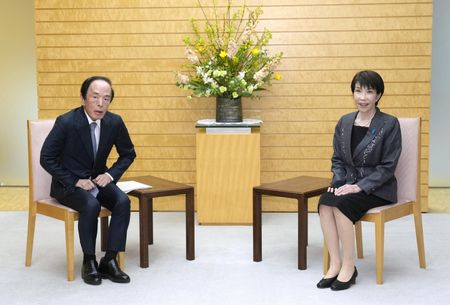

Political pressure is mounting on Japan’s central bank to pump the brakes on interest rate hikes, as the government of Prime Minister Sanae Takaichi works to place more dovish — or low-rate-friendly — policymakers inside the Bank of Japan, potentially reshaping the institution’s direction for years to come.
Though recent calls from Takaichi and her political allies to keep borrowing costs low are not expected to derail near-term rate hike plans, fresh appointments to the BOJ board could reignite older debates about whether Japan needs ongoing monetary stimulus to keep its economy growing.
The Takaichi administration stayed largely quiet as the BOJ moved forward with a June decision to raise interest rates to 1% — a 31-year high — partly out of concern about worsening a yen slide and irritating Washington.
However, Economy Minister Minoru Kiuchi, who was present at the June meeting, urged the central bank to take the government’s pro-growth initiatives into account when making future decisions — a clear sign of the administration’s unease about continued rate increases.
A draft of the Takaichi government’s first economic blueprint, expected to be finalized in July, calls for monetary policy to be aligned with government efforts to stimulate growth — signaling a preference for keeping interest rates low, according to a draft reviewed by Reuters.
For now, the government’s primary strategy appears to be gradually reshaping the BOJ’s leadership. Those changes are already being interpreted by observers as a signal that a more dovish era is coming.
Former BOJ board member Makoto Sakurai offered this assessment: “The Takaichi administration can’t openly criticise the BOJ’s monetary policy for fear of upending markets. But she can wield influence with personnel decisions. That’s a very powerful weapon.”
Takaichi, a well-known supporter of “Abenomics” — the economic strategy of the late Prime Minister Shinzo Abe — took office last October promising to revive Japan’s economy through major spending initiatives that would be easier to fund under low interest rates.
Her first pick for the BOJ board, Toichiro Asada, voted against the June rate hike. Her second appointee, Ayano Sato, joined the board this week and is also regarded as favoring loose monetary policy.
Two hawkish — or rate-hike-favoring — board members, Naoki Tamura and Hajime Takata, are set to see their five-year terms expire in July of next year, giving Takaichi an opportunity to fill more seats on the nine-member board with low-rate advocates.
The biggest turning point could come when BOJ Governor Kazuo Ueda’s term ends in early 2028. Ueda was selected by former Prime Minister Fumio Kishida with a clear directive to unwind the bank’s massive stimulus program.
Questions about Ueda’s health have already raised concerns about how firmly the BOJ can defend its independence. The 74-year-old governor missed the June meeting to receive medical treatment and has not made any public statements since being released from the hospital on June 19.
Whoever succeeds Ueda — likely someone chosen by Takaichi given her strong hold on power following a landslide election victory this year — may receive an entirely different set of marching orders. Some market observers point to former Deputy Governor Masazumi Wakatabe, a pro-stimulus academic with ties to Takaichi, as a leading candidate to take over.
Despite the political headwinds, the BOJ is pressing ahead with its inflation-fighting stance. Energy prices driven up by the war in Iran, combined with a weak yen pushing up the cost of imports, are adding to price pressures across Japan.
In a speech last week delivered by his deputy, Ueda reaffirmed the BOJ’s commitment to continued rate hikes, cautioning about the danger of inflation overshooting the bank’s 2% target.
Hawkish board member Tamura also called for rate increases roughly every few months, emphasizing the BOJ’s responsibility to keep prices stable.
A summary of the June meeting showed that some BOJ policymakers highlighted strong demand tied to artificial intelligence as a factor boosting both growth and inflation — further evidence of their intent to keep raising rates.
“Japan will likely see price rises broaden, which should remain the BOJ’s focus,” said a source familiar with the central bank’s thinking, speaking anonymously due to the sensitivity of the matter. “The BOJ’s policy approach stays unchanged.”
BOJ staff estimate that Japan’s neutral interest rate — the level that neither cools nor overheats the economy — falls somewhere between 1.1% and 2.5%, leaving room for additional hikes. Most analysts surveyed by Reuters expect the rate to reach 1.25% by the end of this year and 1.5% by the middle of next year.
Market dynamics may also help insulate the BOJ from political interference. The June rate hike has not succeeded in reversing the yen’s weakness, which has been squeezing household budgets by raising the price of imported goods. With the yen already near four-decade lows and the possibility of U.S. rate hikes strengthening the dollar further, resisting BOJ rate increases could carry serious economic consequences.
“If the Fed resumes rate hikes, that may force the BOJ to speed up rate hikes,” a second anonymous source said.
Still, political risk shadows all of these projections. Ryutaro Kono, chief Japan economist at BNP Paribas, expects the BOJ to raise rates again in October, citing the central bank’s own emphasis on robust AI-related demand as an inflationary driver.
“But we cannot deny the risk of political considerations delaying the rate-hike timing,” Kono said.