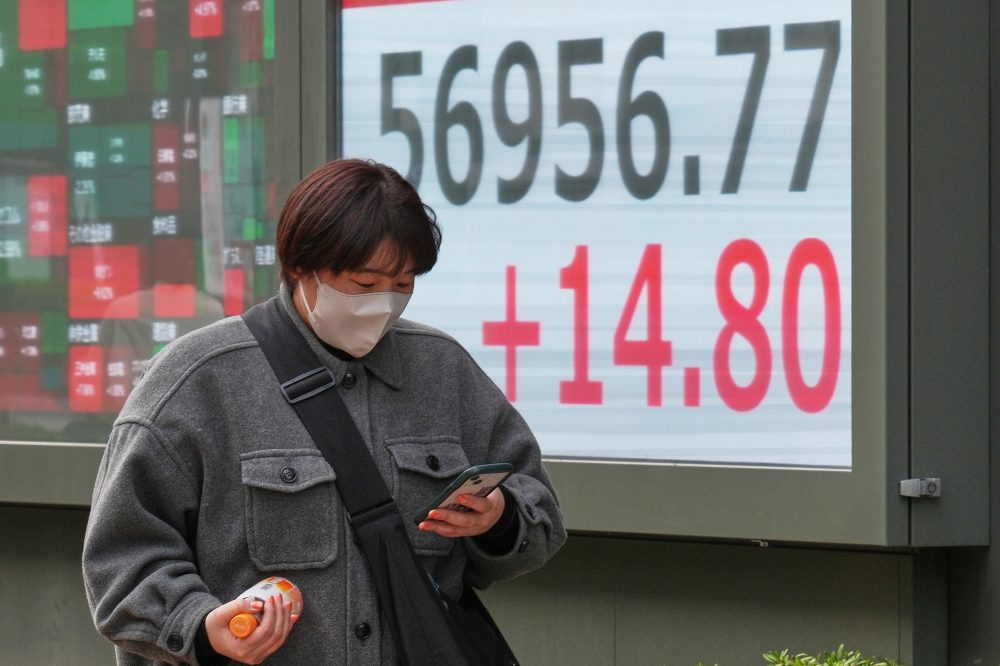

TOKYO – Japanese stocks experienced a notable decline on Tuesday as the country’s primary Nikkei 225 index dropped roughly 1% while the majority of Asian financial markets remained shuttered for Lunar New Year observances.
Commodity markets showed mixed results, with U.S. futures trending downward and petroleum prices displaying varied movement. Both gold and silver values decreased during trading.
Disappointing economic information released on Monday seemed to dampen investor confidence in Tokyo trading, with technology conglomerate SoftBank Group suffering a substantial 6.2% drop that contributed to the broader market decline. These losses came after a significant market surge that followed Prime Minister Sanae Takaichi’s ruling party achieving a decisive victory in the February 8 general election.
The Nikkei 225 stood at 56,237.65 by the midday trading session, representing a 1% decrease.
Market analysts suggested that investors were likely securing gains from the recent upward momentum that pushed the Nikkei to historic highs. Public opinion surveys indicate that Takaichi’s approval ratings are gradually declining as enthusiasm wanes for her economic recovery proposals involving increased government expenditures and tax reductions.
Other active Asian markets showed varied performance, with Australia’s S&P/ASX 200 climbing 0.3% to reach 8,964.10, while India’s Sensex dropped slightly by 0.1%. Thailand’s SET index experienced a minor decline of less than 0.2%.
Monday’s European trading session concluded with mixed results, and U.S. markets remained closed in observance of Presidents Day. American exchanges are scheduled to resume operations on Tuesday.
Last Friday’s U.S. trading saw the S&P 500 gain marginally by less than 0.1% following one of its most significant drops since Thanksgiving. The Dow Jones Industrial Average increased by 0.1%, while the Nasdaq composite fell 0.2%.
Stock valuations have been fluctuating alongside changing investor sentiment regarding substantial artificial intelligence investments. Market participants continue monitoring inflation trends and potential impacts on interest rate policies.
Early Tuesday commodity trading showed benchmark U.S. crude oil rising 65 cents to reach $63.54 per barrel. Meanwhile, Brent crude, which serves as the global pricing standard, decreased 29 cents to $68.36 per barrel.
Currency markets saw the U.S. dollar weaken to 153.17 Japanese yen from the previous 153.51 yen. The euro traded at $1.1841, declining from $1.1852.
Precious metals faced pressure with gold prices falling 1.4% and silver dropping 3.4%.
Digital currency Bitcoin declined 0.6% to approximately $68,500.