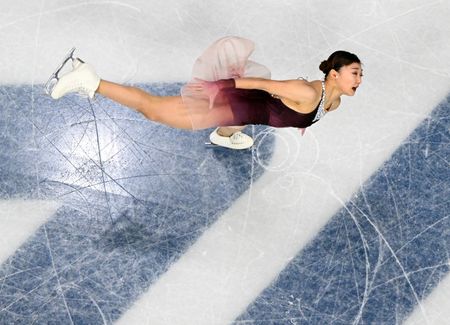

MILAN – Japanese figure skating star Kaori Sakamoto’s quest for Olympic gold came to a heartbreaking conclusion Thursday evening at Milano Cortina, where a single error cost her the championship she desperately wanted to cap her career.
The 25-year-old three-time world champion stumbled on a jump combination during her free skate routine set to music by Edith Piaf, a mistake that proved decisive in her narrow defeat. Sakamoto earned 224.90 points, falling just 1.89 points short of American winner Alysa Liu’s 226.79 total. Television cameras captured Sakamoto weeping as the final results were announced.
“I thought I might be able to finish with a smile but instead I’m ending it with this sense of frustration,” Sakamoto told reporters through an interpreter. “Still, I’ll try to make this experience valuable for the future.”
“The points I lost on those mistakes were exactly the margin that cost me the gold medal … that’s the most frustrating part — I know I left something out there.”
Sakamoto, who has announced plans to retire following this season, had hoped to complete her impressive career with Olympic gold after previously earning bronze in Beijing two years ago.
“I really wanted to skate perfectly here,” she explained. “Knowing that I couldn’t … was painful. I couldn’t stop the tears.”
Despite her disappointment, the veteran skater reflected on her growth since Beijing, where she also captured a team silver medal at these Games.
“My bronze before felt like a miracle. The fact that I now feel frustrated with a silver medal shows how much I’ve grown,” she noted.
Sakamoto also praised her younger Japanese teammates, particularly 17-year-old Ami Nakai, who claimed the bronze medal, and Mone Chiba, who placed fourth in her Olympic debut.
“For a 17-year-old to skate with that kind of composure and finish third is amazing,” Sakamoto said. “Being able to compete with both of them here is something I’ll always treasure.”
Nakai, who held the lead after the short program thanks to a successful triple Axel, encountered difficulties in her free skate when she downgraded a planned triple-triple jump sequence to a triple-double combination. Nevertheless, she secured bronze with 219.16 points, making her among Japan’s youngest Olympic medalists in women’s singles.
“At first, I didn’t even think I’d be able to compete in the Olympics, and now I’ve won a bronze medal, it still doesn’t feel real,” Nakai said. She finished with 219.16 points, becoming one of Japan’s youngest women’s singles medallists.
“I started skating because I loved the sport … and now I was able to fully express my love for skating on the Olympic stage,” she added.
The young skater expressed empathy for her teammate’s disappointment.
“I’ve seen Kaori’s hard work, so when I saw her performance, I felt very sad … From now on, I want to become a skater like Kaori, with a firm sense that I am carrying the weight of Japan on my shoulders.”
Chiba, competing in her first Olympics, acknowledged her fourth-place finish while looking ahead to future competitions.
“I feel like even though I gave it my all, I still fell short,” she said. “I’ll keep this feeling in mind and carry it forward … with a view to the World Championships.”
Looking toward the future of Japanese figure skating, Sakamoto expressed confidence in the next generation, saying she hopes to eventually return to Olympic competition “as a coach to future gold medallists.”