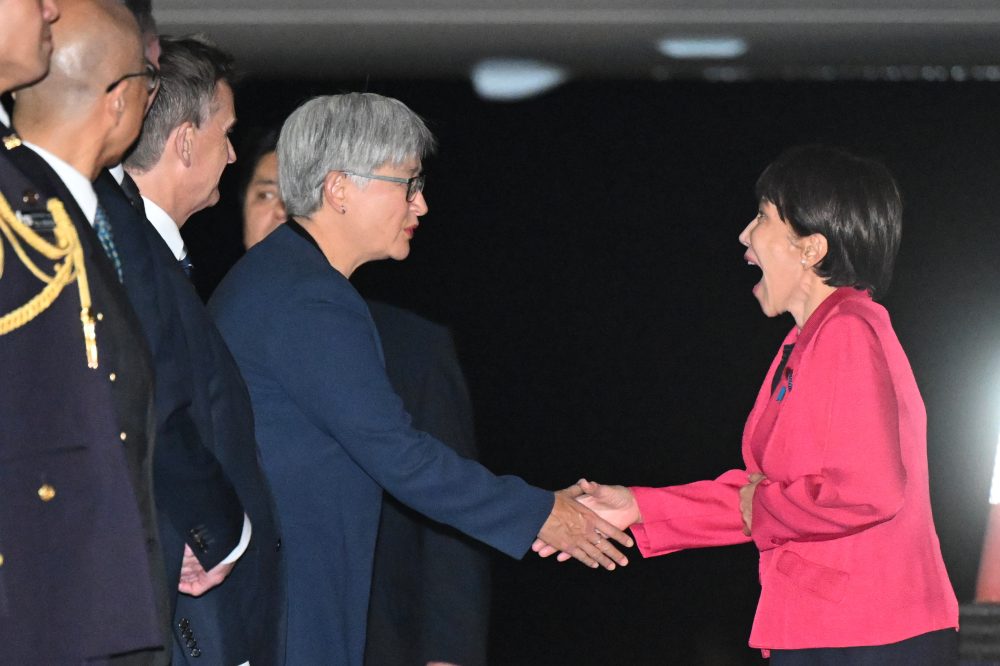

CANBERRA, Australia — Leaders from Japan and Australia have forged stronger partnerships across energy, defense, and mineral sectors as Middle Eastern conflicts continue to disrupt worldwide supply networks.
During her inaugural trip to Australia as the nation’s leader, Japanese Prime Minister Sanae Takaichi conducted talks with Australian Prime Minister Anthony Albanese at Parliament House in Canberra on Monday.
According to Takaichi, their discussions covered strategic topics including China, Southeast Asian nations, Pacific Island regions, nuclear concerns, and North Korean abduction issues.
“The effective closure of the Strait of Hormuz had been inflicting enormous impact on the Indo-Pacific. We affirmed that Japan and Australian will closely communicate with each other in responding with a sense of urgency,” Takaichi told reporters through an interpreter.
The energy relationship between both nations runs deep, with Australia supplying nearly 50 percent of Japan’s liquefied natural gas needs, while Japan ranks among Australia’s top five sources for refined gasoline and diesel fuel.
In recent weeks, Albanese has traveled to Singapore, Brunei and Malaysia seeking to secure fuel supplies after disruptions stemming from U.S. and Israeli military actions against Iran that began in February.
According to Albanese, Monday’s bilateral agreements will provide benefits for citizens in both countries.
“For Australians, it will mean we are less vulnerable to global shocks like we are seeing right now because of conflict in the Middle East,” Albanese said.
“Our joint statement on energy security reaffirms our commitment to navigate the current energy crisis together and maintain open trade flows of essential energy goods including liquid fuels and gas,” he said.
Their economic security cooperation statement pledges consultation during emergencies “including those related to geopolitical tensions, economic coercion or other significant market interruptions.”
The new partnerships also address China’s dominance and control over worldwide heavy rare earth production, materials essential for manufacturing powerful, heat-resistant magnets used in defense systems and electric vehicle manufacturing.
“We express our strong concerns over all forms of economic coercion, and the use of non-market policies and practices that are leading to harmful overcapacity and market distortions, as well as export restrictions, particularly on critical minerals,” the joint statement by the two countries said.
Both leaders announced they would “announce the elevation of critical minerals as a core pillar of our economic security relationship,” according to their statement.
Australia committed up to 1.3 billion Australian dollars ($930 million) in funding for critical mineral projects involving Japanese participation.
The prime ministers also revealed enhanced measures for Japan-Australia defense and security collaboration.
Takaichi’s visit follows recent defense agreements, coming two weeks after Japanese and Australian defense officials signed contracts for the initial three vessels in a AU$10 billion ($6.5 billion) Japanese-designed naval fleet.
Mitsubishi Heavy Industries will construct the first three Mogami-class frigates in Japan, while Australia intends to manufacture eight additional vessels at a Western Australia shipyard.
Albanese, who performs as a disc jockey at charity functions under the name DJ Albo, made light of Takaichi’s well-known passion for heavy metal music.
“Sanae and I will spend more time together later today and we will continue our discussions including on issues like heavy metal music and other important matters of state,” Albanese said.