
Italy’s Jewish community is raising alarm about escalating hostility following confrontations during the country’s Liberation Day commemorations in April that saw Jewish participants expelled from a historic anti-fascist march in Milan.
The annual April 25th celebration, which honors Italy’s liberation from Nazi-fascist rule, began traditionally with partisan songs and flags. However, tensions erupted when the Jewish Brigade contingent joined the procession alongside other Jewish organizations and dialogue groups.
Demonstrators hurled insults at the Jewish participants, shouting “assassins,” “genocidal pigs,” and “you should have been soap” – a reference to Holocaust imagery. The confrontation escalated from verbal attacks toward physical threats before police stepped in and removed the Jewish Brigade from the march for safety reasons.
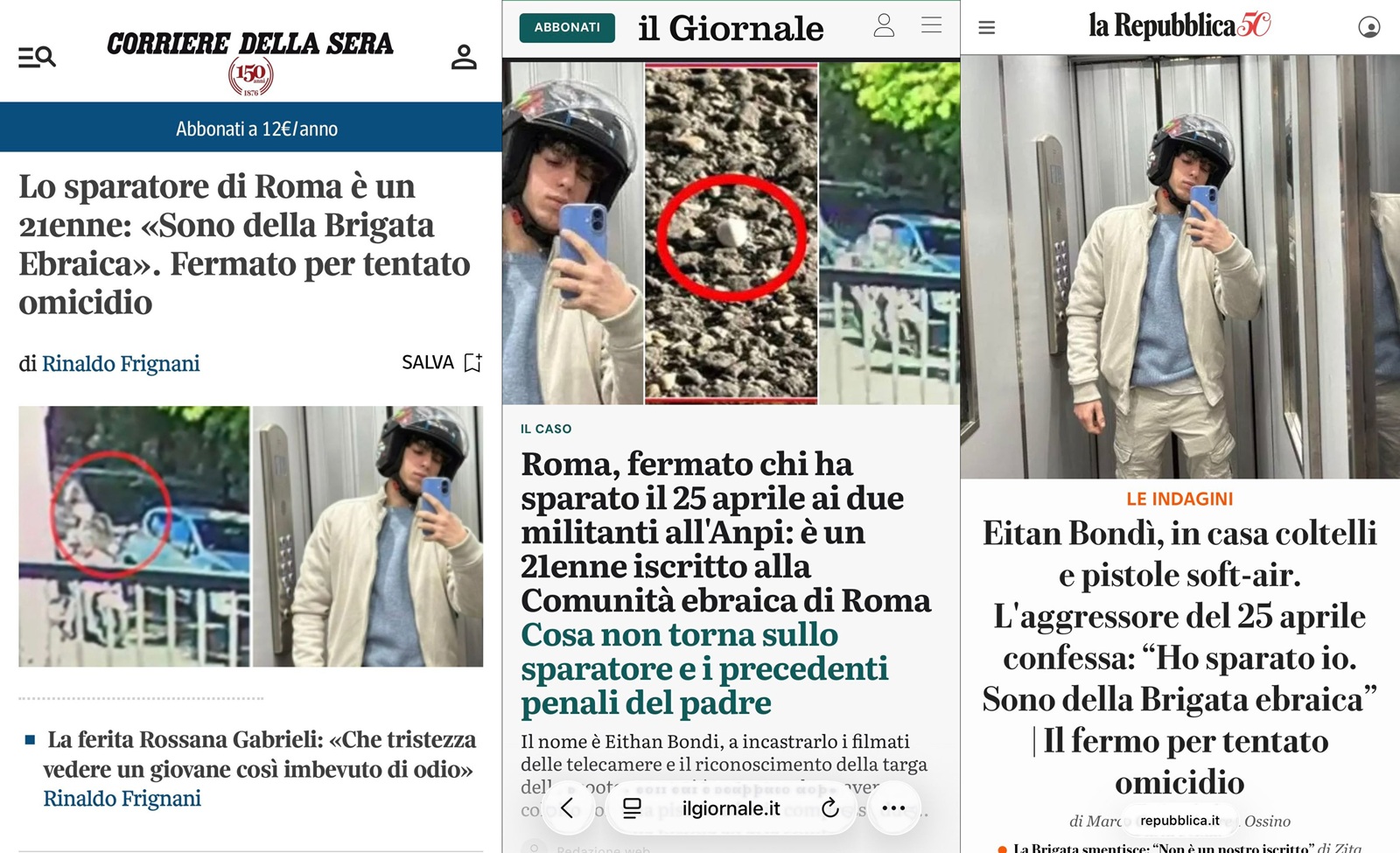
The situation in Milan was further complicated by a separate incident in Rome, where authorities arrested 21-year-old Eitan Bondì in connection with shooting two members of the National Association for Italian Partisans (ANPI) near Parco Schuster during Liberation Day activities. Italian media reports indicate Bondì, described as belonging to Rome’s Jewish community, allegedly confessed to firing an air gun at the victims.
The two injured individuals, Rossana Gabrieli and Nicola Fasciano, suffered non-life-threatening wounds to their neck, face, and shoulder areas. Police tracked down the suspect using surveillance footage and a white scooter’s license plate. A search of Bondì’s residence reportedly uncovered knives, ammunition, air guns, and Israeli flags, though investigators have not yet located the weapon used in the attack.
Rome’s Jewish community president Victor Fadlun expressed the community’s “dismay and indignation” over the arrest, emphasizing that the community “condemns and distances itself without reservation from any form of antidemocratic violence.” Fadlun urged political leaders and civil society to avoid exploiting the incident in ways that could promote hatred and trigger additional violence.
The Jewish Brigade organization denied any association with Bondì, stating they had no knowledge of him and no member with that name. They warned that connecting the Brigade’s name to the attack would dishonor those who served under its banner. Other Jewish organizations throughout Italy also condemned the violence and distanced themselves from the incident.
Some Jewish community members expressed concern that the focus on Bondì’s alleged actions was being used to deflect attention from the antisemitic hostility faced by Jewish participants during Liberation Day events and to shift discussions about antisemitism toward questions of Jewish accountability.
The historical significance of excluding the Jewish Brigade from the Milan march has not been lost on observers. The Brigade was established in 1944 as part of the British Army, composed of Jewish volunteers from Mandatory Palestine who fought alongside Allied and partisan forces in Italy’s liberation during World War II’s final phase. Brigade members are interred in Italian military cemeteries, and the group has traditionally participated in Liberation Day ceremonies.
Carlo Riva, who leads the Italian Federation for Progressive Judaism, characterized the events as marking a significant shift in public sentiment. “What happened on April 25 is not just another episode of tension. It marks a turning point. What we are witnessing is a shift from political criticism of Israel to something broader—a generalized aversion toward anything perceived as Jewish. That is a different phenomenon, and a much more concerning one,” Riva explained.
He noted that the hostility is no longer limited to extremist groups. “What struck us most was not only the hostility itself, but who was expressing it. This is no longer confined to radical fringes or organized groups. It has extended into wider segments of society—people who would normally be perceived as moderate,” Riva observed.
The symbolic contradiction troubled Riva, whose father fought as a partisan in the Resistance. “We are talking about a march that commemorates the liberation of Italy from Nazi fascism. The Jewish Brigade fought in that liberation. To see Jews effectively pushed out of that space is something that is both symbolically and historically contradictory,” he stated.
Walker Meghnagi, president of Milan’s Jewish community, directly criticized ANPI for creating conditions that allowed antisemitic hostility to flourish. He described the episode as “a very bad day” and blamed organizers for enabling the confrontational atmosphere. Reports indicate the Jewish Brigade was blocked from marching for over two hours before being removed for security purposes.
ANPI rejected antisemitism accusations, instead attributing the breakdown to tensions related to some Jewish Brigade participants’ conduct and certain symbols they displayed. The organization’s leadership maintained the incident should be viewed within the context of heightened polarization surrounding the Gaza conflict, while reaffirming their commitment to antifascist principles and inclusivity.
Milan Mayor Giuseppe Sala suggested tensions had been anticipated but that the presence of Israeli flags was unexpected, implying their display may have contributed to the escalation. Participants disputed this interpretation, pointing to the regular presence of other political symbols, including Palestinian flags, at such events.
Data from the Center of Contemporary Jewish Documentation’s Observatory on Antisemitism reveals a sharp increase in antisemitic incidents across Italy in 2024, including vandalism, harassment, and physical attacks. In Milan, weekly cases jumped from approximately 30 before October 7 to peaks of 80 to 90.
Alex Zarfati, an adviser to Rome’s Jewish community, described rapid changes in Jewish life since October 7. “From October 7 onwards, we witnessed a very rapid closure of the spaces of Jewish life in Italy. Activities that were once normal—open, shared with civil society—have become increasingly difficult,” Zarfati said.
“Living a full Jewish life today is no longer possible in the same way as it was even a few years ago,” he continued, explaining that the concern extends beyond isolated incidents to broader environmental changes. “There are events that are no longer organized, invitations that do not arrive, and collaborations that become more difficult. What has changed is not only the level of hostility, but the level of normal interaction.”
Zarfati noted generational differences in perception, citing a gap between older leaders shaped by awareness of Jewish history and European responsibility, and younger people exposed primarily to single narratives. He also pointed to the media environment’s role, arguing that constant exposure to certain narratives makes it difficult for people to distinguish between information and propaganda.
In Bologna, Carmen Dal Monte, president of the Jewish Reform Community, identified what she called “institutional antisemitism.” “What we are seeing is a form of antisemitism expressed through institutional behavior—through choices, silences, and symbols. It is less explicit, but precisely for that reason more pervasive,” she explained.
Dal Monte organized an alternative civic demonstration on April 23, bringing together Israeli flags alongside Iranian anti-regime, Ukrainian, and Venezuelan flags. “The question was whether we are still capable of recognizing resistance when it is expressed by others, under different flags. Different communities share the same necessity—to resist to exist,” she stated.
The events in Milan and Rome suggest that April 25th, traditionally a shared civic reference point where different resistance movements converge, is no longer neutral territory. Jewish institutions remain under constant security protection, and some Israelis have begun avoiding public identification due to hostile reactions or fear of negative responses.
Community leaders view these developments not as isolated incidents but as part of a broader transformation redefining how Jewish identity is perceived and expressed in Italian society. The boundary between political expression and social exclusion appears increasingly unstable, making the civic space more difficult to reconstruct once that line shifts.