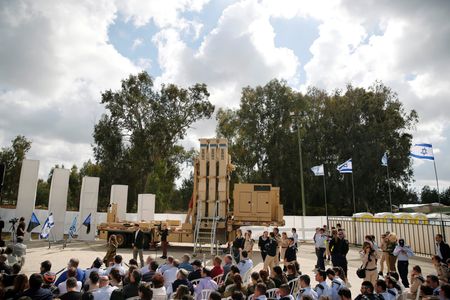

Israel is anticipating a wave of new air and missile defense orders from European countries, with a senior Israeli defense ministry official saying at least one new contract is expected to be finalized within the coming weeks.
European nations are increasingly looking to strengthen their air defenses as concerns about Russia continue to grow, fueling interest in systems capable of countering both intermediate-range ballistic missiles and shorter-range rocket threats.
Moshe Patel, the director and general manager of the Israeli Missile Defense Organization, spoke about the rising demand while attending last week’s Berlin airshow. “There’s a huge interest from Europe, from Western Europe,” he said, though he declined to name the specific countries involved.
Among the systems drawing attention is Arrow, an Israeli air defense platform built to intercept intermediate-range ballistic missiles — including Russia’s Oreshnik missile. Arrow was developed by Israel Aerospace Industries in partnership with the U.S. Missile Defense Agency. Germany has already purchased the system.
Finland, meanwhile, has acquired David’s Sling, a shorter-range system engineered to intercept ballistic missiles launched from distances between 100 and 200 kilometers — roughly 62 to 124 miles. European nations are making these purchases as they prepare for potential Russian aggression, though Moscow has denied any such intentions.
Patel pointed to the ongoing conflict between Russia and Ukraine as the primary driver of European interest. “It’s mainly (driven) by what’s happening between Russia and Ukraine,” he said. “Of course, they’re looking very carefully what is happening in Iran and whatever will be good against Russia could be good for Iran. Whatever they’re doing, it will be good for all those kinds of threats.”
When asked whether European buyers were focused on Arrow or David’s Sling specifically, Patel noted that Iron Dome — a system designed to neutralize short-range threats — was also generating significant interest.
“It’s a huge advantage to those nations that have enemies right on their borders, this is the main capability, and the ability to protect a city, protect (a) strategic area,” Patel said.
On the timeline for additional contracts, Patel indicated that momentum is building. “And there are discussions that, maybe by the end of the year, we’re going to hear about more nations,” he said. “So, it looks like the decision making by those nations, it’s expedite.”
Patel declined to provide details on the financial scale of the anticipated deals, saying only that the negotiations involve “not minor numbers.”