
The ongoing conflict with Iran is creating financial challenges for prospective homebuyers, driving up borrowing costs even as market conditions in many regions continue to benefit those looking to purchase property this spring.
Home loan rates have been climbing steadily since the war started, as rising energy costs fuel inflation concerns and push up yields on 10-year Treasury bonds, which financial institutions use to set mortgage pricing.
Just in late February, 30-year mortgage rates had fallen to slightly below 6% – the lowest point in over three and a half years. This week, those rates jumped to 6.46%, marking the highest level seen in almost seven months.
The international crisis is adding fresh uncertainty to America’s economic future while the employment market shows signs of weakness.
Though current rates remain below last year’s levels, the recent upward movement has already caused a decline in loan applications. Additional rate hikes could dampen home sales during the traditionally peak season for real estate activity.
“The war in Iran has seriously complicated the spring buying season,” said Joel Berner, senior economist at Realtor.com. “I expect that many buyers will be put off by rising rates and mounting economic uncertainty, choosing to bide their time rather than jumping on board for a purchase before rates go up.”
Buyers who can manage current borrowing costs this spring will likely encounter a more favorable market environment compared to last year. This gives them greater bargaining strength when dealing with sellers, many of whom are seeing their properties remain unsold for extended periods, potentially making them more open to reducing initial prices or providing buyer incentives for closing expenses, repairs, or other concessions to complete transactions, according to real estate professionals.
In the Dallas-Fort Worth region, reduced asking prices and increased inventory are compelling many sellers to price more aggressively or consider offering buyer incentives, according to Matthew Crites, an agent with Coldwell Banker Realty.
“It’s been a really good buyer’s market to kind of start the year off with,” he said.
These market dynamics helped homebuyer Anne King secure favorable terms when she targeted a three-bedroom, two-bathroom ranch home in Fort Worth with a $275,000 listing price.
The contract administrator submitted an offer $10,000 under the asking price and requested $5,000 toward closing expenses. The seller agreed, and later provided an additional $12,000 for repairs following a home inspection that uncovered roof issues.
“Fortunately for me, the seller was in a position they needed to sell,” said King, 57. Her purchase closed in late February, just before the Middle East conflict began.
King had hoped borrowing costs would decrease further before her purchase, but decided to proceed rather than risk facing increased competition this spring from other buyers who might create bidding situations – an experience she had last May when purchasing a two-bedroom, two-bathroom townhouse in Arlington, Texas.
She secured a 6% mortgage rate and intends to refinance when rates decline.
“I feel like I got a good deal on this property, and that’s all that matters,” she said.
Although available housing inventory remains below historical norms nationwide, active listings – which include all properties except those with pending sales – increased nearly 8% in February compared to the previous year, based on Realtor.com data.
The growth varies regionally, with Western, Midwestern, and Southern areas significantly outpacing the Northeast. Nevertheless, 43 of the 50 largest metropolitan areas showed increased inventory in February versus a year earlier, with listings rising between 10% and 38.5% in numerous markets, including Seattle, Indianapolis, Las Vegas, Houston, and Denver.
As properties take longer to sell, prices have begun declining. Median listing prices dropped in February compared to the previous year in just over half of the nation’s 50 largest metro areas, including nearly 9% decreases in Austin and Memphis, and reductions exceeding 5% in Washington D.C., San Diego, and Los Angeles.
Another indication that buyers may hold negotiating advantages this spring comes from a Redfin analysis estimating approximately 46% more sellers than potential buyers in the national market during February. This represents an increase from about 30% a year earlier and marks the largest seller-buyer gap in records dating to 2013, according to Redfin.
Miami, Nashville, and Austin are among metropolitan areas where sellers most significantly outnumber buyers, Redfin determined.
America’s housing market has experienced a sales decline since 2022, when mortgage rates started rising from pandemic-era lows. Previously owned home sales remained essentially unchanged last year, staying at a 30-year low. Sales have continued to lag this year, falling in January and February compared to the same period last year.
While home price growth has decelerated or declined in many metropolitan areas, affordability obstacles remain significant for many potential buyers because salary increases haven’t matched home price appreciation.
The median price for existing homes sold in February reached $398,000, according to the National Association of Realtors. This represents nearly five times median household income, compared to the traditional guideline of homes costing three times household income.
Recent mortgage rate increases add to affordability challenges. For a $400,000 home near downtown Dallas, assuming a 20% down payment and 30-year loan at 6%, monthly payments would total approximately $2,248. At 6.4%, that payment would rise to $2,331.
While mortgage rates remain below last year’s levels, making monthly payments more manageable, they’re still significantly higher than the sub-3% averages available during most of 2020 and 2021 when the economy struggled with coronavirus impacts.
The housing market has cooled substantially since earlier this decade, when extremely low mortgage rates created a buying frenzy that drove prices sharply higher. During that period, homes commonly sold well above asking prices after receiving multiple offers.
While some sellers still receive multiple offers currently, it’s no longer typical.
Jo Chavez, a Redfin agent in Kansas City, advises selling clients to expect their homes probably won’t sell immediately. She also recommends “reasonable” pricing strategies.
“We have a lot of sellers who have that idea of like, ‘well, my neighbors sold for this much, and so I think I should price $10,000 above them,’” said Chavez. “And that’s obviously not a logical approach, because there were less sales last year.”
Kansas City ranks among the few metropolitan areas where median listing prices aren’t falling. Prices rose 4.1% in February from a year earlier, according to Realtor.com. However, available inventory surged nearly 20%.
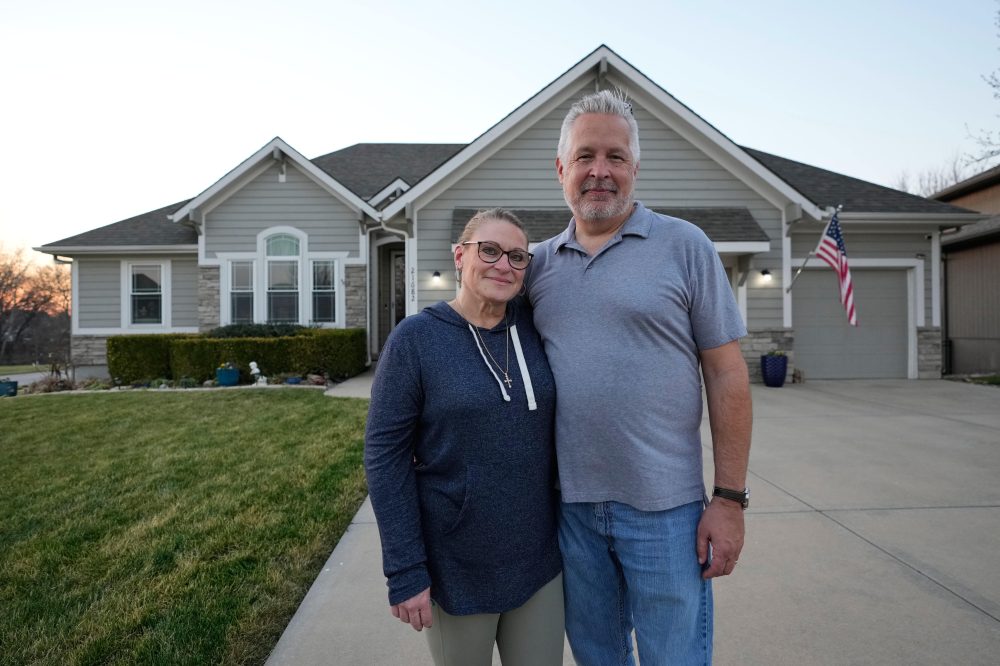
Gail Sanders and her husband David listed their four-bedroom, three-bathroom home in Olathe, Kansas, in late February. Despite hosting multiple open houses and reducing their asking price from $535,000 to $525,000, the couple hadn’t received any offers as March ended.
The couple wants to sell and purchase a home in another Kansas City suburb closer to their three adult children and grandchildren. Until they find a buyer, those plans remain stalled.
“We just didn’t think it was fair to somebody else to put a contingent offer on (another house), but then also lock ourselves into something when we weren’t sure how fast ours was going to move,” said Gail Sanders, a senior claims director. “I don’t want to be stuck with two house mortgages on the off chance.”