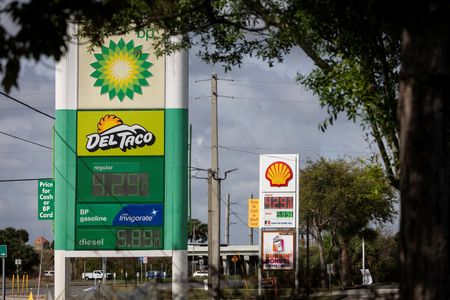

Across America, drivers are making tough choices at the pump as ongoing conflict in Iran sends fuel prices soaring to levels not seen since early 2022.
From coast to coast, motorists are adapting their routines to cope with escalating costs. Boston’s Pat Ouedraogo has eliminated long-distance travel, while law student Skyler Burke drives farther to find cheaper stations. In Houston, car dealer David Wright abandoned his gas-guzzling sports car for an electric alternative.
The six-week conflict has created what energy analysts call the most severe oil supply crisis on record, with major refineries damaged and crucial shipping routes effectively shut down.
“It’s a situation where you feel powerless about these prices,” Ouedraogo commented while filling his Nissan SUV at a Shell station charging $4.99 per gallon.
According to GasBuddy data released Friday, nationwide gasoline averages reached $4.16 per gallon, while diesel hit $5.67 – the highest prices drivers have faced heading into summer driving season since Russia’s Ukraine invasion disrupted global energy markets in February 2022.
The price surge represents an additional $10.4 billion in combined gasoline and diesel expenses for American consumers this year compared to the same March-April timeframe in 2023, according to GasBuddy analyst Patrick De Haan.
Houston trucker Eddie Esquivel has watched his weekly fuel expenses nearly double from $800-$900 to $1,600-$1,700 since the conflict began.
“These prices are hitting real hard. Diesel was $2-something a gallon. Now, it could hit $6,” Esquivel explained at a QuikTrip station in South Houston.
“You got truck payments, you got to buy tires, you got to do oil changes, and you got a family,” Esquivel added. “This is killing us.”
The global impact extends beyond American borders, as Iran’s closure of the Strait of Hormuz has cut off Middle Eastern oil supplies to Asian and European markets.
Fuel prices carry particular political weight in the United States, the world’s largest energy consumer. High gasoline costs from Russia’s ongoing Ukraine war significantly influenced voters’ decision to elect Donald Trump in November 2024.
Now, with midterm elections approaching in November, Trump’s approval ratings have plummeted to historic lows as Americans compare his campaign promises of reduced energy costs with March’s steepest consumer price increases in nearly four years, driven largely by record fuel price spikes.
“I definitely won’t be voting for (the Republican) party or anyone affiliated with this president right now who is in office at all,” said Kari DyLong while refueling her pickup truck at a Denver-area gas station.
The situation may persist even after potential U.S. military withdrawal from Iran, according to government projections.
American and Iranian representatives plan to meet in Pakistan this Saturday, seeking a permanent ceasefire agreement following this week’s announcement of a fragile two-week truce.
However, industry experts warn that even a successful peace deal won’t quickly restore oil and fuel prices to pre-conflict levels. Consumers should expect to continue paying elevated prices for vehicle fuel and airline tickets throughout the summer season.
“We still expect a lingering geopolitical risk premium to remain in the market,” explained Wei Ren Gan, an analyst with Rystad consultancy.
“Rather than a rapid recovery to pre-war levels, prices are likely to soften gradually and could remain relatively higher than pre-war benchmarks.”
Macquarie analysts report that approximately 2 million barrels daily of Middle Eastern refining capacity remains offline due to war-related damage.
Evidence of reduced consumer demand is appearing in federal statistics. Gasoline consumption during the week before Easter dropped to 8.6 million barrels daily, representing a 9% decline from the previous year’s Easter period.
Additional economic indicators reveal the financial strain on consumers: pawn shop transactions have increased 9% since gas prices exceeded $4 per gallon, according to Tim Jugmans, chief financial officer at pawn loan company EZCORP.
Denver resident DyLong has responded to rising costs by curtailing weekend activities. She faces a 40-minute daily commute to her position as sales manager for craft brewery Oskar Blues.
“I’m doing things way more at home and not venturing out because I’m having to spend a bigger portion of my paycheck now towards gas to get me to work,” she explained.