
WASHINGTON – Three intelligence sources are disputing President Donald Trump’s recent assertion that Iran is close to developing missiles capable of striking the United States, saying current intelligence assessments don’t support this timeline.
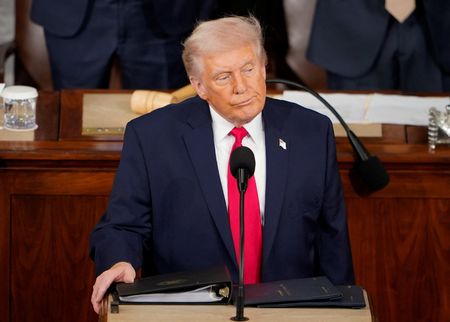
During Tuesday’s State of the Union address, Trump told Congress that Tehran was “working on missiles that will soon reach” American soil as he built his argument for potential military action against the Islamic Republic.
However, two sources indicate that a 2025 Defense Intelligence Agency evaluation remains unchanged, projecting Iran could require until 2035 to create a “militarily viable intercontinental ballistic missile” using its current satellite-launching technology.
White House spokesperson Anna Kelly defended the president’s position, stating: “President Trump is absolutely right to highlight the grave concern posed by Iran, a country that chants ‘death to America,’ possessing intercontinental ballistic missiles.”
One intelligence source suggested that even with technological help from China or North Korea – both Iranian partners – the country would likely need at least eight years to produce “something that is actually ICBM level and operational.”
The sources, speaking anonymously due to the classified nature of intelligence matters, acknowledged they weren’t aware of any assessments showing Iran’s imminent missile threat to the U.S. homeland, though they couldn’t dismiss the existence of newer reports they hadn’t seen.
The New York Times previously reported that intelligence agencies believe Iran remains years away from missiles capable of reaching American territory.
Secretary of State Marco Rubio used more cautious language Wednesday, describing Iran as being “on a pathway to one day being able to develop weapons that could reach the continental U.S.”
Trump’s missile claims emerge as American and Iranian representatives continue nuclear program negotiations without apparent progress, while the U.S. maintains a significant military presence in the region.
In his Tuesday speech, Trump cited Tehran’s support for militant organizations, its crackdown on protesters, and its missile and nuclear programs as regional and American threats.
Without offering proof, Trump claimed Iran was starting to reconstruct nuclear facilities he said were “obliterated” in U.S. airstrikes last June targeting uranium enrichment sites.
Iranian Foreign Minister Abbas Araghchi rejected claims of expanded missile development in a Wednesday interview with India Today TV.
“We are not developing long range missiles. We have limited range to below 2000 kilometers intentionally,” Araghchi explained. “We don’t want it to be a global threat. We only have (them) to defend ourselves. Our missiles build deterrence.”
Iran maintains its uranium enrichment serves purely civilian purposes, denying any nuclear weapons ambitions.
Both U.S. intelligence agencies and the International Atomic Energy Agency, the UN’s nuclear monitoring body, report that Iran ended its nuclear weapons development in 2003.
The IAEA notes, however, that Tehran has continued uranium enrichment in recent years, including to levels approaching weapons-grade purity.
Trump has warned of attacks on Iran if it executes protesters arrested during January’s anti-government demonstrations or fails to reach a nuclear agreement.
Iran operates the Middle East’s largest ballistic missile arsenal, with weapons capable of hitting Israel, regional U.S. installations, and portions of Europe.
The country has also created space-launch vehicles for satellite deployment that specialists say could potentially be converted into ICBMs for nuclear warhead delivery.
David Albright, a former UN nuclear inspector and president of the Institute for Science and International Security, emphasized Iran’s limitations in developing functional warhead delivery systems.
“Iran can launch a very long-range missile because of its space launch program,” Albright noted. “But it needs lots of work to develop an adequate RV (re-entry vehicle).”
Albright and other experts pointed out that Israeli airstrikes in recent years significantly damaged Iranian facilities producing liquid and solid-fuel ballistic missiles.