
Indonesia has launched an aggressive campaign to strengthen government oversight of its nickel mining operations, which have become the world’s dominant source of the critical mineral used in electric vehicle batteries.
The Southeast Asian nation now controls approximately 60% of global nickel production, a dramatic increase from just 31.5% four years ago, according to S&P Global Market Intelligence. This surge followed a strategic decision by former President Joko Widodo to prohibit raw ore exports, which attracted massive Chinese investment in processing facilities.
Indonesian officials had envisioned using their nickel dominance to build a complete domestic electric vehicle manufacturing ecosystem, spanning from raw materials extraction to finished automobiles. However, environmental advocates argue this vision justified widespread forest destruction and mining expansion under the banner of clean energy development.
During 2025, Jakarta intensified enforcement actions against what officials termed unauthorized resource exploitation, claiming numerous mining and plantation permits were obtained through corruption or lacked proper authorization. Government agencies report confiscating more than 4 million hectares of mining sites, palm oil operations, and processing facilities while collecting $1.7 billion in penalties. An additional 4.5 million hectares could face seizure this year.
However, industry experts caution that this enforcement push coincides with declining demand for nickel, as Chinese electric vehicle manufacturers increasingly adopt battery technologies requiring significantly less of the metal, favoring iron-based alternatives instead.
“The forests have been exploited to the brim,” said Putra Adhiguna of the Jakarta-based Energy Shift Institute. “But you never got the electric-vehicle value chain.”
Chinese companies have established themselves as the primary players in Indonesia’s nickel sector, utilizing the mineral for stainless steel production and renewable energy applications.
The Indonesian island of Sulawesi contains the planet’s largest nickel deposits and generates more than half of worldwide nickel mining output, according to the U.S.-based Institute for Energy Economics and Financial Analysis.
While China has purchased Indonesian nickel for decades, this partnership intensified after Jakarta’s 2020 raw ore export prohibition, which spurred substantial Chinese investment in smelting operations.
Nickel exports to China surged dramatically, with imports of nickel matte—a partially processed material used in battery production and metal alloys—increasing nearly 28-fold from 2020 to 2023, with over 90% originating from Indonesia, trade records show. During this same timeframe, North and South America’s combined global nickel production share declined from 16% to 7%, while Europe’s portion fell from 35% to 10%, according to the International Nickel Study Group, a Lisbon-based intergovernmental organization.
Meanwhile, mining activities caused the destruction of approximately 370,000 hectares of Indonesian forests from 2001 to 2020—exceeding forest loss in any other nation—according to World Resources Institute analysis. More than one-third of this deforestation affected old-growth rainforests that store massive amounts of carbon and play essential roles in climate regulation.
The extensive use of coal to power Indonesia’s nickel smelting operations has also hindered the nation’s clean energy transition, creating additional fossil fuel demand despite efforts to reduce emissions. A 2024 IEEFA study determined that major nickel producers generated approximately 15 million metric tons of greenhouse gases in 2023, primarily due to coal dependency.
In one of the most prominent nickel-related seizures last year, Indonesian military personnel, accompanied by local television crews, assumed control of portions of the world’s largest nickel mining operation.
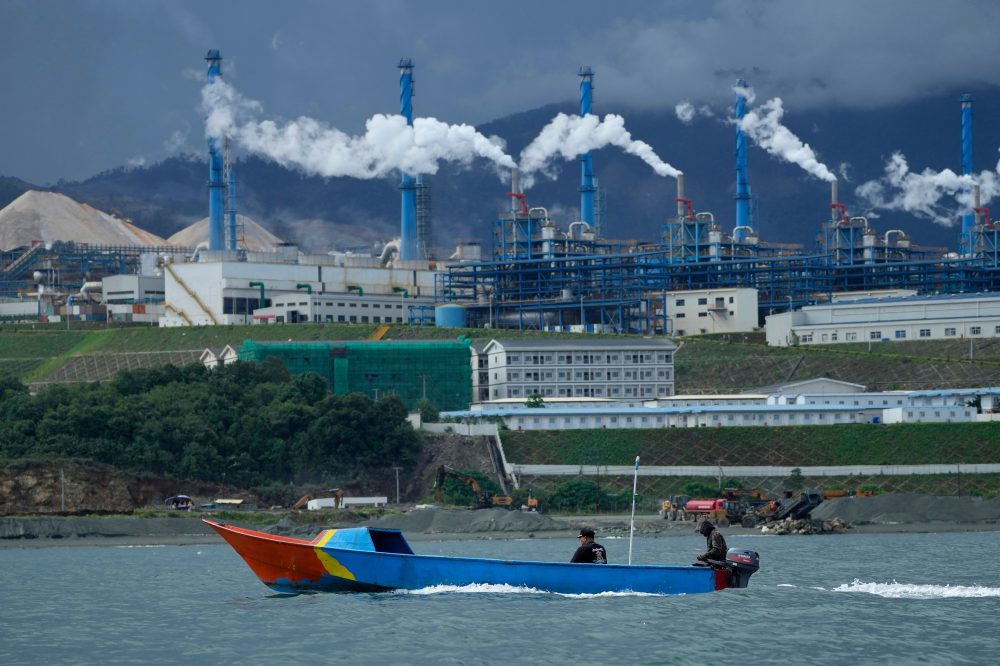
The facility, primarily owned by Chinese metals conglomerate Tsingshan Holding Group, has contributed to deforestation, air and water contamination, and increased coal-fired emissions while displacing local communities, damaging livelihoods, and creating health hazards for residents, according to a 2024 Climate Rights International report.
The government action wasn’t designed to enhance environmental protection or restore forestry safeguards, explained Bhima Yudhistira from the Jakarta-based Center of Economic and Law Studies.
“There is no guarantee things will get better,” he said. They could get “even worse.”
Indonesia’s strategy to transform its nickel resources into the foundation of a domestic EV manufacturing sector initially attracted investment from South Korean and Chinese companies but has failed to meet projections.
In July 2024, South Korea’s Hyundai Motor Group and LG Energy Solution launched Indonesia’s inaugural EV battery cell manufacturing facility, with yearly capacity to power more than 150,000 electric vehicles. However, in April 2025, LG Energy Solution abandoned a much larger $8.4 billion battery investment, citing market and investment conditions.
Chinese automaker BYD continues constructing an EV manufacturing plant, while China’s CATL, the world’s leading EV battery producer, is building a battery factory in partnership with Indonesian state companies.
Indonesia’s electric vehicle market is expanding rapidly but remains relatively small.
The nation sold more than 43,000 electric vehicles in 2024, representing approximately 5% of total automotive sales, according to the Indonesian Business Council. Public charging infrastructure remains limited, with roughly 1,500 stations nationwide in 2024.
Even if Indonesia manufactured 1 million EVs annually—matching total yearly auto sales—and prioritized nickel-rich batteries, this would still consume less than 1% of national nickel production, according to the Energy Shift Institute.
Electric vehicle manufacturers are transitioning to lithium iron phosphate (LFP) batteries, decreasing nickel and cobalt requirements. LFP batteries offer lower costs, enhanced stability, and extended lifespans, now powering nearly half of all electric vehicles, the International Energy Agency reports.
Industry analysts suggest Indonesia’s nationalization efforts could reduce Beijing’s control over supply chain segments, potentially providing Jakarta greater leverage to attract American buyers and investors.
One possible concession by Indonesia in extended trade negotiations with the Trump administration, expected to conclude soon, would involve removing the ban on raw nickel exports to the United States.
Indonesia has already extended invitations to U.S. companies to invest in its critical minerals sector as part of ongoing tariff discussions between the two nations, though the country faces a challenging balancing act.
“How does Indonesia straddle between the two superpowers who both want to gain control of the national resource that Indonesia has?” said Li Shuo, director of the Asia Society Policy Institute’s China Climate Hub.
Other Southeast Asian nations similarly positioned between the U.S. and China are closely monitoring Indonesia’s approach, Li noted.
“Make no mistake, it’s going to be very difficult,” he said.
Indonesia’s land confiscations risk further destabilizing its nickel sector, added CELIOS’s Yudhistira. Foreign investors observing these developments will likely delay commitments to new Indonesian mining and processing ventures, he warned.
“This is making the future of nickel, both mining and downstream processing, unknown,” Yudhistira said. “Uncertainty is very costly for investors.”