
Federal prosecutors announced charges Tuesday against the head of an Indian criminal organization in connection with a high-profile political assassination in Canada — a killing that previously threw the diplomatic relationship between Canada and India into turmoil.
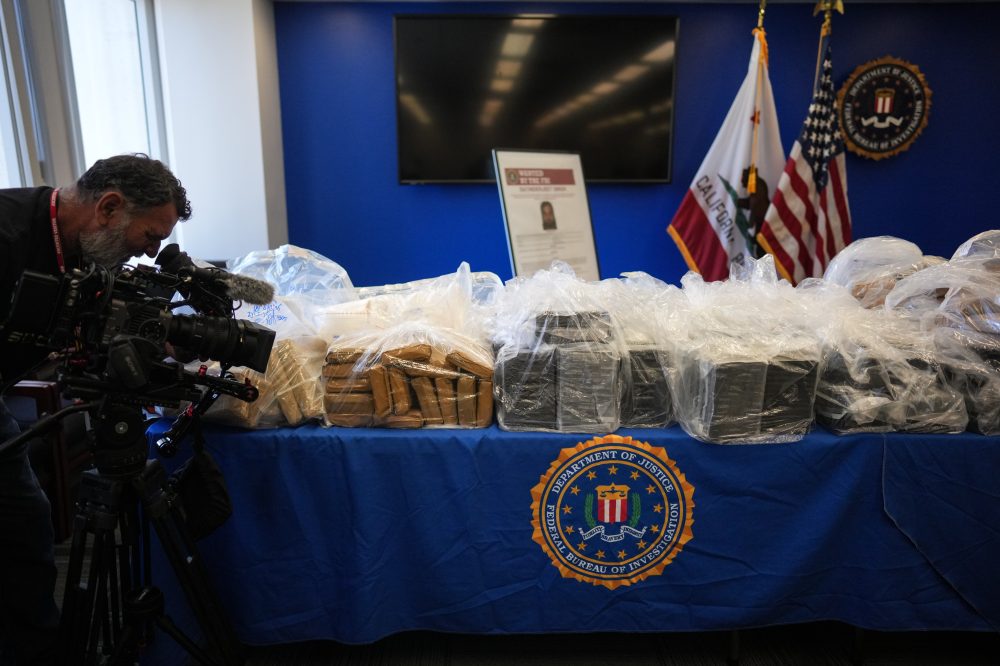
The announcement came as part of a sweeping law enforcement crackdown involving agencies from the United States, Canada, and Europe. In total, 37 individuals have been charged in connection with three separate Indian international crime syndicates accused of involvement in kidnappings, racketeering, extortion, illegal firearms sales, drug trafficking, and murder. U.S. Attorney Bill Essayli made the announcement at a press conference Tuesday, joined by representatives from the Los Angeles Police Department, the FBI, and the Royal Canadian Mounted Police. Investigators are still searching for seven fugitives believed to be in the U.S., two in India, and one in Europe.
Patrick Grandy, assistant director in charge of the FBI’s Los Angeles field office, said the criminal groups have “fueled violence, fear and instability within the East Indian communities throughout California and abroad.”
Lawrence Bishnoi, 33, and his longtime friend Satinderjeet Singh are accused of planning and directing the murder of Hardeep Singh Nijjar, a well-known Sikh independence advocate who was shot and killed outside a temple where he served as president in 2023. The slaying ignited a diplomatic firestorm after then-Canadian Prime Minister Justin Trudeau stated there were “credible allegations” pointing to the Indian government’s involvement in Nijjar’s death. Bishnoi is currently in custody, while Singh remains at large.
Prosecutors say Bishnoi’s organization “routinely targeted prominent religious, social and political leaders with violence” in exchange for significant sums of money.
Nijjar was 45 years old at the time of his death. He was a leading figure in a movement seeking to establish an independent Sikh homeland called Khalistan, and had been organizing an unofficial vote among Sikhs living outside India through the group Sikhs For Justice. Born in India and a Canadian citizen, Nijjar was wanted by Indian authorities at the time of his killing, with a reward offered for information leading to his capture.
Tensions between Canada and India over Sikh diaspora activism are not new. Canada is home to the largest Sikh population outside of India, and India has long accused Canada of allowing what it calls “terrorists and extremists” to operate freely. The dispute escalated to the point where both nations expelled each other’s diplomats.
Tuesday’s announcement also identified two additional criminal organizations swept up in the same two-year investigation on similar charges. These transnational groups have members operating in the United States, New Zealand, Australia, Portugal, and the United Kingdom. Some members are also accused of stealing large amounts of drugs from rival criminal operations in California and then distributing those drugs across the country and into Canada.
Court documents allege that some defendants used corrupt connections with local officials in India to go after rivals or individuals suspected of cooperating with law enforcement. At least one defendant is accused of directing criminal activity while being held at an Immigration and Customs Enforcement facility — though authorities have not yet explained how he managed to communicate without detection.
No attorney for Bishnoi had been listed as of Tuesday afternoon.
U.S. Attorney Essayli framed the operation as a testament to international cooperation, stating: “Working together, law enforcement in the U.S., Canada, Europe, and Asia are determined to target and dismantle these criminal organizations wherever they operate.”