
NEW DELHI (AP) — India’s government is targeting up to $200 billion in data center investments over the coming years as the nation works to establish itself as a global artificial intelligence powerhouse, according to the country’s electronics and information technology minister who spoke Tuesday.
These massive investments highlight how major technology companies view India as a crucial foundation for talent and innovation in the worldwide competition for AI leadership. For India’s government, these commitments represent significant infrastructure development and foreign investment that could fast-track the country’s digital modernization goals.
This initiative emerges as nations across the globe compete to capture AI’s economic benefits while managing concerns about employment impacts, regulatory challenges, and the concentration of computing resources among wealthy nations and corporations.
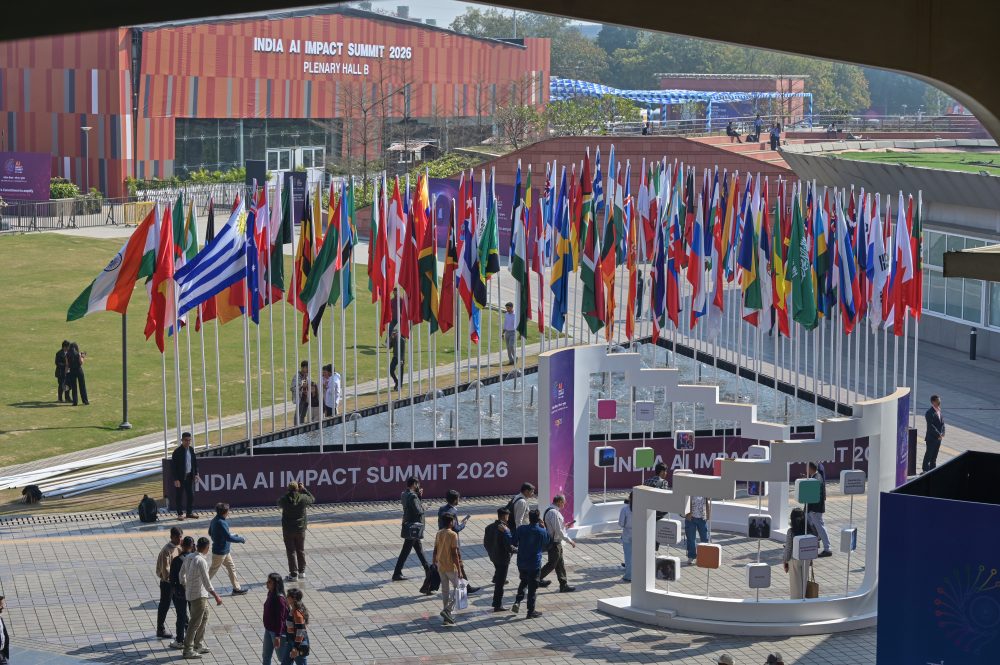
“Today, India is being seen as a trusted AI partner to the Global South nations seeking open, affordable and development-focused solutions,” Ashwini Vaishnaw told The Associated Press through email, speaking during New Delhi’s major AI Impact Summit this week that features participation from over 20 international leaders and prominent technology industry figures.
Google revealed plans in October for a $15 billion investment commitment in India spanning five years to create its inaugural artificial intelligence center in the South Asian nation. Two months afterward, Microsoft announced its largest-ever Asian investment of $17.5 billion to enhance India’s cloud computing and AI infrastructure over four years.
Amazon has also pledged $35 billion in Indian investments through 2030 to grow its operations, with particular focus on AI-powered digital transformation. These combined commitments form part of the $200 billion investment pipeline that New Delhi anticipates will materialize.
According to Vaishnaw, India’s approach emphasizes that artificial intelligence should produce tangible, large-scale benefits rather than remaining limited to elite applications.
“A trusted AI ecosystem will attract investment and accelerate adoption,” he stated, noting that infrastructure development serves as a cornerstone of India’s AI strategy.
The administration recently unveiled extended tax incentives for data centers, aiming to create policy stability and draw international capital.
Vaishnaw reported that officials have launched a shared computing platform featuring over 38,000 graphics processing units, enabling startups, academic researchers, and government institutions to utilize advanced computing resources without substantial initial investments.
“AI must not become exclusive. It must remain widely accessible,” he emphasized.
Beyond infrastructure development, India supports creating independent foundational AI systems trained using Indian languages and cultural contexts. Several of these systems achieve international standards and compete with popular large language models in specific applications, Vaishnaw noted.
India also pursues expanded influence in determining how AI technology develops and deploys globally, as the nation views itself not simply as a “rule maker or rule taker,” but as an engaged contributor to establishing practical, effective standards while growing its worldwide AI services presence, according to Vaishnaw.
“India will become a major provider of AI services in the near future,” he stated, describing an approach that remains “self-reliant yet globally integrated” across applications, models, semiconductors, infrastructure, and energy systems.
Building investor confidence represents another priority for New Delhi amid increasingly cautious global technology funding.
Vaishnaw said the technology initiative relies on proven implementation, referencing the Indian government’s AI Mission program that emphasizes industry-specific solutions through public-private collaborations.
The government also focuses on workforce retraining as international concerns mount that AI might displace professional and technical positions. New Delhi expands AI education throughout universities, training programs, and digital platforms to develop a substantial AI-prepared talent base, the minister explained.
Comprehensive 5G network coverage nationwide and a youthful, technology-oriented population should facilitate rapid AI adoption, he added.
However, balancing innovation with protective measures remains challenging as AI extends into critical areas including government operations, healthcare, and financial services.
Vaishnaw described a four-part approach encompassing actionable international frameworks, reliable AI infrastructure, regulation of dangerous misinformation, and enhanced human and technical capabilities to manage potential impacts.
“The future of AI should be inclusive, distributed and development-focused,” he concluded.