
WASHINGTON (AP) — In the days following the shooting deaths of two American citizens in Minneapolis earlier this year, then-Homeland Security Secretary Kristi Noem pledged that the department would move quickly to put body cameras on officers across the nation.
Nearly six months later, that commitment remains unfulfilled — and a new deadly shooting involving federal immigration officers has reignited anger from critics who argue body cameras are essential for holding officers accountable during the ongoing immigration enforcement push.
The ICE officers who were present during the fatal shooting of Lorenzo Salgado Araujo — a Mexican national who had lived in the United States for more than 35 years — were not equipped with body cameras, according to Homeland Security.
No evidence has surfaced to back up the department’s account of what happened, which claims an officer fired after Salgado Araujo used his van to ram an ICE vehicle that was pursuing him. Eyewitnesses dispute that version of events. Body camera footage could have provided crucial clarity about what actually occurred.
The incident has brought renewed attention to ICE’s enforcement methods at a time when arrests are increasing and the department has received a significant influx of congressional funding — a portion of which was specifically set aside to equip officers with body cameras.
“Even after we’ve given ICE specifically $20 million for body cameras and Kristi Noem promised in February of this year that she was going to purchase them and get them in the field, that here we were in Houston that the agents didn’t have them,” said Rep. Sylvia Garcia, a Democrat from Houston, at a news conference on Friday.
Shortly after Alex Pretti was killed while protesting ICE activity in Minneapolis in January, Noem announced that every Homeland Security officer deployed there would receive a body-worn camera, calling it the start of a nationwide rollout as funding became available.
“We will rapidly acquire and deploy body cameras to DHS law enforcement across the country,” Noem — who has since been replaced by Markwayne Mullin — wrote in a social media post.
Homeland Security stated Thursday that body cameras have now been distributed to more than half of ICE field offices nationwide, with the remaining offices expected to receive them within the next 60 days.
Garcia said she expressed her frustration directly to acting ICE director David Venturella during a phone call, and that Venturella acknowledged fewer than one-third of officers nationwide currently have body cameras. He reportedly told her all officers would be equipped by the end of July.
“Trust me, I will hold him to it, and I will make sure that all my colleagues in Congress and the Democratic caucus hold him to it,” Garcia said.
Michelle Gross, president of the Minnesota-based advocacy group Communities United Against Police Brutality, argued that ICE should halt enforcement operations until every officer has a camera.
“If they’re going to be running around with guns and stopping people, you damn well better have some body cameras,” she said. “This is an agency that’s soaking up an incredible amount of tax dollars and we can’t have any accountability?”
During the Pretti shooting, Homeland Security confirmed that four Border Patrol agents on the scene were wearing cameras. Investigators from Customs and Border Protection used that footage, along with other video sources, to determine that more than one officer fired shots during that incident.
The department has not confirmed whether any ICE officers present at the January killing of Renee Good — a 37-year-old mother of three — were wearing body cameras. Bystander video from both Minneapolis shootings drew intense public scrutiny and fueled widespread outrage.
The former acting head of ICE, Todd Lyons, testified before Congress following the Minneapolis shootings and said body camera footage would eventually be made public — but that footage has not yet been released. Lyons has since retired.
Lyons and his counterpart at CBP, Rodney Scott, told Congress at the time that thousands of their officers were already outfitted with body cameras, with more deployments planned.
“That’s one thing that I’m committed to is full transparency. And I fully welcome body cameras all across the spectrum in all of our law enforcement activities,” Lyons said.
A January court filing revealed that a senior ICE officer, Samuel J. Olson — head of the St. Paul field office — stated in a deposition that body-worn cameras had not been issued to deportation officers working out of that office at a time when roughly 2,000 ICE officers were deployed in Minnesota. Olson estimated the agency would need about six months to complete the equipment and training needed for a full statewide rollout.
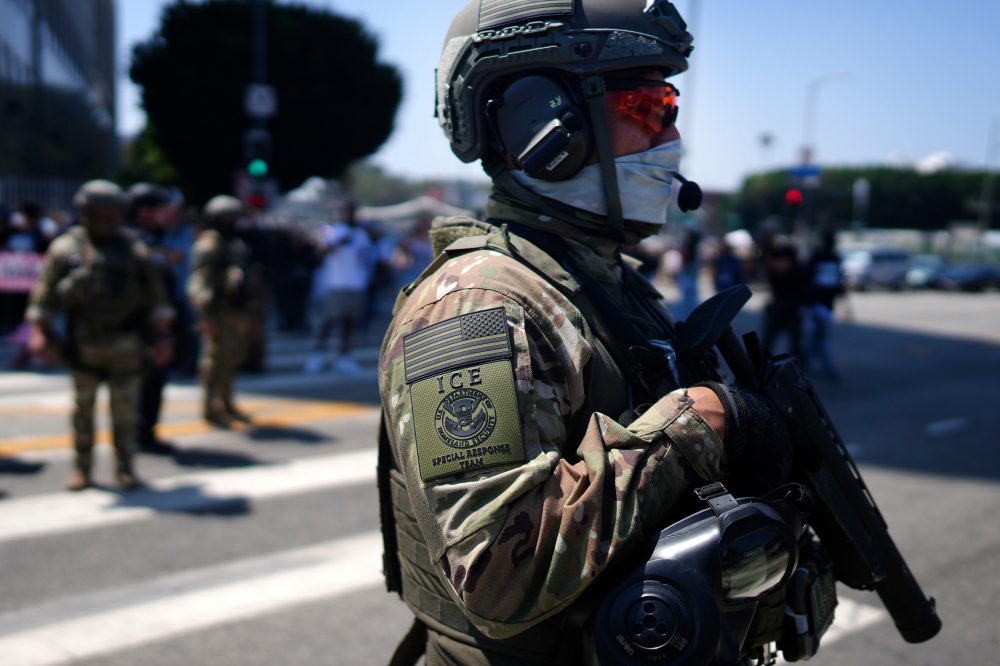
The body camera question has surfaced repeatedly during the current administration as growing numbers of ICE and CBP officers carry out the president’s mass deportation agenda. In Chicago, during an operation called “Operation Midway Blitz,” a judge ordered federal immigration officers to wear body cameras, citing the need for evidence in cases involving confrontations with protesters.
Homeland Security officials have pointed the finger at Democrats, saying the officers in Houston lacked cameras because of “back-to-back Democrat shutdowns” — government shutdowns driven by Democratic opposition to the administration’s immigration policies and demands for reforms at the department.
In the aftermath of the Pretti and Good shootings, body cameras represented one of the few areas where both parties expressed agreement. In April, Congress approved $20 million for Homeland Security specifically for “the procurement, deployment, and operations of body-worn cameras” for officers involved in immigration enforcement.
Garcia dismissed the claim that Democrats bear responsibility for the officers’ lack of cameras as “ludicrous.”
“That’s just a freaking excuse, because the bottom line is they made a commitment,” Garcia said.