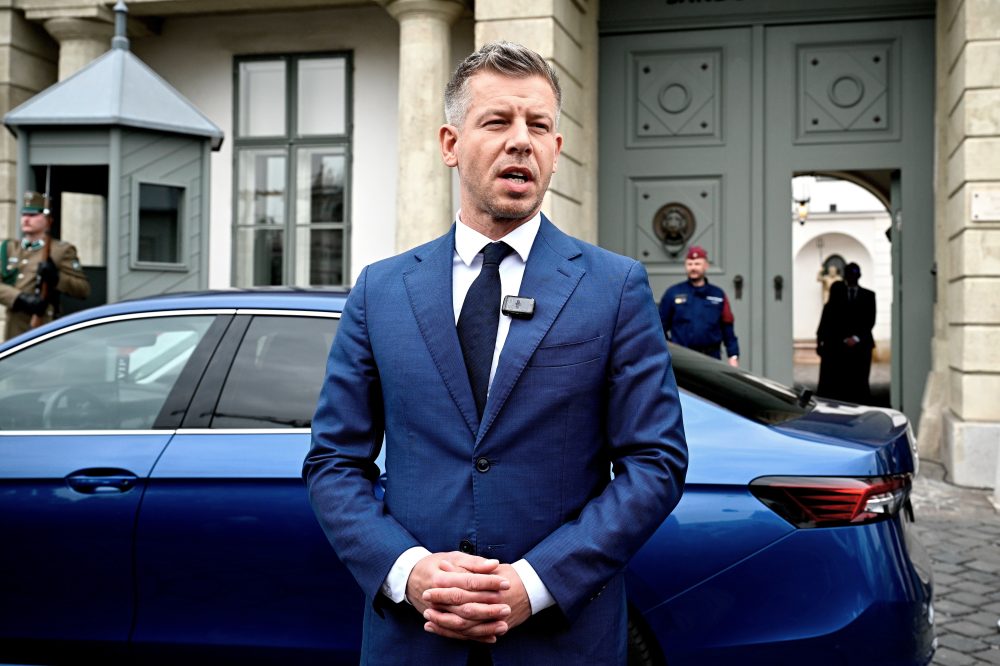

BUDAPEST, Hungary (AP) — Representatives from the European Union gathered Friday in Hungary’s capital to meet with advisors from incoming Prime Minister Péter Magyar’s administration. The discussions center on urgent matters including financial assistance for Ukraine and releasing approximately 17 billion euros ($20 billion) in aid that was frozen during Viktor Orbán’s administration.
While Magyar won’t assume office until May, EU leadership wants to begin discussions early to accelerate cooperation with Hungary’s new administration, according to European Commission spokesperson Paula Pinho, who spoke from Brussels Thursday.
“The clock is ticking for a number of topics,” Pinho stated. These advance discussions happening before Magyar’s inauguration aim to “make sure that once the government is in place action can be taken, if appropriate, and that we do not waste any time.”
The European Union suspended billions in financial support to Hungary due to corruption allegations and concerns about democratic deterioration during Orbán’s 16-year leadership. Now both EU leadership and Hungary’s new administration are working to release these funds quickly to provide crucial financial support for Hungary’s struggling economy.
European Commission President Ursula von der Leyen posted on X Tuesday that “there is swift work to be done to restore, realign and reform” Hungary’s policies to release the blocked funding.
“Restore the rule of law. Realign with our shared European values. And reform, to unlock the opportunities offered by European investments,” wrote von der Leyen, who faced frequent criticism from Orbán throughout his campaign.
Magyar’s Tisza party secured a parliamentary supermajority that will allow for comprehensive and rapid policy changes. He has indicated his administration will focus on judicial independence, academic and press freedom, and anti-corruption measures to access the withheld funds.
During his initial press briefing following his decisive April 12 victory, Magyar stated Monday that Hungary “is in a very difficult financial situation,” and his new administration’s mission will be “to bring home the money that is hers.”
Magyar also committed to honoring a December agreement providing Ukraine with a critical 90-billion-euro loan, unlike Orbán who blocked the legislation after initially supporting it, causing frustration among EU officials and leaders across the 27-member union.
The withheld money includes 10 billion euros from COVID recovery programs and 6.3 billion euros from cohesion funds intended to support struggling EU economies.
Brussels and Budapest are working urgently to release the COVID funds first, as they expire in August.
Hungary, which receives substantial EU funding, faced growing criticism for abandoning democratic principles. For over ten years, the Commission accused Orbán of weakening democratic institutions, controlling media outlets, and violating minority rights. Orbán denied these claims and called them violations of Hungary’s independence.
In 2022, the Commission froze Budapest’s funding citing democratic regression by Hungary’s right-wing populist leadership and inadequate efforts to address corruption and ensure judicial independence. The following year, the Commission determined that sufficient reforms had been implemented to release approximately 10.2 billion euros ($12.1 billion).
According to Zsolt Darvas, a researcher at Brussels-based think tank Bruegel, Magyar can quickly implement reforms needed to unlock the funds.
“All the legislative work can be done in a single day if there is a will from the Tisza party to do it,” he explained. “That’s relatively straight forward and not technically difficult.”
This would require modifying judicial selection processes and their authority.
Darvas noted that Magyar can address the August COVID funds deadline by following Poland and Portugal’s approach of placing funds in a national development bank for future distribution.
However, Darvas warned that Hungary has already forfeited about 2 billion euros from the 16 billion total due to the two-year suspension, and has been paying 1 million euros daily since June 13, 2024, plus a 200 million-euro penalty for Orbán’s refusal to align Hungary’s asylum procedures with EU standards.
Darvas suggested Hungary could follow Poland’s model by maintaining restrictive migration policies while still complying with EU law to end these penalties.
While these funds alone won’t resolve Hungary’s economic difficulties, Darvas explained that EU compliance will demonstrate the country is a reliable investment destination.
Hungary could also access significant funding by joining the EU’s 150 billion-euro Security Action for Europe initiative (SAFE), designed to strengthen Europe’s defense capabilities as the United States reduces its security role on the continent.
Currently, 18 of 27 EU nations have received low-interest defense loans, and Hungary qualifies for 16 billion euros through this program. Combined with other funding sources, these resources would equal roughly 15% of Hungary’s GDP, according to analysis by Jeremy Cliffe at the European Council on Foreign Relations.