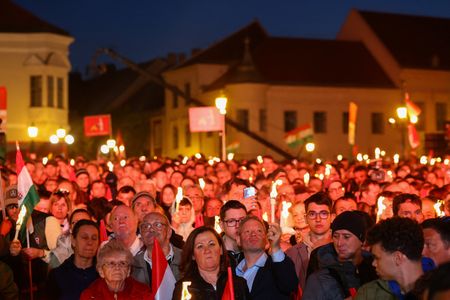

Hungarian citizens cast ballots Sunday in a pivotal election that could terminate Prime Minister Viktor Orban’s decade-and-a-half reign, potentially disrupting Moscow’s influence and creating ripple effects among right-wing movements worldwide, including supporters of former U.S. President Donald Trump.
The 62-year-old Orban, known for his eurosceptic nationalism, has established what he calls an “illiberal democracy” that has served as inspiration for Trump’s MAGA movement and similar groups throughout Europe.
However, a growing number of Hungarian citizens have become frustrated with Orban following three years of economic decline and rising costs of living, along with allegations that government-connected oligarchs have accumulated vast fortunes.
Recent polling data from the past two weeks indicates Orban’s Fidesz party is behind Peter Magyar’s emerging center-right opposition Tisza party by 7-9 percentage points, with Tisza polling around 38-41%.
Polls for the 199-seat parliamentary election opened at 6 a.m. local time and will remain open until 7 p.m.
European Union officials in Brussels are monitoring the election closely, as many have criticized Orban – who maintains friendships with Russian President Vladimir Putin and former President Trump – for what they describe as weakening Hungary’s democratic institutions, press freedoms, and minority protections.
Ukraine, Hungary’s eastern neighbor, could benefit significantly from an Orban loss, as it might unlock a 90-billion-euro ($105 billion) European Union loan crucial for Kyiv’s defense efforts. Such an outcome would also eliminate Russia’s strongest EU ally.
Orban has framed the election as a decision between “war and peace.” Throughout the campaign, his government has covered the nation with advertisements claiming that Tisza leader Magyar would involve Hungary in Russia’s conflict with Ukraine, allegations Magyar firmly rejects.
“I am looking forward to Sunday’s election with the best hope,” Orban stated to supporters in his hometown of Szekesfehervar.
“If we know ourselves well, if we know our country well and if we know our own people well, then I must say Hungarians will vote for safety on Sunday,” he continued.
The Trump administration has publicly supported Orban, highlighted by Vice President JD Vance’s recent Budapest visit, alongside backing from the Kremlin and European far-right politicians.
However, his campaign has faced challenges from news reports suggesting his administration collaborated with Moscow. Orban, who refutes any misconduct, states his objective is safeguarding Hungary’s national character and traditional Christian principles within the EU while ensuring security in an unstable world.
Magyar, 45, a former Orban supporter, has capitalized on frustration regarding alleged government corruption and declining living conditions, with younger voters showing particular enthusiasm for transformation.
“I am very excited but also very scared,” commented Kriszta Tokes, a 24-year-old Budapest vendor selling postcards and souvenirs. “I know that my future depends on this,” she explained, noting her intention to emigrate if Orban prevails.
Although Orban’s party has achieved positive results “on paper,” Tokes noted, referencing substantial financial benefits he has distributed to maintain support, she believes young people face greater hardships than the government acknowledges.
To combat his mere 8% approval rating among voters under 30, Orban has eliminated income taxes for the youngest workers and created a subsidized home loan program to assist first-time buyers amid the EU’s sharpest housing price increases during his tenure.
Nevertheless, Magyar’s promise of change appears to have greater appeal.
During a final campaign event in the eastern city of Miskolc on Friday, Magyar declared: “This will be a referendum… about our country’s place and our country’s future.”
Political experts warn that the election results remain unpredictable, pointing to numerous undecided voters, electoral boundary changes favoring Fidesz, and substantial support from ethnic Hungarians in surrounding nations who typically back the governing party.
They indicate possibilities ranging from a Tisza supermajority capable of constitutional amendments to a Fidesz majority.
Should Tisza emerge victorious, reversing the legal and institutional modifications Orban has implemented may present significant challenges for a new administration with only a simple parliamentary majority.