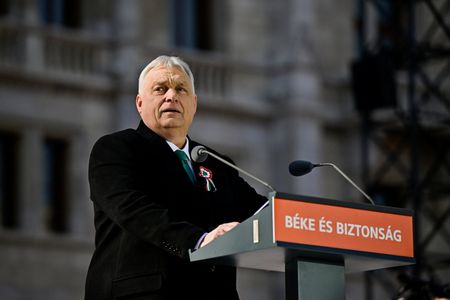

Hungarian Prime Minister Viktor Orban has initiated an investigation into allegations that his foreign minister was under surveillance amid reports of secret communications with Russian officials.
The controversy erupted following a Washington Post report claiming that Foreign Minister Peter Szijjarto regularly contacted Russian Foreign Minister Sergei Lavrov during European Union meetings to share confidential discussions.
“We are dealing with two serious issues: there is evidence that Hungary’s Foreign Minister was wiretapped, and we also have indications of who may be behind it. This must be investigated immediately,” Orban posted on social media Monday.
The timing proves particularly challenging for Orban, who is facing his most difficult reelection campaign since taking office in 2010. With Hungary’s April 12 election approaching, polls show the center-right opposition Tisza party holding a significant lead.
According to the Washington Post report, which cited a European security official, Szijjarto allegedly provided Lavrov with “live reports on what’s been discussed” during breaks in EU meetings over several years.
Szijjarto quickly rejected these claims, calling the report “fake news” on Sunday.
The situation intensified when Hungarian conservative publication Mandiner released audio recordings featuring investigative journalist Szabolcs Panyi discussing how he provided Szijjarto’s phone numbers to “a state organ of an EU country” for verification purposes.
Panyi acknowledged the conversation’s authenticity on Facebook, explaining he was cross-referencing the numbers with intelligence from a European security service while investigating potential information sharing between Szijjarto and Russia.
Speaking to Reuters, Panyi accused the government of employing intelligence tactics to expose his source communications while he investigated sensitive matters.
Szijjarto expressed outrage over the Mandiner revelations, describing them as “shocking.”
“It is astonishing that with the active cooperation of a Hungarian journalist one or more foreign intelligence services have wiretapped me,” Szijjarto stated in a Facebook video.
The foreign minister has maintained regular contact with Moscow since Russia’s 2022 invasion of Ukraine, including a March 4 meeting with President Vladimir Putin to discuss oil supply arrangements.
Despite the ongoing conflict in Ukraine, Orban has preserved close relationships with Putin and continued Hungary’s dependence on Russian energy resources. Last week, citing disagreements with Kyiv over a damaged oil pipeline, Orban prevented the European Union from implementing a loan package for Ukraine that was approved in December.