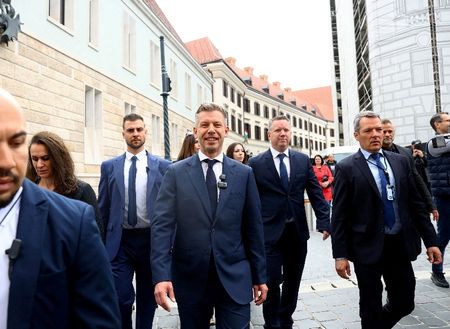

Hungary’s Prime Minister Peter Magyar launched his first international diplomatic mission Tuesday with a two-day journey to Poland, marking a significant step in his campaign to restore his country’s standing within European circles.
The Hungarian leader is scheduled to meet with Polish Prime Minister Donald Tusk on Wednesday. Tusk successfully guided a Europe-friendly coalition into power in Poland during 2023, repairing damaged relationships with Brussels and releasing billions in previously withheld funding that had been suspended due to rule of law issues.
Magyar hopes to achieve similar success following his decisive electoral triumph over nationalist Viktor Orban in April. Tusk characterized Magyar’s victory as a defeat for authoritarian governance and evidence of Central European politics moving away from anti-European nationalism.
The relationship between Warsaw and Budapest had soured significantly as Tusk and Orban feuded over Hungary’s confrontational stance regarding Ukraine and its friendly ties with Russia.
According to a Polish government official, this visit serves primarily as a symbolic fresh start following a period of essentially halted communication, designed to restart conversations about European matters and Ukraine.
“It is very clear that they want to restore relations with Poland to a very good level,” the official added. “These are, I would say, gestures showing a return to the best traditions of strong bilateral ties.”
Magyar’s itinerary will span Poland from Krakow in the southern region to the capital Warsaw, concluding in the Baltic coastal city of Gdansk.
On Monday, Magyar announced his intention to travel by rail to Warsaw Tuesday evening using “a high-speed rail line built with EU funding – by the ‘evil Brussels’,” referencing Orban’s anti-EU rhetoric.
He explained that his choice to experience Poland’s railway system reflects his goal of eventually establishing a high-speed connection between Warsaw and Budapest.
Magyar’s delegation includes several key ministers: Foreign Minister Anita Orban, Economy and Energy Minister Istvan Kapitany, Transport and Investment Minister David Vitezy, and Defence Minister Romulusz Ruszin-Szendi.
“The areas of responsibility of the participating ministers naturally shape the direction of the talks,” Magyar said.
Energy cooperation will feature prominently in the discussions, as Magyar has committed to eliminating Hungary’s reliance on Russian energy sources by 2035.
“This is a priority issue for both countries, with the oil crisis being a major challenge,” Magyar said.
Warsaw intends to propose that Budapest gain access to American LNG through a new Gdansk facility scheduled to begin operations in 2028, according to a knowledgeable source. Orlen has previously supplied American LNG to Ukraine.
Polish officials indicated that discussions will also cover Ukraine support and the future structure of cooperation within the Visegrad group of central European countries.
Hungary’s administration seeks Poland’s support in negotiations to release frozen EU funding, given both nations faced comparable rule-of-law disagreements.
“The decision has not yet been taken and will clearly be political as well as procedural, which is why this backing is crucial for Budapest,” said Wojciech Przybylski of the Visegrad Insight think-tank.