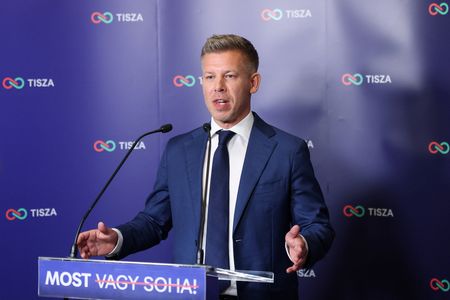

A childhood admirer who once hung a poster of Viktor Orban on his bedroom wall has now toppled the Hungarian strongman from power after 16 years of rule.
Peter Magyar’s pro-European Union Tisza party secured a stunning victory in Sunday’s parliamentary elections, capturing 137 seats for a commanding two-thirds majority in Hungary’s 199-member legislature. The upset defeat of Orban’s nationalist Fidesz party drew record voter participation and is expected to send ripples through right-wing political movements worldwide, including supporters of U.S. President Donald Trump.
As a nine-year-old when communism fell in 1989, Magyar had adorned his Budapest bedroom with images of prominent political leaders, including Orban, who had gained fame as an anti-Communist activist demanding Soviet withdrawal from Hungary.
“There was a surge of energy around the regime change that swept me up as a child,” Magyar shared during an interview with the Fokuszcsoport podcast last year.
Magyar, whose surname translates to “Hungarian,” emerged from relative anonymity two years ago following a scandal involving his former wife, Judit Varga, who had served as Orban’s justice minister. Varga stepped down from all political positions after public outrage over a controversial sex-abuse case pardon.
Following that incident, Magyar severed ties with the ruling party and launched sharp criticism of Fidesz, alleging corruption and propaganda while expressing his growing disenchantment with the organization.
In a remarkable political ascent, Magyar’s newly formed party captured 30% of the vote in June 2024’s European elections just four months after his debut interview on YouTube channel Partizan, finishing second to Fidesz while decimating other opposition groups.
The electoral outcome carries major consequences extending far beyond Hungary’s borders, potentially reshaping European politics and dealing a blow to populist movements across the continent.
Since returning to power in 2010, Orban has constructed what he terms an “illiberal democracy,” restricting press freedom, limiting non-governmental organization operations, and undermining judicial independence.
While cultivating close ties with Russian President Vladimir Putin and U.S. President Donald Trump, Orban has repeatedly clashed with European Union leadership, resulting in the suspension of billions in EU funding over democracy concerns.
Magyar has outlined a dramatically different path, promising to restore Hungary’s Western partnerships and eliminate Russian energy dependence by 2035 while maintaining “pragmatic relations” with Moscow. He also pledged to unlock frozen EU funds to jumpstart Hungary’s struggling economy.
“On the first day we need to pass anti-corruption measures and we need to submit our application to join the European Prosecutor’s Office,” Magyar declared Sunday morning after voting.
Throughout the campaign, Magyar carefully balanced his positions to avoid alienating conservative voters. While not opposing Ukraine’s eventual EU membership in principle, his party’s platform stops short of supporting accelerated entry for Kyiv. Like Fidesz, Tisza maintains opposition to EU migrant quotas and would preserve border barriers constructed under Orban.
Political observers suggest Magyar’s victory could ease Budapest’s tensions with Brussels, particularly after Orban blocked a 90 billion euro aid package for Ukraine.
“Orban has lost faith in the current form and direction of European integration, and is pursuing a policy of vetoes and obstruction,” explained Botond Feledy, a geopolitical analyst at Red Snow Consulting. “Tisza has no objection in principle to integration and would pitch its battles at a practical level.”
Magyar adopted several tactics from Orban’s political handbook, conducting a grassroots campaign that penetrated Fidesz strongholds in rural areas. His rallies prominently displayed Hungarian flags in an appeal to voters’ patriotic sentiments, mirroring Orban’s approach.
Gabor Toka, senior research fellow at the Vera and Donald Blinken Open Society Archives, credited Magyar’s rapid ascent to consistent messaging and effective social media strategy.
“Many people are also reassured by the story of someone who has irrevocably come into conflict with the system, and has no way back,” Toka noted, referring to Magyar’s definitive break with Orban’s circle.
Born in 1981 to a legal family, Magyar pursued law studies and married Varga in 2006. When her career led to Brussels, Magyar joined Hungary’s diplomatic service working on EU legislation. Upon returning home, he worked at a state bank before leading a student loan agency.
Magyar and Varga, who divorced in 2023, share three sons. He describes himself as religious and enjoys cooking and playing soccer with friends and his children.
When asked in December about changes since entering politics, Magyar referenced media reports describing his temper, saying: “Now I count to 10.”