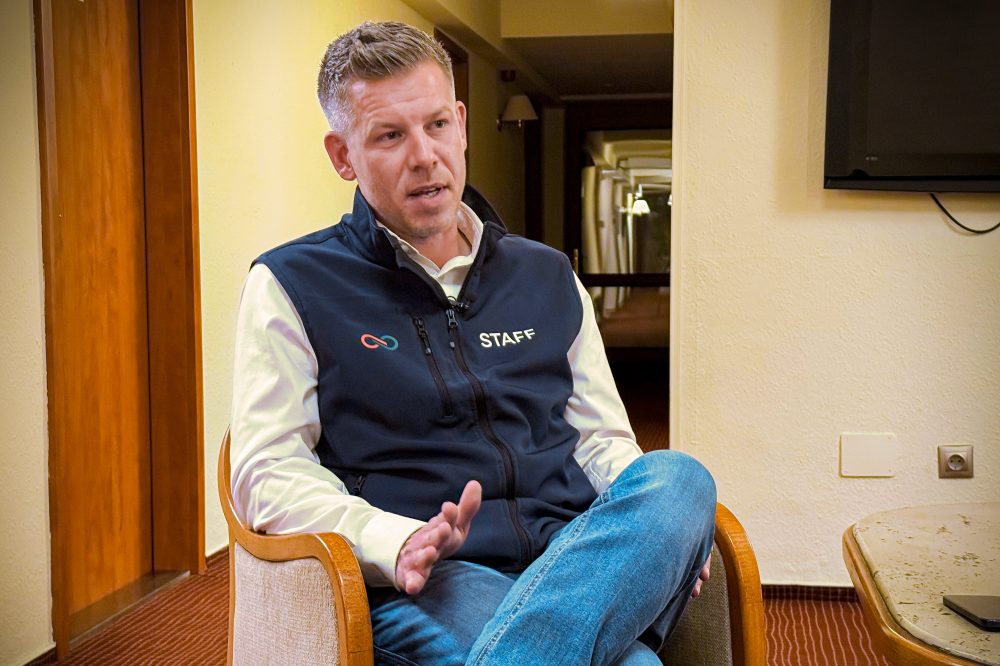

KISKUNHALAS, Hungary — Opposition leader Péter Magyar describes next week’s critical Hungarian election as a decisive moment that will determine whether the nation continues moving toward Eastern authoritarian regimes or returns to its position among Europe’s democratic nations.
The former Orbán associate represents the strongest challenge to the nationalist prime minister’s authority since Orbán assumed power in 2010.
Speaking exclusively with The Associated Press, Magyar criticized the European Union’s most tenured leader for implementing a complete policy reversal in recent years, jeopardizing Hungary’s Western alignment while strengthening ties with Moscow.
Despite this shift, Magyar noted that “Hungarians still see that Hungary’s peace and development are guaranteed by membership of the European Union and NATO.” He emphasized, “I think this really will be a referendum on our country’s place in the world.”
The comments came after Magyar addressed supporters at a campaign event for his center-right Tisza party in Kiskunhalas, a community of approximately 25,000 residents in Hungary’s southern plains region. The appearance was part of an intensive campaign schedule that has taken him to hundreds of locations across the nation, with visits to as many as six communities daily before the April 12 vote.
Orbán has established himself as a persistent source of friction within the EU through his regular blocking of significant policy decisions. His campaign strategy focuses on warning voters about various external threats he claims endanger Hungarian citizens — including the Ukrainian conflict, alleged conspiracies involving EU officials and financial powers working against Hungary, and ongoing immigration concerns.
Magyar, who holds leads in most polling data, has concentrated on domestic concerns that impact citizens’ daily experiences, including the deteriorating state healthcare system, failing public transit infrastructure, and what he characterizes as widespread government corruption.
During campaign appearances, he consistently accuses Orbán and his nationalist-populist Fidesz party of transforming Hungary into the “poorest and most corrupt” EU member nation — while presenting an alternative vision of a “peaceful, humane and functioning” society that remains achievable.
Beyond domestic policy issues, Magyar has increasingly emphasized how Orbán’s confrontational approach with the EU and growing alignment with Russia pose significant risks to Hungary’s future prospects.
“I think that Tisza will have an overwhelming electoral victory, because even Fidesz voters do not want our country to be a Russian puppet state, a colony, an assembly plant, instead of belonging to Europe,” he stated.
The rapid emergence of Magyar and his political movement surprised many Hungarian observers. For nearly fifteen years, various fragmented opposition groups had attempted unsuccessfully to seriously challenge Orbán’s political dominance.
While opposition lawmakers frequently criticized Orbán during parliamentary proceedings, they typically failed to connect with his rural support base. Following repeated electoral defeats, many opposition supporters became politically disengaged.
Magyar, a 45-year-old attorney and former Fidesz member, was previously married to an Orbán supporter who held the position of Hungary’s justice minister. Following diplomatic service in Brussels, he returned to Hungary and accepted roles within government institutions, developing extensive knowledge of Orbán’s administrative structure.
However, following a 2024 political controversy involving a presidential pardon for someone connected to child sexual abuse, Magyar publicly separated from Orbán’s party, alleging systematic corruption and institutional capture.
He subsequently established the center-right Tisza party — taking its name from Hungary’s second-largest waterway — which achieved 30% support in European Parliament elections just four months after Magyar entered electoral politics.
As Tisza gained momentum, supporters adopted the rallying cry “The Tisza is flooding,” which became synonymous with the party’s growth.
While Magyar frames his electoral mission as dismantling Orbán’s authoritarian structure, he has committed to maintaining certain policies he considers beneficial, including border barriers to prevent migration and popular utility cost reduction programs.
Nevertheless, his party — which belongs to the European Parliament’s largest center-right coalition — differs significantly from far-right political movements across Europe and elsewhere that regard Orbán as an exemplary model of nationalist populism.
Demonstrating U.S. President Donald Trump and his MAGA movement’s support for Orbán, Vice President JD Vance plans to visit Budapest on Tuesday to endorse his reelection campaign.
Numerous EU leaders are monitoring Hungary’s election with hopes that Orbán will be defeated.
His frequent use of veto power — most recently blocking a substantial 90-billion euro ($104-billion) EU loan package for Ukraine — often serves to satisfy his euroskeptic supporters, Magyar explained, “vetoing just to veto so he can say at home that he is vetoing.”
The prime minister’s behavior has prompted renewed discussions within the EU about reforming foundational treaties by reducing decisions requiring unanimous approval — a strategy to prevent paralysis caused by uncooperative member nations.
Magyar indicated that under a Tisza administration, European leaders could anticipate a “constructive position,” though one that remains “critical and willing to debate. We want to be there at the table.”
Despite Orbán’s misuse of EU unanimity requirements, the veto authority represents a “valid option,” he continued, noting: “I think the European leaders have no problem with this, they have a problem with the unnecessary troublemaker role.”
“The task of a Hungarian prime minister at any given time is to represent Hungarian interests, and if necessary, to represent them forcefully,” he declared. “Whatever it costs.”
Orbán has frustrated and angered virtually all other EU leaders through his accommodating stance toward Russia and close relationship with President Vladimir Putin. Some EU officials and domestic critics have accused him of abandoning his commitments to the bloc in favor of Moscow.
While nearly all EU nations eliminated Russian fossil fuel imports following the February 2022 full-scale invasion of Ukraine, Hungary and Slovakia continued and even expanded their purchases — drawing criticism from countries that accused them of financing the conflict.
Though Magyar has condemned Hungary’s movement toward Moscow and reports of Russian intelligence interference in the election to benefit Orbán, he indicated his potential government would adopt a “pragmatic” approach toward Russia.
“Pragmatism means that we have no say in Russia’s internal affairs, and they don’t have any say in our affairs,” he explained. “We are both sovereign countries, and we respect each other, but we don’t have to like each other.”
Magyar has criticized Orbán’s administration for failing to diversify energy sources and supports developing new agreements and infrastructure to import oil and gas from alternative suppliers into landlocked Hungary.
However, he noted, “this does not mean that we must stop using Russian oil tomorrow. It means that the European Union’s resources must be used well.”