
A company that builds humanlike robots designed to haul bins and totes around warehouses is making its Wall Street debut, putting to the test whether investors believe AI-powered humanoid machines are ready for the workforce.
Agility Robotics, headquartered in Salem, Oregon, announced Wednesday a planned merger with an investment firm that would place the company’s value at $2.5 billion. The deal would make Agility the first publicly traded company focused exclusively on building and selling humanoid robots.
The company faces competition from several major players in the space, including Tesla, whose CEO Elon Musk has promoted the carmaker’s humanoid prototype, called Optimus, as a glimpse into the future.
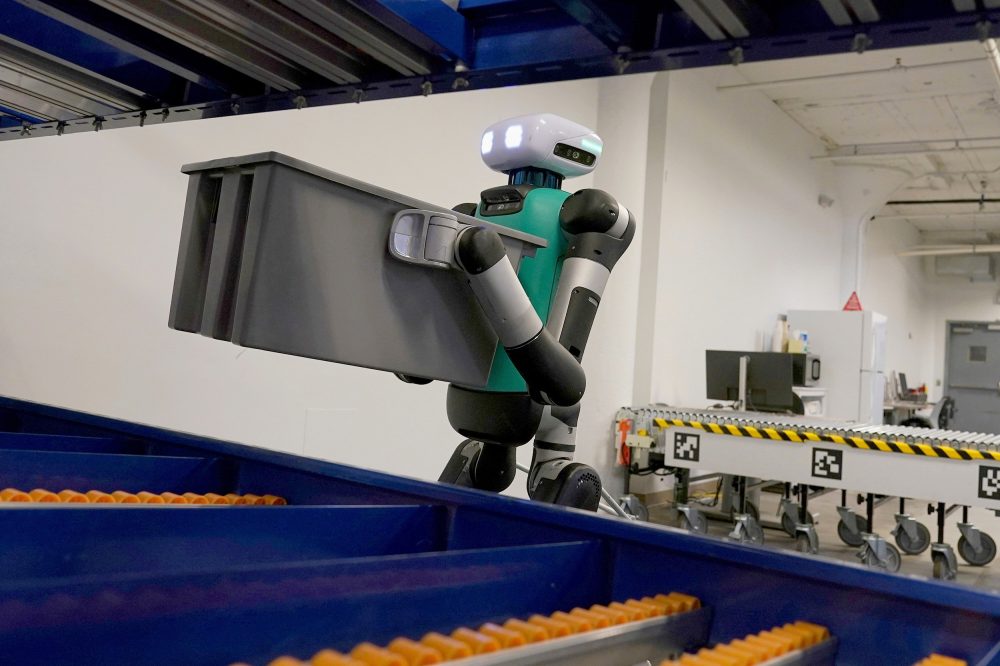
Agility’s robot product line, known as Digit, is built to pick up and transport heavy containers. Michael Klein, co-founder and chairman of Churchill Capital Group — the special-purpose acquisition company planning to merge with Agility before year’s end — called Digit the “first humanoid robot employed and commercially operational in warehouse and industrial facilities.”
During an investor call Wednesday, Klein noted that the company has received backing from Amazon, Nvidia, SoftBank, and Taiwanese electronics manufacturer Foxconn. Early customers include Toyota, industrial parts supplier Schaeffler, and Latin American e-commerce giant Mercado Libre.
Though the company markets Digit as a humanoid, co-founder and chief robot officer Jonathan Hurst told investors Wednesday that “we’ve never set out to build a machine that looks like a person.” Unlike humanoids such as Tesla’s Optimus, Digit features legs that more closely resemble a bird’s than a human’s — a design choice intended to better suit the physical demands of warehouse work. Its hands function more like grippers or claws than human hands.
Agility CEO Peggy Johnson said Digit is built for the kind of manual labor that tends to be repetitive, hazardous, and physically taxing for human workers.
“The demand here is large and increasing,” Johnson said on the investor call. “We have companies reshoring production, older workers retiring, and younger generations just not opting for these types of menial jobs.”
Traditional industrial robots are typically large and fast-moving, requiring physical barriers to separate them from human workers. Hurst said future versions of Digit are being designed to operate safely alongside people on warehouse and manufacturing floors.