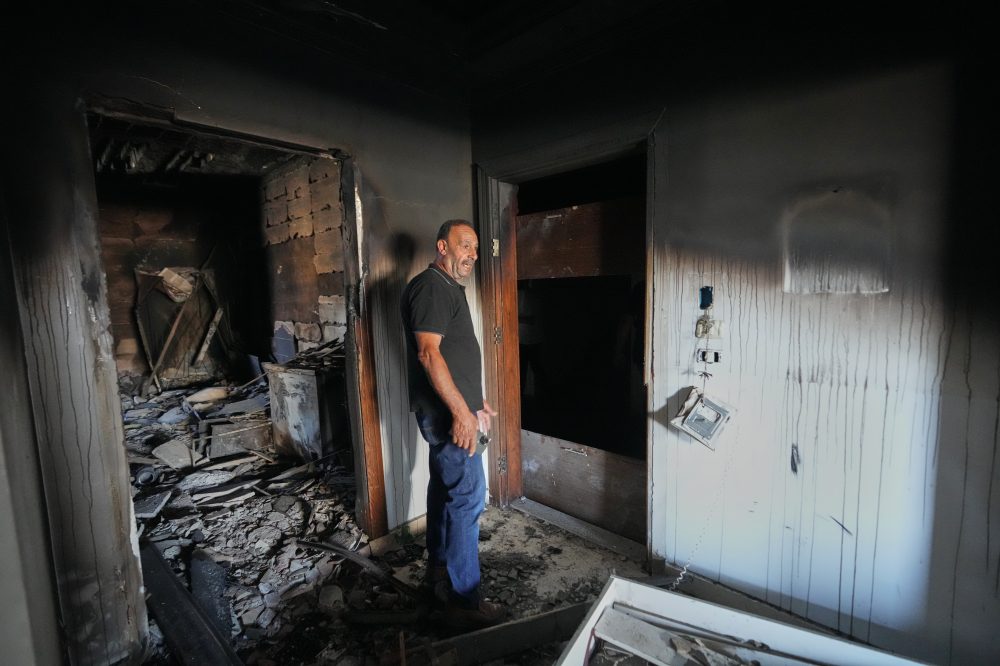

TYRE, Lebanon (AP) — Adnan Kaour made his way back to the coastal city of Tyre in southern Lebanon on Thursday, just one week after Israel ordered all residents to leave. Once celebrated as a beloved summer destination, the city now bears the scars of heavy bombardment.
Israel had followed those evacuation warnings with widespread airstrikes, which it said were aimed at the Lebanese militant group Hezbollah.
What Kaour discovered upon his return was devastating. The family apartment he cherished — with its view of the Mediterranean Sea — had been reduced to a pile of rubble and broken glass.
His visit home came the same day the United States and Iran announced a deal aimed at ending the broader Middle East conflict. The agreement also includes provisions calling for an end to the fighting between Israel and Hezbollah in Lebanon, though what that means on the ground remains uncertain.
Notably, neither Israel nor Hezbollah are parties to the agreement. Iran is demanding that Israel pull back from the large portion of southern Lebanon it currently occupies, but the interim deal’s language does not explicitly require that — it only guarantees Lebanon’s “territorial integrity.”
Israeli Prime Minister Benjamin Netanyahu had not yet responded publicly to the deal’s signing. Israel has pledged to maintain its military presence in Lebanon, while Hezbollah has declared its continued commitment to resisting Israeli forces. Clashes between the two sides were still being reported as recently as Wednesday in towns and villages across southern Lebanon, raising doubts about whether the deal will hold.
For the people of southern Lebanon, already worn down by years of crisis, cautious optimism is tempered by deep skepticism — too many ceasefire announcements have come and gone without stopping the violence.
Kaour, who lives in Germany but typically spends summers in Tyre, was abroad with his family when an Israeli strike hit their street without warning last month. When he returned Thursday, he found his building was still standing — a sweets shop and an electronics store occupy the ground floor — while the structures around it had been completely leveled.
Inside his apartment, however, the walls had been blown out and the windows shattered. He said he felt relief knowing his family had not been there. They all made it out safely.
“I’m hopeful for peace, and God willing this is the end of the war, and everyone can go back to their homes,” he said. “We are living abroad, but our minds are here in our country.”
Outside, neighbors quickly gathered to begin clearing away the debris.
One floor above Kaour’s apartment, his neighbor Samih Haidar had also just returned to find his door sealed shut with wooden boards. He tried kicking them down but couldn’t break through. He waited anxiously until two men working nearby came and unscrewed the bolts.
Haidar squeezed through the opening and stepped inside. He had rented the apartment to a family displaced from another part of the south — people connected to a trusted friend — and had no idea what to expect.
What he found stopped him cold: broken furniture, shattered glass, debris everywhere, and a burned-out kitchen. Neighbors told him the kitchen caught fire after a nearby strike. He walked slowly through each room, quietly recording the damage on his phone. He has no idea where the family went — like so many others, he assumes they fled Tyre.
Still, he said he wants to hold onto hope.
“We want things to work out and live in safety, so there can be stability for us and everyone else,” Haidar said.
Lebanon’s state-run National News Agency reported multiple Israeli drone strikes Thursday morning in the country’s south, including one that struck a vehicle in the town of Kfar Tebnit, killing one person and critically injuring another. Israel declined to comment on the strikes.
About 80 kilometers — roughly 50 miles — to the north, displaced families were camped along the waterfront in Beirut, Lebanon’s capital. Many have been living in tents for months, surviving day to day with no clear path forward. Others sleep on benches or mattresses laid out on the ground.
Many of those displaced say they have little confidence the US-Iran deal will last or that they will have anything to return to. In border communities near Israel, entire Lebanese villages have been nearly wiped out.
“I haven’t felt relieved at all,” said Mohammed Ashmar, who was displaced from the border village of Deir Seryan. Sitting near his tent with a cup of coffee in hand, he added: “Until I get back to my home … I won’t be convinced of anything.”
According to Lebanese officials, the war between Israel and Hezbollah has displaced more than one million people and claimed nearly 3,900 lives. Netanyahu’s office reports that approximately 30 Israeli soldiers and one defense contractor have been killed in or near southern Lebanon, while two civilians have died in northern Israel.
Lebanon’s Social Affairs Minister Haneen Sayed, speaking Thursday during a visit by foreign dignitaries, said the country faces both immediate humanitarian needs and the enormous challenge of planning for the return of displaced families and the rebuilding of devastated communities.
“The Lebanese people deserve peace,” she said. “They deserve to return safely to their homes, rebuild their communities, and look to the future with confidence and hope.”