
HONG KONG — Police in Hong Kong detained a performance artist Wednesday as he attempted to create a memorial display for those killed in Beijing’s 1989 Tiananmen Square crackdown, marking another instance of the territory’s diminishing freedom of expression.
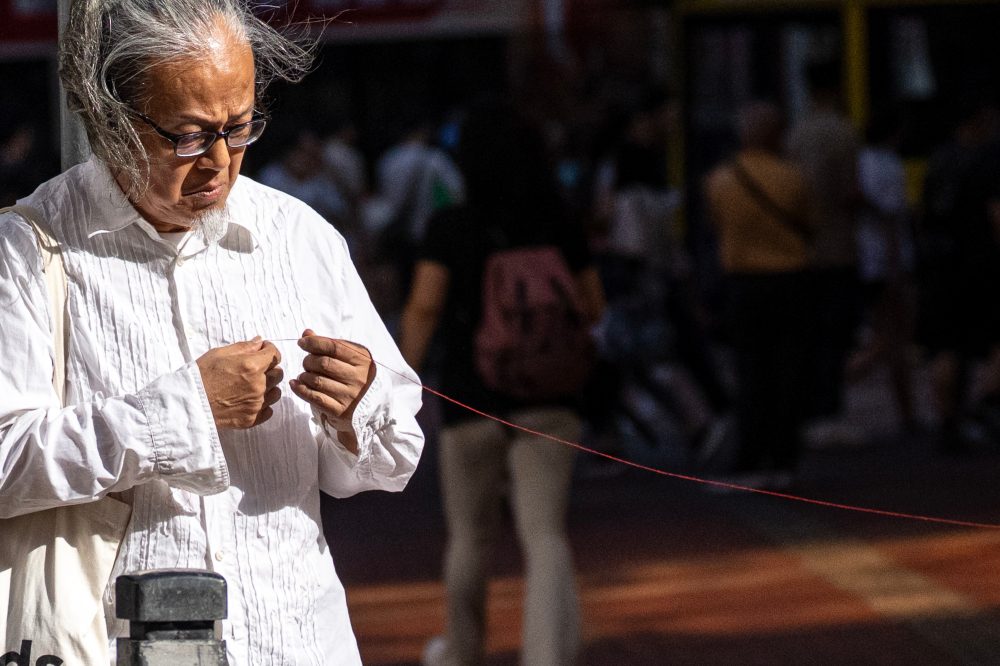
Sanmu Chen was stopped while attempting to attach a thin red thread to a street sign in Causeway Bay, a bustling commercial area near a park that previously hosted annual candlelight ceremonies on June 4 to honor those who died when the government ended student demonstrations in Beijing in 1989.
For many years, Hong Kong remained the sole location within China where large public remembrance events for the crackdown could take place. However, these once-enormous yearly gatherings were prohibited in 2020 amid the COVID-19 pandemic, and public demonstrations marking the Tiananmen Square deaths have grown increasingly restricted in the territory recently.
Chen revealed his thread measured 6.4 meters in length, seemingly referencing the June 4 anniversary date.
Officers detained and searched Chen’s belongings before releasing him. When a journalist questioned him about his red thread demonstration following his release, Chen explained it was intended to honor the deceased.
“It’s abnormal when people monitor you when you are saying or doing something,” he told reporters.
Chen has faced detention at least twice on June 3 in previous years. In 2024, authorities briefly held him after he appeared to trace the Chinese characters for “eight nine six four” — numbers representing the crackdown date — in the air with his hand.
Law enforcement also detained Chen on the same date in 2023 in the same vicinity, where he called out “Hong Kongers, do not be afraid. Don’t forget tomorrow is June 4.”
As evening approached, another artist, Chan Mei-tung, positioned herself outside a nearby retail store displaying a balloon shaped like a question mark. Officers swiftly intervened and accompanied her to the subway station.
Under the leadership of then-leader Deng Xiaoping, Chinese forces were deployed to Beijing’s Tiananmen Square to suppress weeks of student demonstrations during the night of June 3-4, 1989. Military personnel used live ammunition, resulting in hundreds and potentially thousands of deaths, including several dozen soldiers.
Yearly memorial services in Hong Kong’s Victoria Park previously drew tens of thousands of participants annually until authorities banned the gathering in 2020 during the initial year of the coronavirus outbreak.
This occurred during the same year Beijing implemented a national security law in the territory following extensive anti-government demonstrations in 2019. Since that time, officials have progressively suppressed opposition voices. Numerous prominent activists faced arrest while several outspoken media organizations ceased operations. Dozens of civil society organizations dissolved, including the group responsible for organizing the vigils.
Three former vigil coordinators faced charges in 2021 for inciting subversion under the national security law. Two of the former organizers proceeded to trial and await a verdict, potentially in July. Upon conviction, they could face up to 10 years imprisonment. Their co-defendant pleaded guilty, which typically leads to reduced sentencing.
Both Hong Kong and Beijing officials stated the security law is essential for the city’s stability. Hong Kong authorities emphasized the law explicitly requires that human rights be respected and protected while maintaining national security.
Following the end of COVID-19 restrictions, pro-China organizations established a carnival at the former vigil location. Some individuals who attempted to honor the event near the site on June 4, the crackdown’s anniversary date, faced detention.
The five-day carnival commenced Wednesday. The subdued commemorations in Hong Kong highlighted the erosion of civil freedoms promised by Beijing when the former British territory returned to Chinese control in 1997.
While public remembrance diminished in Hong Kong, international communities have assumed responsibility for preserving these memories through vigils and demonstrations in cities including London and Canada.