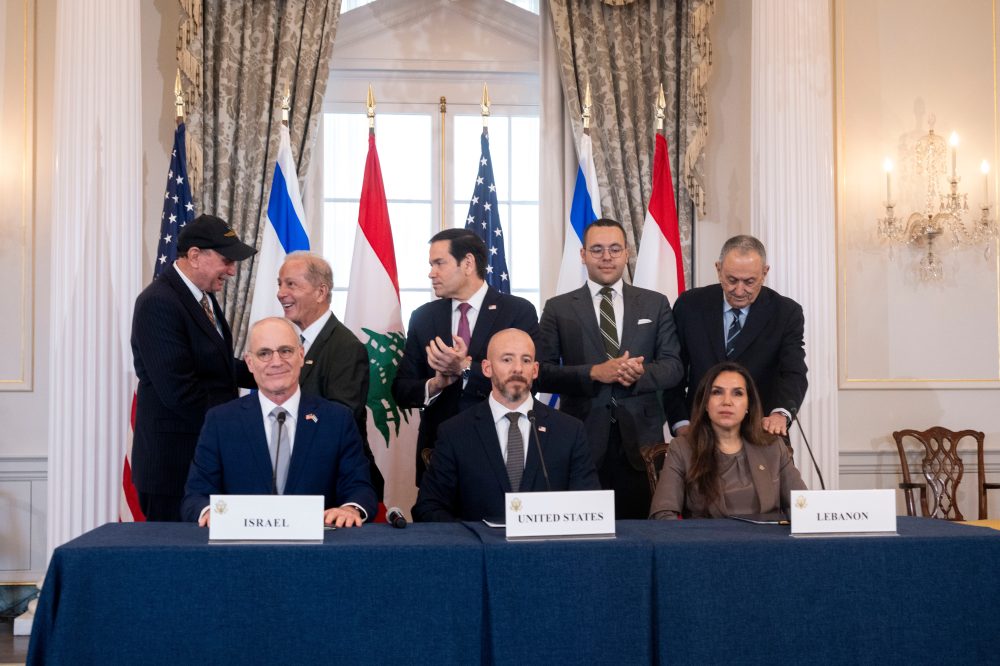

BEIRUT — Just one day after Israel and Lebanon signed a framework agreement in Washington aimed at ending months of conflict, Hezbollah’s leader came out strongly against it Saturday, casting serious doubt on whether the deal can hold.
The agreement, reached Friday without Hezbollah at the table, ties Israel’s military withdrawal from Lebanon directly to the disarmament of the Iran-backed militant group — a condition Hezbollah has flatly refused. It wouldn’t be the first time a ceasefire deal involving Lebanon and Israel has failed to take effect; several previous agreements have collapsed before being implemented.
Hezbollah leader Naim Kassem declared Saturday that his group would continue fighting until Israel is forced out of Lebanon. Supporters of the group took to the streets of Beirut in protest following the announcement. Kassem went further, saying from his perspective the deal simply does not exist.
He labeled the agreement a “humiliation” and described the condition linking Israel’s withdrawal to Hezbollah’s disarmament as a “very dangerous suggestion.”
One of the group’s officials, Hassan Fadlallah, issued a stark warning that the deal could spark civil war, saying Hezbollah will not surrender its weapons and will resist any attempt by the Lebanese army to enforce the agreement.
Despite the signing of the deal, violence continued. Lebanon’s state news agency reported an Israeli drone strike near the southern city of Nabatiyeh on Saturday. The agency also reported that three Lebanese and three Syrian workers, detained near the southern village of Ain Arab on Friday, were released by the Israeli military.
Details released Saturday by the U.S. State Department reveal that both countries aim to ultimately end the state of war between them — a conflict that dates back to Israel’s founding in 1948. Under the agreement, Israel would begin by withdrawing from two small designated areas, referred to as pilot zones, though the specific locations were not disclosed. The Lebanese army would gradually take over full security responsibility in those areas, with additional withdrawal zones to be agreed upon later.
A security annex outlining the specifics of Lebanese army deployment and Israeli troop movements was included in the deal but was not released to the public.
The agreement also emphasizes that Hezbollah’s disarmament across all of Lebanon, along with additional security measures to be negotiated, would eliminate any future need for Israeli military action or presence in Lebanese territory.
The Lebanon-Israel negotiations were conducted separately from an interim agreement reached earlier this month between the U.S. and Iran regarding the fighting in that country.
In an effort to cut off Hezbollah’s financial lifeline — in what appeared to be a reference to Iran, which has provided the group with billions of dollars over four decades — the deal commits both Lebanon and the United States to blocking funds from reaching non-state armed groups. The Lebanese government also explicitly pledged to ensure reconstruction money does not flow to such organizations.
Lebanon’s top public prosecutor, Judge Ahmed Rami al-Hajj, responded to the unrest by ordering the heads of the country’s security agencies Saturday to take steps to prevent rioting.
Reactions among ordinary people were sharply divided. At the border town of Metula in Israel, citizen Ronit Belson expressed skepticism about the deal’s staying power. “Personally, I don’t think it will be lasting because the Lebanese military cannot really stand a chance against Hezbollah,” she said.
In the southern Lebanese city of Sidon, opinions were split. Resident Rabie Sammour voiced support, saying: “People just want to rest for good. I support the Lebanese authorities in the decision” taken. But fellow Sidon resident Khaled Ghannoum took a very different view, saying the deal “legitimized Israel’s occupation.”