
Global financial markets displayed mixed signals Thursday as investors remained cautious while monitoring rapidly changing developments in the Middle East, where Iran indicated it might consider a U.S. proposal aimed at ending the Gulf conflict.
The expanding conflict has disrupted worldwide markets, driving oil costs higher, sparking renewed inflation concerns, and altering global interest rate projections.
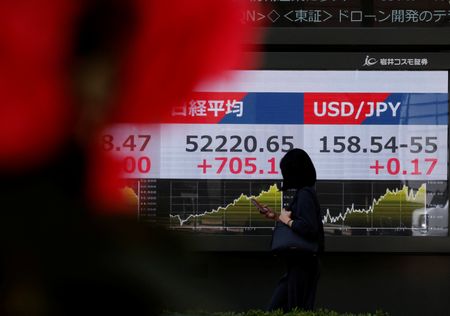
Trading results varied across Asia during early sessions, with Japan’s Nikkei climbing 0.6% while South Korean markets fell 1.2%. The MSCI Asia-Pacific index excluding Japan dropped 0.23%, heading toward an 8.7% monthly decline – its largest monthly fall since October 2022.
The U.S. dollar maintained strength near recent peaks and appeared positioned for a 2% monthly increase, reinforcing its role as investors’ preferred safe-haven currency.
Recent statements from Iran indicated some openness by Tehran to negotiate a war’s end if certain conditions were satisfied. The United States had submitted a 15-point ceasefire plan to Iran that Iranian officials initially rejected.
“While the headline flow points to a more constructive tone, markets remain unsure which signals to trust and act upon,” Chris Weston, head of research at Pepperstone, said.
“Price action suggests participants expect further twists and turns, even as the probability of a negotiated outcome edges higher.”
The conflict, which has lasted nearly a month following joint U.S.-Israeli strikes on Iran in late February, has effectively blocked the Strait of Hormuz, a critical passage for one-fifth of worldwide oil and liquefied natural gas transportation.
This disruption has pushed prices beyond $100 per barrel. Brent crude futures reached $103.35 per barrel, gaining 1% daily and heading for a 42% monthly increase.
“If you look at what the U.S. wants to achieve, what Israel wants to achieve, and what Tehran wants to achieve, it will be very hard to reconcile all these points,” said Matthias Scheiber, senior portfolio manager and the head of the Multi Asset team at Allspring Global Investments.
“We still think there is a case to make for structurally higher energy prices for the moment.”
Concerns about inflationary impacts from rising energy costs have led traders to eliminate expectations for Federal Reserve rate cuts this year, strengthening the dollar. Speculation about U.S. rate increases temporarily gained momentum but has since diminished.
European Central Bank President Christine Lagarde suggested Wednesday that eurozone interest rates might rise if Middle Eastern warfare drives regional inflation higher for an extended period.
“If the shock gives rise to a large though not-too-persistent overshoot of our target, some measured adjustment of policy could be warranted,” Lagarde said in Frankfurt.
The euro remained relatively stable at $1.1562, while the British pound traded at $1.3358. The Japanese yen stayed near 159.43 per dollar, maintaining proximity to the closely monitored 160 level that traders view as a possible intervention trigger.
In commodity markets, gold increased 0.66% to $4,537 per ounce, though it has declined significantly this month and faces a potential 14% monthly drop – its sharpest decrease since October 2008.