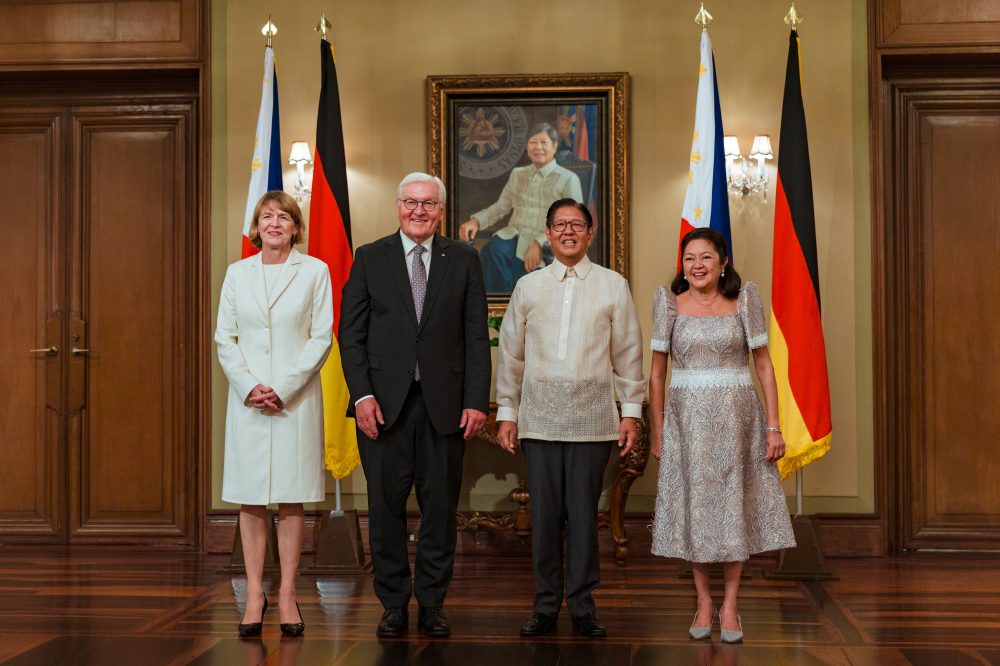

MANILA, Philippines — During a state visit to the Philippines on Tuesday, German President Frank-Walter Steinmeier voiced Europe’s growing alarm over escalating tensions in the South China Sea, cautioning that a serious flare-up in the region could threaten international shipping lanes — much like what occurred recently in the Strait of Hormuz.
Steinmeier appeared alongside Philippine President Ferdinand Marcos Jr. in Manila, where he pointed to the Hormuz blockade — a consequence of the Iran war — as a stark warning of what could happen if territorial confrontations in the South China Sea are left unchecked. Those disputes have been especially heated between the Philippines and China.
Speaking through an interpreter, Steinmeier said, “The situation in the South China Sea … continues to be tense and that gives us cause to be concerned because the Indo-Pacific, in particular the region of Southeast Asia, is one of the most economically dynamic regions of the world.”
He went on to say, “If incidents occur in that part of the world that is also cause for great concern in Europe. Violations of the international law of the sea endanger the freedom of navigation as the blockade of the Strait of Hormuz has brought home to us recently in a very drastic manner.”
The Hormuz closure, which triggered worldwide spikes in fuel and fertilizer prices, was among the topics the two leaders addressed in a private meeting.
While Steinmeier stopped short of assigning blame to any specific country for the South China Sea tensions, Germany has previously stated that China’s conduct in those disputed waters violates the rights of coastal nations like the Philippines and puts freedom of navigation at risk.
The United States, though it makes no territorial claims in the South China Sea, has repeatedly stated its obligation to defend the Philippines — its longest-standing treaty ally in Asia — should Filipino forces, ships, or aircraft face an armed attack. China has consistently warned the U.S. against involvement in the disputes, which also include competing claims from Vietnam, Malaysia, Brunei, and Taiwan.
During a 2024 visit to Manila, then-German Foreign Minister Annalena Baerbock had also raised concerns about China’s actions, which have included minor collisions with Philippine vessels. She said such behavior “violate rights and opportunities for economic development of your own country and other littoral states” and declared that China’s claims “are not covered by international law.” Baerbock visited the Philippine coast guard headquarters and briefly operated a surveillance drone donated by Germany during that trip.
On Tuesday, Steinmeier pledged Germany’s ongoing backing for the Philippine coast guard, which has served as a frontline defender of Manila’s territorial interests and has been involved in multiple confrontations with Chinese forces at sea.
Marcos expressed gratitude to Steinmeier and Germany “for consistently and publicly expressing its support for Philippine efforts to uphold the rule of law in the South China Sea, including by calling on all parties to abide by the final and binding 2016 Arbitral Award.”
That 2016 ruling, grounded in the 1982 U.N. Convention on the Law of the Sea, struck down China’s sweeping territorial claims in the South China Sea. Beijing refused to take part in the arbitration process initiated by the Philippines, rejected the ruling’s outcome, and continues to ignore it.