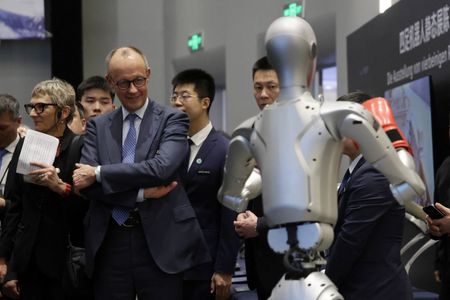

German Chancellor Friedrich Merz concluded his first official trip to China on Thursday, acknowledging positive diplomatic relations while expressing concerns about trade imbalances that have significantly impacted German markets.
During his two-day inaugural visit to the high-tech city of Hangzhou, Merz toured several facilities including Chinese robotics company Unitree, where robotic dancers greeted him, along with a Siemens Energy location and demonstrations of autonomous Mercedes-Benz vehicles.
While recognizing these as “impressive examples of good cooperation, technological development,” Merz emphasized that “difficult issues” required frank discussion between the two nations.
“Above all, there are issues relating to competition – China has high capacities, some of which are now also posing a problem for Europe because they far exceed market demand,” Merz stated during his visit.
The German leader announced plans for continued dialogue, saying “We will have to discuss this in detail after my visit.” He indicated that Economy Minister Katherina Reiche would also travel to China and confirmed that structured government-to-government meetings with Beijing would commence before next year begins.
China has consistently disputed European claims regarding overcapacity issues, dismissing such allegations as “entirely unfounded.” Chinese officials argue that their capabilities in sectors like renewable energy actually support shared objectives, including environmental sustainability efforts.
The economic relationship between Germany and China has undergone dramatic changes over recent years. While China remains Germany’s primary trading partner, the trade dynamics have shifted considerably in the past five years.
Chinese companies, benefiting from what German authorities believe is an artificially low yuan currency value, have eliminated Germany’s historical trade advantages. This has resulted in Germany facing a substantial trade gap with China approaching 90 billion euros ($106 billion) in 2025.
Merz’s China visit occurs as traditional German foreign policy approaches face challenges due to U.S. President Donald Trump’s more aggressive stance toward European allies. The chancellor is scheduled to travel to Washington next month.
Accompanied by a substantial group of German business representatives, Merz held meetings with Chinese President Xi Jinping and Premier Li Qiang on Wednesday. During these discussions, he committed to developing a “comprehensive strategic partnership” between the two countries.
However, his diplomatic mission, following similar visits by French President Emmanuel Macron and British Prime Minister Keir Starmer, could not mask the substantial challenges affecting China-Europe relations. Merz acknowledged that “numerous tasks” still required attention.
German business executives argue that Chinese companies’ excess production capacity, supported by currency advantages and restricted market access policies, has created unfair competitive conditions. China’s control over critical sectors including semiconductor manufacturing and rare earth materials has also created supply chain risks for Western companies.
Despite these concerns, the advanced technology capabilities of Chinese firms, their deep integration in global manufacturing networks, and China’s massive consumer market make the country an essential economic partner.
Chinese Premier Li assured Merz on Wednesday that China would consider “reasonable demands” from Western businesses. Regarding currency concerns, Beijing has described itself as a “responsible major country” and denied any intention to gain trade advantages through currency manipulation.