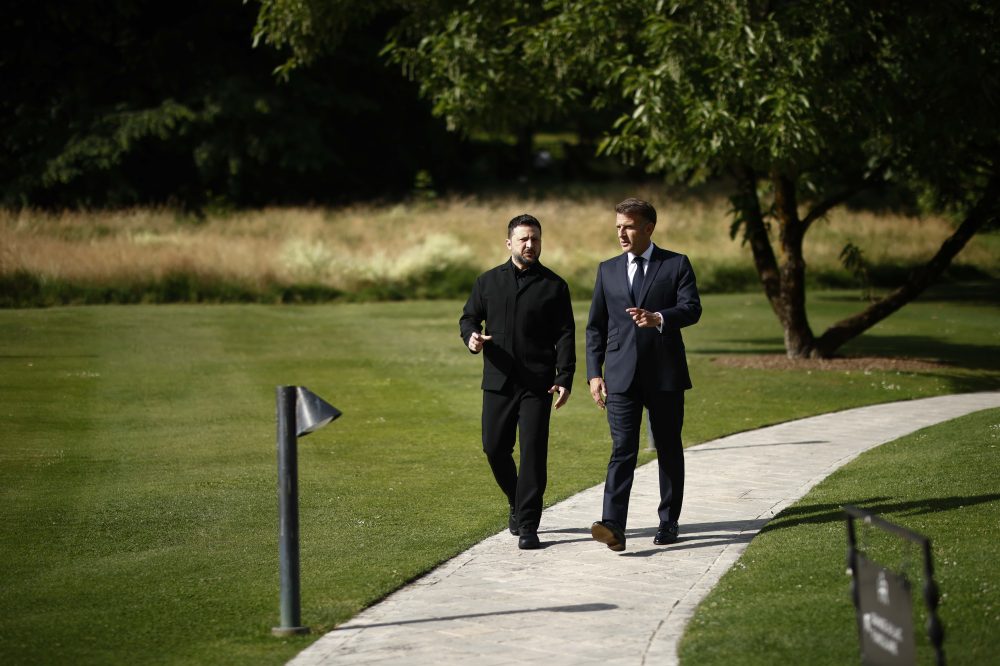

EVIAN-LES-BAINS, France — At the Group of Seven summit of major industrialized nations, U.S. allies spent Tuesday pressing President Donald Trump to refocus attention on the war in Ukraine, which has now stretched past four years since Russia launched its full-scale invasion.
Recent weeks have seen the conflict in Ukraine overshadowed by the war between the U.S. and Iran. French President Emmanuel Macron, who is hosting the summit, said he intends to convince Trump to keep backing Ukraine and ramp up pressure on Russia in pursuit of a peace deal.
With the United States having scaled back its assistance to Ukraine under the Trump administration, France and its European partners have stepped up as the primary sources of both military equipment and financial support for Kyiv.
Ukrainian President Volodymyr Zelenskyy participated in a morning working session with G7 leaders, though the talks concluded quickly — lasting just 75 minutes, according to the French G7 presidency.
The Ukraine discussions followed Trump’s announcement of a deal to bring an end to the 3 1/2-month U.S. conflict with Iran. Trump confirmed Tuesday that he plans to sit down privately with Zelenskyy. He said he wants to shift his focus to Ukraine now, suggesting that Iran will soon be “back in the rearview mirror.” While he played down the war’s direct impact on the United States, he expressed sadness over the lives lost.
“The whole thing is ridiculous,” Trump told reporters. “So, yeah, I’m going to do whatever I can.”
On a related front, the United Kingdom unveiled a fresh round of sanctions aimed at the so-called “shadow fleet” Russia relies on to export oil and gas, along with the financial networks Moscow uses to dodge Western penalties. Among the vessels targeted are several ships recently acquired by Russia to move liquefied natural gas from its sanctioned Arctic LNG 2 project. Last weekend, British forces seized a Russian shadow fleet ship in the English Channel — the first time such an action has taken place there.
Just hours before the G7 summit got underway, Russia unleashed hundreds of drones and dozens of missiles against Ukraine’s largest cities in an assault that left 11 people dead and set a religious landmark ablaze.
The strikes came after both Zelenskyy and Russian President Vladimir Putin spoke separately by phone with Trump on Sunday — the U.S. president’s 80th birthday. Those calls indicate Washington has not abandoned its diplomatic push to bring the fighting to an end, which began with Russia’s all-out invasion of Ukraine in 2022.
During his 2024 campaign to return to the White House, Trump boasted he could resolve the Russia-Ukraine war within 24 hours of taking office. He has since admitted the situation has turned out to be far more complicated than he originally believed.
In another development, Ukraine on Monday formally launched European Union membership negotiations, beginning a lengthy process that will demand significant political reforms from its government — all while the country continues to battle the Russian invasion. Ukraine views EU membership as a key security guarantee for its future stability once the war concludes. Membership in the NATO military alliance would offer even stronger guarantees, but the Trump administration has ruled that out, and many others are reluctant to admit Ukraine while the war is still ongoing.
The U.S.-Iran ceasefire agreement has also drawn considerable attention at the summit. Trump held a private meeting with the Emir of Qatar and is scheduled to meet with the President of the United Arab Emirates later in the day. Neither Gulf nation is a G7 member, but Macron invited their leaders to attend the summit given the turbulent situation in the region.
Trump also voiced frustration over Israel’s continued military operations against the Iranian-backed militia Hezbollah in Lebanon, telling reporters he is “not happy with the way Israel has handled themselves with Lebanon and with Hezbollah.”
“They should have been able to deal with them faster,” Trump added. “It just goes on forever. And when that happens, it throws a negative light on the big deal. And that’s the deal with Iran.”
G7 leaders also gathered for a working lunch to address the broader Middle East situation, with the conversation expected to center on what comes next following the U.S.-Iran ceasefire.
In recent months, Trump has clashed with leaders from France, the United Kingdom, Germany, and Italy over his decision to go to war with Iran without consulting them. He has threatened consequences, including potentially pulling U.S. troops from all four countries — all NATO members — citing their lack of support.
Despite those tensions, U.S. allies are pushing for swift progress that could help ease the economic strain caused by rising oil prices tied to the blockade of the Strait of Hormuz. Macron said France and other Western partners are “ready to take action very quickly” to help reopen the strait through peaceful means. France and the U.K. have been leading efforts to restore maritime security in the strait when conditions allow.
The G7 is made up of France, the United States, Canada, Germany, Italy, Japan, and the United Kingdom. Several guest nations — including Brazil, India, Kenya, and South Korea — were also invited to take part in certain sessions of this summit.