
(Note: The views expressed in this analysis are those of the author, Reuters Breakingviews columnist Pierre Briancon.)
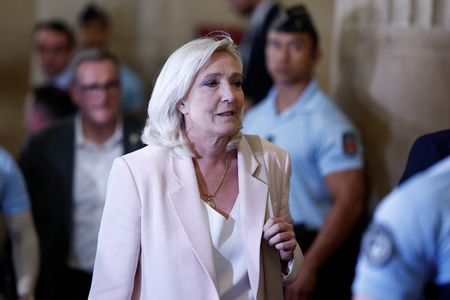
French courts have already sent a former president to prison. Now they have handed down a detention sentence to a potential future one — far-right leader Marine Le Pen. Unlike that former president, who actually served prison time, the most Le Pen can expect is home confinement with an electronic ankle bracelet, a situation she is hoping to overturn through an appeal.
Regardless of her legal troubles, Le Pen announced Tuesday that she plans to enter the presidential race scheduled for April 2027. This time, she stands a genuine chance of reaching the Élysée Palace. Bond markets appear largely unconcerned about the populist economic proposals her party is advancing, or her capacity to handle the country’s finances. That calm may be misplaced.
Whoever steps into the presidency after Emmanuel Macron will face a country in deep financial difficulty. Recent French governments have repeatedly failed to rein in out-of-control budget deficits. The national public debt has now climbed to €3.6 trillion — a 60% jump since Macron took office more than nine years ago. According to the IMF, that debt is on pace to hit 120% of GDP next year. Budget deficits have exceeded 5% of economic output for three straight years and are unlikely to shrink significantly in the near term. The 2027 budget debate is expected to be a fierce battle, given a fragmented parliament and a crowded field of nearly 20 declared presidential candidates so far.
Over the years, Le Pen has pulled back from some of her more extreme earlier positions. She has abandoned her push to exit the euro, softened her pro-Russia stance on Ukraine, and even took aim at U.S. President Donald Trump, calling his approach to Iran “erratic.” Still, core elements of her economic agenda have stayed in place. She has consistently opposed government efforts to raise the retirement age to shore up the pension system. Her central argument — that reducing immigration will generate enough savings to pay for tax cuts for both households and businesses — is widely viewed as unrealistic.
Le Pen and her protégé Jordan Bardella, the 29-year-old she elevated to party leader while dealing with her legal battles, have been making overtures to the business community. In April, they sent a letter to business leaders saying they wanted to “listen” to them and identify what was holding back economic growth. This has fueled speculation that Le Pen might follow the example of Italy’s right-wing prime minister, who surprised many in Europe by managing her country’s finances with unexpected restraint over the past four years — even with a debt load of 140% of GDP. Italy’s borrowing costs have gradually moved closer to France’s, with both countries’ 10-year bond yields now within a percentage point of Germany’s.
While nothing is off the table, Le Pen remains committed to an interventionist economic approach centered on government benefits aimed at her core supporters in France’s struggling industrial regions. She has a long way to go before she can offer a convincing roadmap for addressing France’s serious fiscal challenges.
BACKGROUND: A French appeals court on July 7 upheld Le Pen’s conviction for misappropriating European funds but reduced the length of her ban from holding elected office, potentially reopening the door for her 2027 presidential run. The court imposed a three-year jail sentence, suspending two years of it, and ordered her to wear an electronic ankle tag for one year — a condition that could make running a presidential campaign both politically and practically difficult.