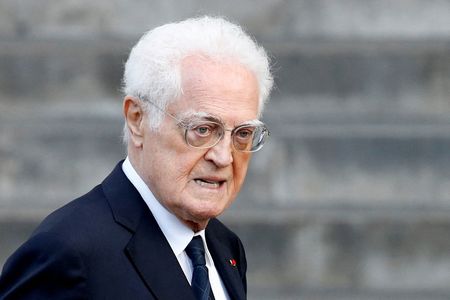

PARIS – Former French Prime Minister Lionel Jospin, who led the Socialist government from 1997 to 2002, has passed away on March 23rd, prompting an outpouring of condolences from political leaders across France.
French President Emmanuel Macron honored Jospin’s distinguished career on social media, describing him as a major force in French governance who held numerous key positions including Socialist Party leader under François Mitterrand, education minister, prime minister, and Constitutional Council member. “Through his rigour, his courage and his commitment to progress, he embodied a noble vision of the Republic,” Macron stated.
Current Prime Minister Sebastien Lecornu praised Jospin’s dedication to the nation, writing that “He served France with steadfastness, high standards and a strong sense of responsibility.” Lecornu added that Jospin’s contributions, “guided by a vision of social progress and Republican values, has left a lasting legacy and stands as a model of dedication. France has today lost a faithful public servant, whose name will forever be associated with the State.”
Even political opponents acknowledged Jospin’s character. Far-right leader Marine Le Pen, while noting their policy disagreements during his tenure, called him “a man of integrity on the left, the only one who had the courage, in the aftermath of the 2002 presidential election, to denounce the shameless lie of the fascist threat that was being frantically stirred up by both the right and the left between the two rounds.”
National Rally party chief Jordan Bardella remembered Jospin as “a leading figure of the Fifth Republic and, despite our differences, as an honest man of the left.”
Former Prime Minister Elisabeth Borne, who worked with Jospin personally, highlighted his lasting influence on French politics through “his dedication, his rigour and his sense of public duty, qualities I was able to appreciate first-hand whilst working alongside him.”
Hard-left politician Jean-Luc Melenchon, who served under Jospin as vocational education minister, called him “a paragon of high standards and hard work.” Melenchon credited Jospin with implementing the 35-hour work week and maintaining “his refusal to move the retirement age,” adding that Jospin represented “an intellectual presence in a world that was drifting off course.”
National Assembly President Yael Braun-Pivet emphasized Jospin’s concrete achievements, noting how “he transformed the daily lives of the French people: universal healthcare, gender parity, youth employment schemes, and civil partnerships.” She praised his reputation for “integrity and his sense of public duty: rigour and respect for institutions.”
Socialist Party leader Olivier Faure expressed deep sorrow over the loss, describing Jospin as embodying “a left-wing movement that was demanding, principled and Republican.” Faure emphasized that Jospin “had succeeded in leading the pluralist left to victory” and called for a national tribute, stating that Jospin’s career “serves as a reminder that it is possible to govern without pandering to the prevailing trends.”
Segolene Royal, the 2007 Socialist presidential candidate who served in Jospin’s cabinet, mourned the passing of “a political ideal of rare integrity, guided by an unwavering moral compass.” Royal noted that with Jospin’s death, “a certain vision of politics is leaving us — one that respects debate and is committed to sound decision-making, without insults or fury.”
Former Prime Minister Bernard Cazeneuve described Jospin as “a respected statesman” whose “integrity, his sense of responsibility and his loyalty to the values of socialism and the left made him a guiding light for all those who believed in social progress.”
Hubert Vedrine, who served as Jospin’s foreign minister, told Le Monde newspaper that Jospin “was an extraordinary prime minister” with “a remarkable way of exercising authority, as he was both a great teacher and very precise.” Vedrine defended Jospin against critics, explaining that while some viewed his management style as micromanagement, “in reality he was very respectful of the necessary authority of each of his ministers, whilst himself being very clear in his ability to articulate where he wanted to go and to explain his decisions.”