
On the evening of January 7, 2025, Matt Blea faced a frightening choice. A fire had broken out just a few miles from his Altadena, California, home — and he had to decide whether to stay or get out fast.
A friend who worked in mountain rescue pointed him toward a free app called Watch Duty. Through it, Blea could see exactly where the fire’s perimeter was, check evacuation orders, and follow real-time updates from emergency responders. “It influenced me to leave the home sooner than later,” he said. Blea packed up his wife and son and left that evening — before the Eaton Fire burned their home to the ground.
Blea was among more than 2.5 million people who turned to Watch Duty during the devastating fires that swept through Los Angeles County that week. Behind the app, roughly two dozen staff members and more than 100 volunteers worked around the clock, sifting through emergency radio traffic, aircraft reports, and communications from local agencies to gather and verify information.
David Hertz, a Malibu resident who serves as captain of his community’s fire brigade, said the service was critical — particularly in areas where residents received little to no advance warning about the Eaton and Palisades fires, which together killed 31 people. “It’s like a democratization of data that empowers people,” he said.
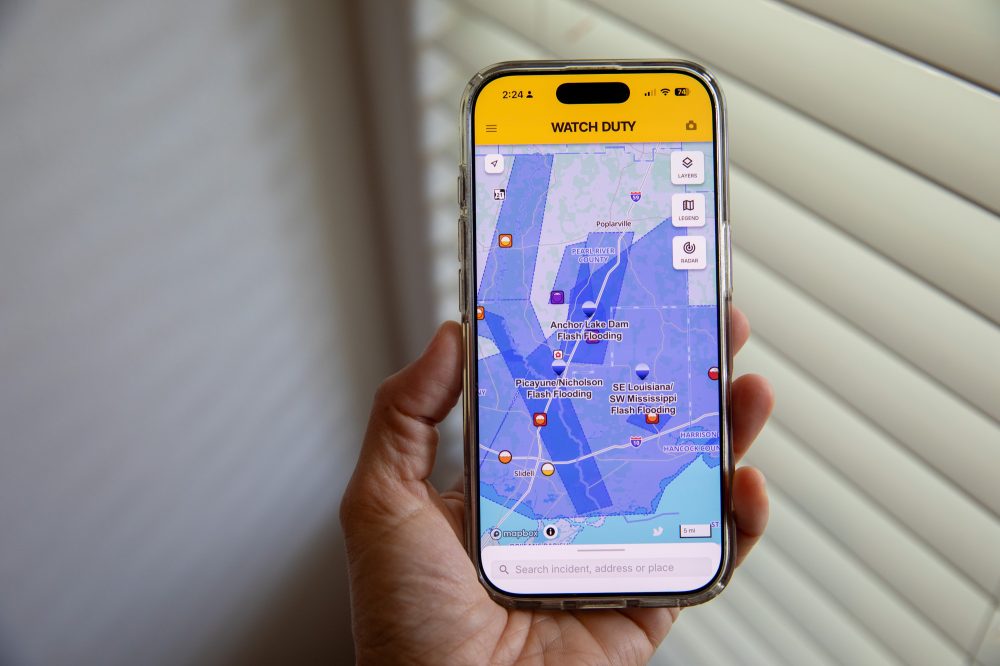
Now, Watch Duty is taking on a new threat. This month, the app began helping users track flooding — another deadly and increasingly destructive hazard. The move comes as the peak flash flood season gets underway in the U.S., nearly a year after last July’s catastrophic floods in Texas, which killed more than 130 people and sparked widespread criticism over the lack of timely warnings reaching residents and visitors in the Texas Hill Country.
“This is painful that this keeps happening,” said John Mills, the CEO and co-founder of the donor-supported nonprofit that operates the app. “We’re not spreading enough information fast enough on as many channels as humanly possible.”
Mills launched Watch Duty in 2021 after he himself failed to receive official alerts or evacuation instructions when a fire threatened his Northern California home. He recognized a problem that has shown up repeatedly in recent disasters: the U.S. does have systems in place to send emergency alerts by text, radio, and other channels, but issuing a specific warning or evacuation order can get bogged down in bureaucracy and requires humans to make high-stakes calls under enormous pressure.
The information people need to assess their own risk is often out there, Mills said — it’s just scattered and hard to access. “The systems are really struggling to meet people where they are,” he said.
During fire emergencies, Mills noticed he was relying on volunteer radio operators who would listen to scanners and post updates on social media. Those posts were helpful, but social media came with serious drawbacks — misinformation and unrelated content could easily bury the critical updates people needed most.
A software engineer and entrepreneur by background, Mills brought together some of those volunteers and fellow engineers to build something better. He structured Watch Duty as a nonprofit, a decision that has helped earn the trust of its more than 20 million users. In 2025, the organization received nearly $6 million in grants and donations.
Today, Watch Duty relies on around 300 volunteer “reporters” who gather and verify information from radio scanners, cameras, satellites, user-generated content, and official public announcements. The app delivers that information in five languages through maps, text feeds, and push notifications — ones that can cut through even when a phone is set to silent.
“You’re not going to have to go to multiple other entities, to the weather service, emergency management website, county website,” said Watch Duty meteorologist Pete Curran. “It’s in one place, in plain language, and it’s going to wake you up if you’re asleep.”
Curran, a retired firefighter, noted that Watch Duty can sometimes get information out faster than local agencies because its reporters have a singular focus. “Our only responsibility is to watch and listen. We’re not in charge of the incident,” he said.
The nonprofit chose to expand into flood monitoring because of how broadly flooding affects communities. “We are seeing crazy rainfall in places that it’s not normal for them,” said Dr. Lori Moore-Merrell, a longtime data scientist and Watch Duty board member who previously served as U.S. Fire Administrator. “Maybe it’s never happened before, but it’s happening now, so you need to be aware.”
The app draws on weather modeling and data from the National Weather Service, the National Oceanic and Atmospheric Administration, and the U.S. Geological Survey. Users can view flood warnings and watches, check river gauge levels, and receive alerts about potential dam or levee failures. They can also see whether their property falls within a FEMA-designated flood zone, understand what river gauge readings signal danger, and set customized notifications tied to specific gauge thresholds.
But experts caution that even the best app has its limits. “I love seeing products like this come out, but one thing we know to be true in the Texas floods, is a warning is only as good as the knowledge to do something about it,” said Chad Berginnis, executive director of the Association of State Floodplain Managers.
Berginnis said his organization recommends that people not only have an emergency plan — but actually practice it. “One of the massive failures is not knowing what to do,” he said.
He also raised concerns about the broader emergency alert infrastructure, which faces risks from past and proposed funding cuts to federal agencies and local warning systems. “At the end of the day, if you want eyes and ears out there, you’ve got to pay for it,” Berginnis said.
Mills is clear that Watch Duty is not designed to replace government weather or emergency services. “We need National Weather Service, we need fire service, we need all this infrastructure to operate,” he said, urging users to also sign up for their local alert systems.
And like any app, Watch Duty only works for those who have downloaded it — and who have cell service when they need it most. Berginnis recommended building in backup options, such as an inexpensive NOAA weather radio. “You have to have redundancy,” he said. “Sometimes we get so focused on tech, we forget the easy stuff.”