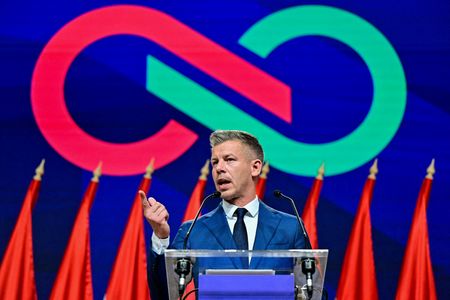

Financial markets are expressing confidence in Hungary’s economic prospects as newly elected Prime Minister Peter Magyar prepares to take office after decisively defeating Viktor Orban in recent elections.
Magyar’s overwhelming victory positions his center-right Tisza party to overhaul key legislation governing the judiciary, elections, public contracts, and media oversight – areas that created significant tension between Orban’s administration and European Union leadership, resulting in approximately 18 billion euros ($21.2 billion) in suspended EU financial support.
Following his electoral triumph, Magyar outlined an ambitious reform agenda during an extensive news conference. His plans include implementing comprehensive government changes, joining the European Public Prosecutor’s Office, establishing term limits for prime ministers, and clearing the path for a 90 billion euro EU loan package designated for Ukraine.
Economic analysts view the potential restoration of EU funding as particularly significant, given that these resources represent roughly 8% of Hungary’s total annual economic output. Morgan Stanley projections suggest that accessing these funds could boost the country’s growth rate by 1 to 1.5 percentage points.
Investment professionals see substantial opportunities in this political transition. “It’s a new chapter for Hungary and it’s a great opportunity,” said Magdalena Polan, who leads emerging market research at PGIM. “To move the economy will not take much because sentiment and rule of law are such an important part of the economic set of factors that impact growth.”
JPMorgan researchers anticipate that Hungary’s relationship with the EU will improve rapidly, with initial reform commitments likely sufficient to begin releasing the frozen European funding.
European Commission President Ursula von der Leyen praised Magyar’s electoral success as “a victory for fundamental freedoms,” drawing parallels between Orban’s departure and Hungary’s historic 1956 resistance against Soviet control and its 1989 transition away from communist rule.
While the mid-year timeline for utilizing EU post-pandemic recovery funds appears challenging, JPMorgan analysts believe the “extraordinary circumstances will call for exceptional flexibility” from European officials.
Financial markets responded enthusiastically to the election outcome. Hungary’s currency reached its strongest position against the euro in four years, government borrowing costs dropped by half a percentage point to 2024 lows, and the national stock exchange climbed nearly 5%.
However, the incoming administration faces significant fiscal challenges that may temper initial market enthusiasm. Hungary currently maintains one of the EU’s largest budget shortfalls at over 5% of GDP, while its debt burden exceeds 70% of economic output and continues rising. Credit rating agency S&P Global has positioned the country just one downgrade away from junk bond status.
Magyar has expressed hope that accelerated economic growth and improved investor confidence leading to lower government borrowing costs will address these financial pressures. He has committed to eliminating corruption, ending vanity infrastructure projects, and stopping inflated government purchasing practices.
“I’m sure they will find some skeletons,” commented Viktor Szabo, who manages emerging market debt portfolios at Aberdeen, referring to Tisza’s planned financial audit. Despite this concern, he expects S&P to maintain Hungary’s current credit rating given the likelihood of restored EU funding.
The new government must also develop a credible long-term budget strategy, with a formal plan due to the European Commission by October. However, preliminary measures and budget outlines may be required much sooner.
Euro currency adoption remains a long-term objective despite being years away from implementation. This commitment was central to Magyar’s campaign platform, and Tisza’s parliamentary supermajority should enable passage of necessary constitutional amendments.
Deutsche Bank analysts note that Hungary’s “fiscal and debt dynamics remain incompatible with Maastricht criteria at the moment,” given eurozone requirements for budget deficits below 3% of GDP and debt levels at or declining toward 60% of economic output.
Additionally, Hungary’s current 3% inflation target needs alignment with the European Central Bank’s preferred level of just under 2%.
PGIM’s Polan identifies several persistent economic and political challenges. Rapid EU funding distribution before implementing reforms could prompt legal challenges from other member nations. Hungarian businesses continue struggling with labor shortages worsened by demographic aging, language barriers, and immigration policies. Living standards haven’t improved as quickly as in neighboring countries, and reducing dependence on Russian energy appears more difficult given current Middle East conflicts.
Despite these obstacles, Orban’s departure signals significant change ahead, with most developments likely favoring international investors. “We are in a completely new situation here,” Polan observed.