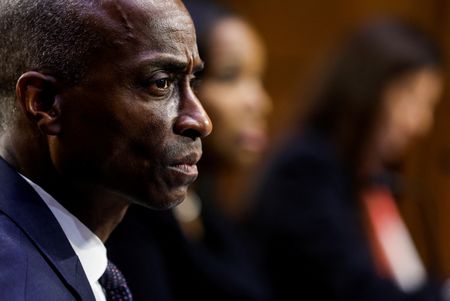

Federal Reserve Vice Chair Philip Jefferson expressed concerns Tuesday about dual economic pressures threatening both employment stability and price increases across the nation.
Speaking at the University of Detroit Mercy, Jefferson outlined his cautious economic perspective amid ongoing global uncertainties.
“In the current environment, I confront an outlook in which there is downside risk to the labor market and upside risk to inflation,” Jefferson stated in his prepared remarks. “I remain cautious about my outlook…. I continue, however, to see our current policy stance as appropriately positioned to allow us to assess how the economy evolves.”
Jefferson emphasized that current short-term interest rate levels provide the Federal Reserve flexibility to address unpredictable impacts from Middle Eastern conflicts and fluctuating energy costs on the central bank’s dual goals of maintaining stable prices and full employment.
Federal Reserve officials maintained their benchmark interest rate between 3.50% and 3.75% last month, indicating they want to observe additional inflation improvements before implementing rate reductions.
The Fed vice chair characterized the employment situation as generally balanced but susceptible to negative disruptions, noting that companies are already hesitant about new hiring decisions.
Jefferson warned that a significant economic setback could reduce job creation and increase unemployment beyond the current 4.3% rate.
Regarding inflation concerns, Jefferson acknowledged that price increases continue exceeding the Federal Reserve’s 2% objective. While he previously anticipated inflation would moderate later this year as previous tariff impacts diminished, he now projects short-term price increases due to oil market disruptions.
Jefferson expressed confidence that existing monetary policy will continue supporting employment while enabling inflation to resume its downward trajectory.
Despite acknowledging that sustained higher energy costs could burden consumer and business expenditures while simultaneously pressuring inflation forecasts upward, Jefferson remained optimistic about policy effectiveness.
“I am confident that our current policy stance is well-positioned to respond to a range of outcomes,” he concluded.