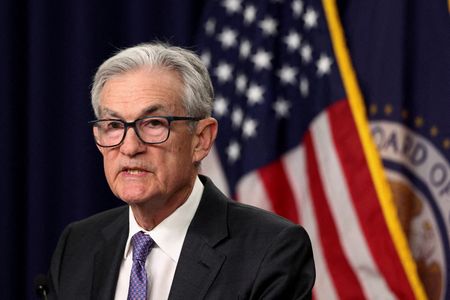

Jerome Powell’s leadership of the Federal Reserve comes to an end Wednesday, concluding an eight-year period defined by clashes with President Trump and unprecedented economic challenges.
Powell’s journey to the Fed’s top position began in 2017 when he was serving as a Fed governor, appointed by President Obama in 2011. During a foggy spring evening that year, he traveled six hours round-trip to West Virginia University to discuss Federal Reserve history with students – topics that would soon become central to national monetary policy debates.
Trump nominated Powell for the Fed’s leadership role eight months later, but their relationship quickly soured over disagreements about central bank independence – a conflict that continues today.
ROCKY START WITH PRESIDENTIAL CRITICISM
Taking over from Janet Yellen in February 2018, Powell inherited an economy with unemployment at 4.1%, inflation below the Fed’s 2% goal, and growing economic momentum. He maintained Yellen’s approach of gradual interest rate increases while Trump’s tax cuts stimulated the economy and tariffs threatened price increases.
Trump publicly criticized Powell’s decisions, telling CNBC five months into Powell’s leadership: “I don’t like all of this work that we’re putting into the economy and then I see rates going up.”
Powell continued his policies despite the pressure, though he caused market turbulence with comments about rate hikes being “a long way” from neutral and describing balance sheet reductions as being “on automatic pilot.” These remarks conflicted with investor expectations and led Trump to consider removing him. The experience taught Powell about the weight of his words as Fed leader.
PANDEMIC RESPONSE AND BOUNDARY CROSSING
The COVID-19 pandemic became the defining challenge of Powell’s leadership. The Fed’s response starting in early 2020 was both groundbreaking and controversial, potentially preventing another Great Depression while taking unprecedented risks.
Powell embraced bold action during the crisis, supporting massive government spending programs, cutting the Fed’s key interest rate to near zero, authorizing trillions in bond purchases, and launching lending programs that stretched traditional central banking limits.
“We crossed a lot of red lines,” Powell acknowledged during a Princeton University event in May 2020. “This is that situation in which you do that, and you figure it out afterward.”
Kevin Warsh, Trump’s nominee to replace Powell, has criticized these expansive policies as contributing to subsequent inflation and representing political overreach.
INFLATION SURGE AND POLICY REVERSALS
During the pandemic’s peak, Powell restructured Fed strategy based on lessons from the previous decade, believing low unemployment could boost worker wages without triggering inflation. “A robust job market can be sustained without causing an outbreak of inflation,” Powell declared in August 2020, announcing the Fed would not preemptively fight inflation solely due to tight job markets.
When inflation accelerated in 2021, Powell initially labeled it “transitory” – a characterization he later regretted. As inflation reached 40-year highs, the Fed aggressively raised rates in 2022.
Powell’s rate increases came with stark warnings. At the Fed’s Jackson Hole research conference in 2022, he cautioned that rate hikes would “bring some pain” through economic slowdown and job losses.
Economists remain divided on this period’s lessons. While the Fed eventually abandoned its 2020 strategy changes, debate continues over their role in inflation. The modified framework delayed the Fed’s inflation response, but Powell’s subsequent aggressive rate hikes echoed Paul Volcker’s 1980s approach of risking recession to combat persistent inflation.
Powell successfully avoided economic downturn, achieving the lowest average monthly unemployment rate among recent Fed chairs at 4.6%. However, inflation averaged 3.09% during his tenure, exceeding the Fed’s target by more than a percentage point.
Compared to Alan Greenspan’s era, Powell delivered one percentage point lower unemployment but roughly six-tenths of a percentage point higher inflation.
SECOND TRUMP CONFRONTATION
President Biden renominated Powell in late 2021, but his tenure ends again under Trump’s criticism. This time, Trump has attempted to remove Fed Governor Lisa Cook and initiated a criminal investigation of Powell through the Justice Department, which concluded last week.
The investigation focused on costs associated with renovating the Fed’s Washington headquarters. In January, Powell responded with a video statement calling the probe “a consequence of the Federal Reserve setting interest rates based on our best assessment of what will serve the public, rather than following the preferences of the President.”
Powell’s response generated Congressional support, allowing him to conclude his central bank leadership on his own terms.