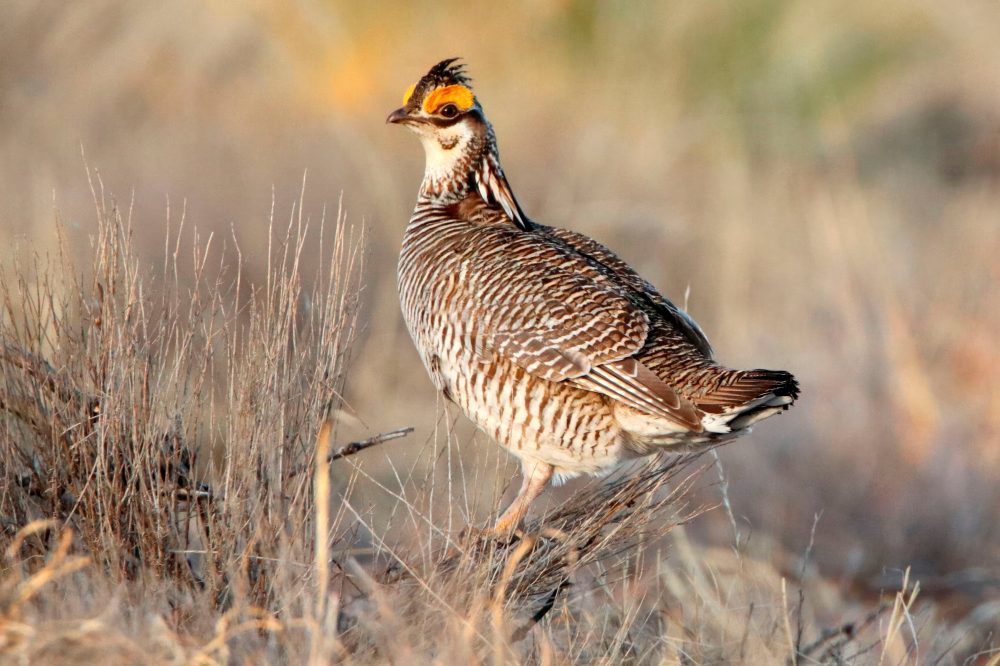

FORT COLLINS, Colo. — Federal protections have been officially removed for a distinctive ground-dwelling bird famous for its intricate courtship rituals across the southern Great Plains, following the Trump administration’s agreement with challenges from three states and oil and cattle industry representatives who contended the species was incorrectly designated for protection.
The U.S. Fish and Wildlife Service made the delisting official on Thursday, cementing a recent court decision that recognized the federal agency had aligned itself with those opposing federal safeguards for the lesser prairie chicken.
A federal judge’s decision in Midland, Texas, effectively terminated Endangered Species Act protections for the bird last summer. These safeguards had required energy companies and cattle ranchers to implement measures to prevent interference with the birds’ natural habitat, particularly their breeding grounds known as leks.
These crow-sized birds previously existed in populations reaching into the millions. Development for energy production and farming has reduced their numbers to approximately 30,000 individuals distributed throughout portions of Colorado, Kansas, New Mexico, Oklahoma and Texas.
Bird enthusiasts are captivated by the males’ springtime courtship performances and their distinctive combination of warbling, clucking and stomping sounds used to draw potential mates. Some Native American tribal dances incorporate these dramatic displays, which are also exhibited by the more prevalent greater prairie chicken.
Federal protection status for the lesser prairie chicken has been established twice in recent history. In 2015, a federal judge in U.S. District Court in Midland overturned the bird’s threatened species designation from the previous year, supporting petroleum industry arguments that adequate protections were already established.
During 2022, the Biden administration designated the lesser prairie chicken as threatened throughout the northern portion of its territory in Colorado, Kansas, Oklahoma and Texas, while classifying a “distinct population segment” in the southern regions of New Mexico and Texas as endangered.
This designation triggered legal action from Kansas, Oklahoma and Texas, along with organizations such as the Permian Basin Petroleum Association and National Cattlemen’s Beef Association.
Following President Donald Trump’s inauguration last year, the Fish and Wildlife Service conducted a new assessment of the bird and concurred with the states and industry groups that there was insufficient basis to separate the lesser prairie chicken into two distinct population groups.
In August, another U.S. District Court judge in Midland approved a Fish and Wildlife Service request to overturn the Biden administration’s lesser prairie chicken listings.
“Fish and Wildlife’s concession points to serious error at the very foundation of its rule,” District Judge David Counts stated in his Aug. 12 decision, which received praise from Texas officials.
Texas energy regulatory representatives, including Texas Railroad Commission spokesperson Bryce Dubee and Texas Land Commissioner Dawn Buckingham, expressed support for the delisting.
“It will ensure American oil and gas production in the Permian Basin remains robust and our economy steadfast,” Buckingham stated in an email response.
Environmental advocates pledged to continue their legal battle.
“It’s shameful that the Trump administration sees fit to sacrifice these magnificent birds for oil and gas industry profit,” Jason Rylander, legal director at the Center for Biological Diversity’s Climate Law Institute, said in a statement. “Lesser prairie chickens may be lost forever without Endangered Species Act protections.”