
WASHINGTON — A federal commission is set to examine President Donald Trump’s ambitious proposal for a massive Triumphal Arch during Thursday’s meeting, as the president pursues multiple construction projects aimed at creating a permanent mark on the nation’s capital.
The president declared on social media that the proposed arch “will be the GREATEST and MOST BEAUTIFUL Triumphal Arch, anywhere in the World” and described it as a “wonderful addition to the Washington D.C. area for all Americans to enjoy for many decades to come!”
The U.S. Commission of Fine Arts, composed of seven members chosen by the Republican president, will also examine his proposal to change the color of the Eisenhower Executive Office Building from gray granite to white during their monthly session.
Additionally, commissioners will consider plans for constructing a below-ground facility designed to handle security checks for White House visitors and guests.
The panel is set to examine design documents for each of the three initiatives. This marks the initial review for both the arch and building color change proposals. The visitor screening facility was previously discussed during the March session. Whether the commission will give approval to any projects during Thursday’s meeting remains uncertain.
Another regulatory body, the National Capital Planning Commission, began evaluating the visitor center proposal last month. Trump’s arch design should reach this commission shortly for their review and potential approval.
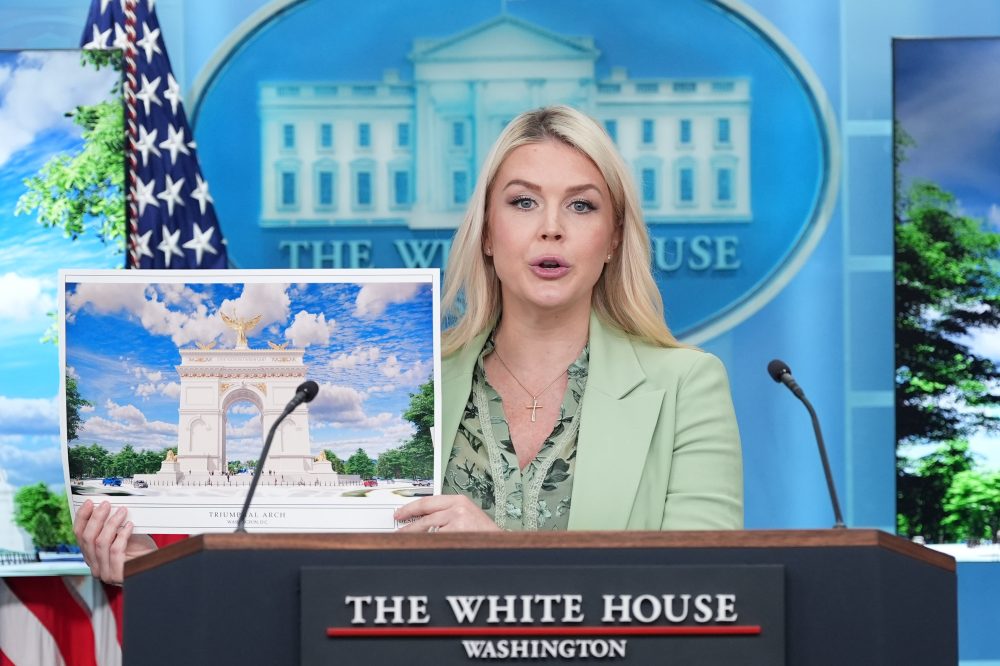
The proposed monument would reach 250 feet in height from ground level to a torch carried by a Liberty-inspired figure crowning the structure. Two eagles would accompany the figure at the top, while four lions would stand guard at ground level — all covered in gold. The inscriptions “One Nation Under God” and “Liberty and Justice for All” would appear in golden letters on both sides of the monument.
Construction would take place on an artificial island under National Park Service management on the Virginia bank of the Potomac River, positioned at Memorial Bridge’s terminus from the Lincoln Memorial in Washington. The proposed arch would tower over the Lincoln Memorial, which measures 99 feet in height.
White House press secretary Karoline Leavitt explained Wednesday that the 250-foot measurement celebrates America’s 250 years of independence.
However, legal challenges have already emerged. Veterans groups and a historian have filed a federal lawsuit seeking to prevent construction, arguing the arch would interfere with the view corridor connecting the Lincoln Memorial and Arlington House at Arlington National Cemetery, along with other objections.
The U.S. Secret Service, Interior Department, National Park Service, and Executive Office of the President aim to begin construction in August on a 33,000-square-foot facility for screening White House tourists and visitors.
The underground center would be constructed beneath Sherman Park, government property located southwest of the White House, creating a more secure environment for processing tour participants and event attendees. The new installation would feature seven processing lanes to improve efficiency and minimize waiting periods.
Authorities hope to have the facility operational by July 2028, which would be six months prior to the conclusion of Trump’s presidency.
Regarding the Executive Office Building, Trump expressed appreciation for its architecture while criticizing its current appearance.
“It’s one of the most beautiful buildings anywhere in Washington,” Trump stated in August. “I think it’s just incredible, but you have to get past the color because the stone they used was a really bad color.”
Commissioners received two options: completely cover the structure in bright white or apply white paint to most areas while preserving the original granite on the exposed lower levels.
According to written documentation from the White House, the structure has received insufficient maintenance since its completion. The administration argues the building’s appearance, style and scale don’t “align visually with the surrounding architecture” and fail to provide “any symbolic cohesion with the White House.”
This painting proposal has also become the target of federal court litigation.
The structure stands adjacent to the West Wing across a driveway. Construction concluded in 1888 following 17 years of building work, and its granite, slate, and cast iron facade represents one of the finest examples of French Second Empire architectural style in America.
Initially, the building served as headquarters for the State, War and Navy departments, and now provides office space for the vice president and National Security Council, among other agencies.
The structure holds designation as a National Historic Landmark and appears on the National Register of Historic Places.