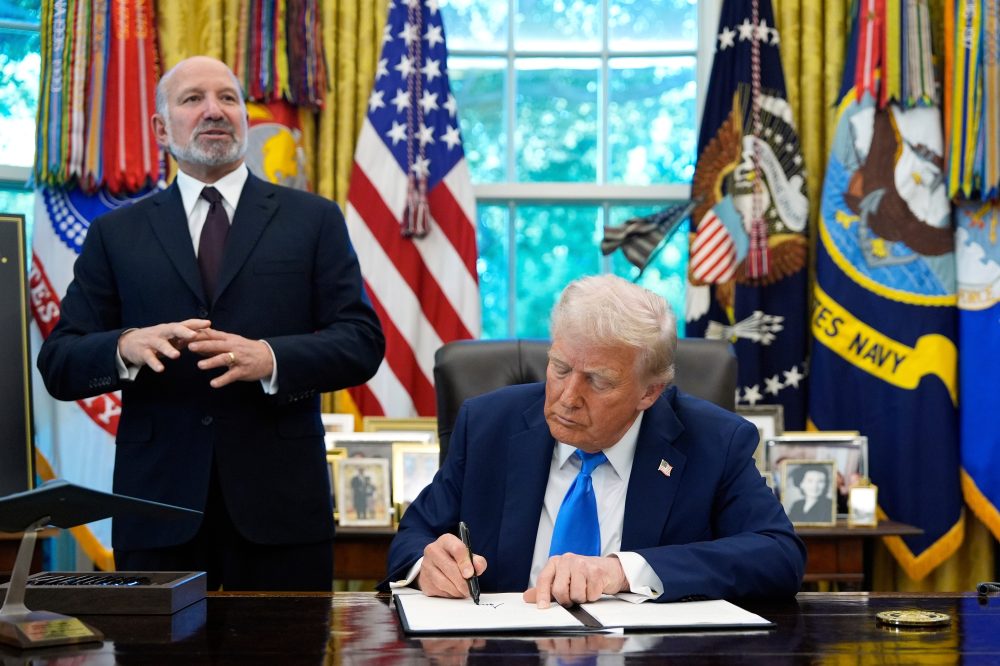

A federal judge has overturned President Donald Trump’s massive increase in H-1B visa application fees, dealing a blow to an administration policy that drove costs from $215 to $100,000 per application.
The ruling on Monday came from a Boston federal court, where Judge Leo Sorokin sided with 20 states challenging the fee hike. Sorokin determined the Trump administration overstepped its legal boundaries by implementing such a dramatic increase without getting Congress to approve it first.
Trump had implemented the steep fee increase last September, claiming it would shield American workers from being displaced by foreign employees willing to accept lower wages. The new cost took effect just one day after being announced, and very few companies have been willing to pay the hefty price tag.
The H-1B visa program, established through the 1990 Immigration Act, allows American employers to bring in foreign workers with specialized technical abilities that are difficult to locate domestically. These temporary work permits are designed for individuals with bachelor’s degrees or equivalent experience in specialized fields.
Each H-1B visa remains valid for three years and can be renewed for an additional three-year period. According to Stephen Brown from Capital Economics, approximately 700,000 people currently hold H-1B visas in the United States, with another 500,000 family members living here as dependents.
The program has become particularly important for technology companies and higher education institutions seeking to fill skilled positions. Research from the Pew Research Center shows that since 2012, at least 60% of approved H-1B applications have been for computer-related positions. However, hospitals, financial institutions, universities and various other employers also utilize the program.
Annual limits restrict new visa issuance to 65,000, with an extra 20,000 available for applicants holding master’s degrees or higher qualifications. These permits are distributed through a lottery system, though certain employers like universities and nonprofit organizations are not subject to these caps.
Program critics argue that H-1B visas harm American workers by bringing in overseas employees who often accept lower compensation than domestic technology workers would demand. Staffing firms like Tata Consultancy Services frequently provide Indian workers to corporate customers. Pew data indicates nearly three-quarters of 2023 approved applicants originated from India.
“To take advantage of artificially low labor costs incentivized by the program, companies close their IT divisions, fire their American staff, and outsource IT jobs to lower-paid foreign workers,” the White House stated in its proclamation last year. A 2020 study by the left-leaning Economic Policy Institute discovered that 60% of H-1B positions certified by the U.S. Labor Department receive wages below the median for those jobs.
Program advocates counter that H-1B visa recipients boost company productivity and work alongside native-born Americans rather than replacing them.
Judge Sorokin ruled the fee violated the Administrative Procedure Act, which controls how federal agencies create and implement regulations. “The Court finds that the Policy imposes a tax on H-1B petitions without the requisite delegation by Congress,” Sorokin wrote, contradicting a previous federal court decision that had supported the fee increase and allowed it to remain in place until its scheduled September expiration.
In the Boston lawsuit, the states contended the policy would hamper their capacity to recruit elementary and secondary school teachers, staff public colleges and universities, hinder academic research, and reduce the number of medical professionals.