
NEW YORK (AP) — Facing sharp criticism from a federal judge over sloppy legal work, the government on Thursday pulled back subpoenas that would have forced three New York Times journalists to testify before a grand jury and reveal who gave them information about President Donald Trump’s Qatar-gifted Air Force One aircraft.
The withdrawals came after a tense courtroom exchange in U.S. District Court between a visibly frustrated Judge Arun Subramanian and attorneys representing the government. The episode is unfolding as the Trump administration aggressively targets news outlets whose coverage it disapproves of, while also working to clamp down on leaks within the federal government.
The government’s decision to back down — in the face of strong legal pushback and a stern rebuke from the bench — represents the latest retreat by the Justice Department from its efforts to force journalists to name their sources before a grand jury. The administration had also recently dropped comparable subpoenas aimed at journalists from The Washington Post and The Wall Street Journal in Virginia.
Judge Subramanian stated that he would have sided with the newspaper and thrown out the subpoenas regardless, because laws and regulations governing journalist subpoenas require that such measures be used only as a last resort during an investigation.
“Subpoenas are the last step, not the first step, but the last step,” the judge declared, pointing to rules designed to guard against First Amendment violations. He said the government’s conduct had turned the law and its own regulations “on its head.”
Subramanian emphasized that when press protections are at stake, the government must exhaust all other avenues for obtaining information before turning to journalist subpoenas. “Subpoenas are not the first thing you do, they are the last thing you do,” he said, growing increasingly pointed in his questioning of government lawyers about the steps they had taken during their investigation.
The judge also warned that the government’s conduct was serious enough that, in a civil case, he would have considered ordering the parties to explain why sanctions should not be imposed.
The hearing took place in open court, despite the Trump administration’s push to keep the legal proceedings under wraps. Attorneys for the Times had challenged the validity of the grand jury subpoenas, as well as separate subpoenas demanding phone records from several Times journalists and some of their family members. Senior Times leadership, including the paper’s managing editor and general counsel, attended Thursday’s hearing as observers.
The demand for phone records raised broader questions about just how far-reaching the Justice Department’s investigation actually is.
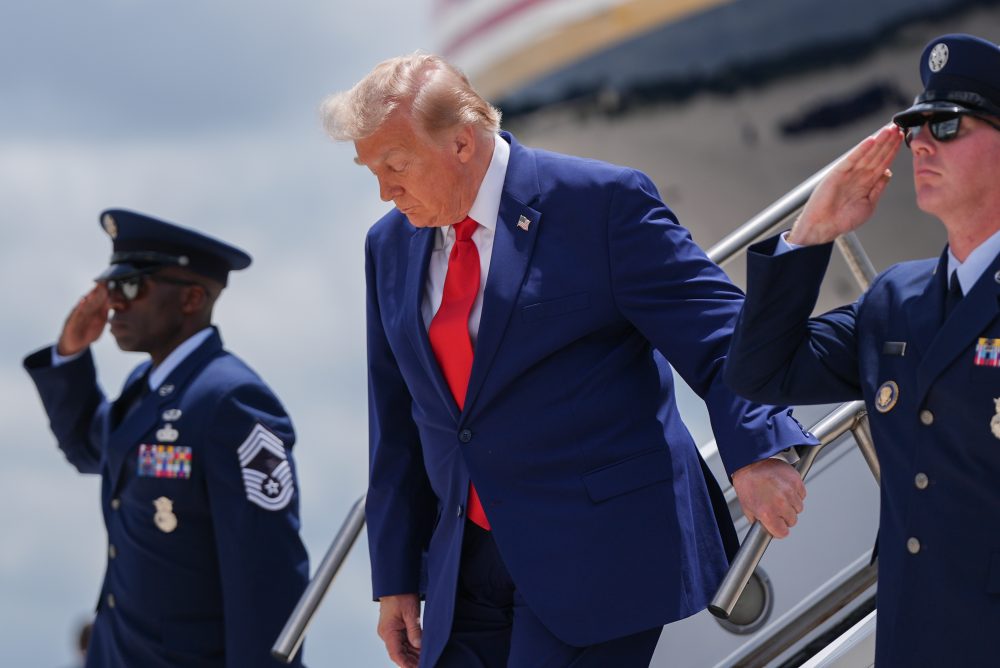
At the center of the controversy is a Boeing 747 jet donated by Qatar, which Trump’s administration spent $400 million to overhaul and equip before it entered service. However, Trump flew on an older Air Force One model when departing a NATO summit in Turkey earlier this month.
The Times, relying on anonymous sources, reported that the Secret Service had pushed for the switch because the newer plane lacked certain advanced security systems found on the older aircraft, including antimissile defenses. Trump pushed back on those security concerns via social media.
In a letter filed with the court several days ago, the Times noted that two of the subpoenas sought records going back to January 1 — months before the newspaper published the articles on July 8 and July 9 that triggered the grand jury subpoenas. The paper argued this broad timeframe suggested the subpoenas may have been designed “to forage for information about the Journalists’ source relationships more broadly.”
The Times also argued that the phone record subpoenas should be thrown out because the government had acted in “bad faith” by bypassing its own rules — failing to give journalists advance notice that their records were being sought and demanding the information “without first conducting any serious investigation.”
The Justice Department defended the grand jury subpoenas, insisting that “reporters are not the targets, those leaking classified information are.” It also maintained that it had followed its own regulations when issuing the subpoenas and had conducted investigative steps beforehand. The department added that while it was permitted to delay notifying journalists about the subpoenas, it chose to inform their attorneys so the subpoenas could be challenged.
Among the additional subpoenas were demands for the phone records of one reporter’s mother and the spouses of two other journalists. Court filings noted that the mother is a mental health professional with confidential client relationships, and that one of the spouses serves as the general counsel of a law firm.