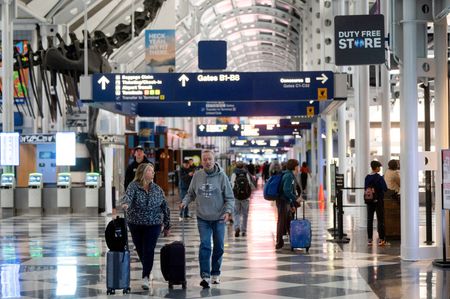

Federal aviation officials will impose flight restrictions at Chicago’s O’Hare International Airport this summer after determining that major carriers have scheduled excessive operations that could overwhelm airport systems.
The Federal Aviation Administration announced Friday it will hold a meeting with airline executives on March 3 to address schedule reductions for the upcoming summer travel period, which begins March 29 and continues until October 25.
Aviation authorities report that carriers have planned more than 3,080 daily flights during peak summer days, representing a substantial jump from the 2,680 daily operations recorded last summer. Officials warn this “increase is significant and would stress the runway, terminal, and air traffic control systems.”
Currently, O’Hare manages approximately 100 departures and 100 arrivals per hour, totaling roughly 2,800 daily operations. The FAA describes this level as workable “given the current infrastructure and staffing resources.”
Federal officials propose maintaining the 2,800 daily operation ceiling throughout the summer season “to prevent large-scale operational disruption while also allowing air carriers to operate within the airport’s demonstrated manageable capacity.”
United Airlines has announced intentions to run 780 daily flights from O’Hare this month, a significant increase from its average of 541 daily flights last year. The carrier plans to boost its mainline departures by 20 percent compared to last summer.
American Airlines revealed in December it would introduce 100 additional daily departures to over 75 destinations from O’Hare in preparation for spring break travel, marking a 30 percent rise in spring departures versus 2025.
American expects to reach 500 daily departures from O’Hare in March, bringing flight levels back to pre-pandemic numbers.
FAA Administrator Bryan Bedford expressed concerns to airline representatives during a private meeting about O’Hare’s capacity to handle the increased flight volume this summer. He referenced similar action taken last year when the agency organized schedule reduction discussions and decreased flights at Newark Airport to address congestion issues.