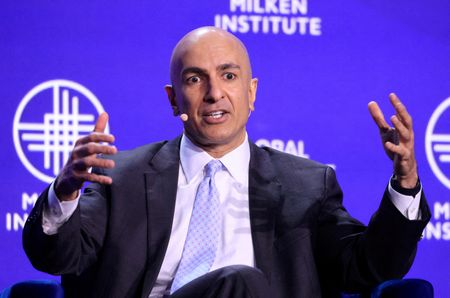

Minneapolis Federal Reserve President Neel Kashkari warned Sunday that the extended conflict with Iran is creating significant economic uncertainty that prevents the central bank from offering clear guidance on future interest rate decisions.
During his appearance on CBS’s “Face the Nation,” Kashkari expressed deep concern about how the war is affecting inflation and economic demand, particularly with the continued blockade of the Strait of Hormuz, which handles one-fifth of the world’s oil and gas shipments.
The conflict started when President Donald Trump and Israel conducted air attacks against Iran on February 28, triggering dramatic increases in energy costs worldwide and worsening America’s already challenging inflation situation.
Due to the unpredictable nature of the war’s economic impact, Kashkari indicated the Fed might need to increase interest rates rather than lower them.
“I don’t feel comfortable signaling that a rate cut is in the cards. You know, we might be in worse scenarios, we might have to go the other direction,” he stated.
Kashkari joined an unusually large group of Fed officials who opposed the central bank’s recent policy statement language at the latest Federal Open Market Committee gathering.
Last Wednesday, the Fed maintained its benchmark interest rate between 3.5% and 3.75% while keeping language suggesting officials still expect the next policy move to be a rate reduction.
Kashkari’s dissent was supported by the heads of the Cleveland and Dallas Fed branches, while Governor Stephen Miran opposed the decision from the opposite direction, favoring an immediate rate cut.
The three regional Fed presidents who dissented supported maintaining current rates, later explaining that interest rates might need adjustment in either direction based on the war’s economic effects.
While the Fed typically overlooks temporary energy price spikes, some officials note the current crisis compounds years of inflation exceeding the central bank’s goals.
This situation could require rate increases to control inflation. However, higher energy costs also reduce consumer spending power, potentially prompting the Fed to maintain steady rates or even cut them to protect employment.
Chicago Fed President Austan Goolsbee described recent U.S. inflation figures as “bad news” during a Saturday television interview. The personal consumption expenditures price index showed headline inflation running at 3.5% annually through March, well above the Fed’s 2% objective.
Leadership changes at the Fed add another layer of uncertainty, with Kevin Warsh expected to replace current Chairman Jerome Powell when his term expires this month. While Warsh suggested support for lower rates during his confirmation process, current events and Fed official sentiment may complicate those plans.
The U.S. and Israel halted their bombing operations against Iran a month ago, but negotiations to end the conflict remain stalled, raising concerns about broader global economic consequences.
Kashkari expressed pessimism about a quick resolution, noting that even the most favorable outcome would mean prolonged disruptions.
“I talked to the CEO of a global company headquartered in Minnesota that has supply chains all around the world just last week, and they have estimated that even if the strait reopened today, it probably takes six months for their supply chains to return to something like normal,” Kashkari explained.
Treasury Secretary Scott Bessent offered a more optimistic perspective on Fox News’ “Sunday Morning Futures,” predicting energy prices would decline once the conflict ends.
Bessent said the war and other oil market developments “gives me a lot of optimism that oil prices on the other side of this conflict are going to be much lower than they were going in, or at the beginning of the year, or at any point in 2020-2025.”
Bessent noted that futures markets anticipate lower energy costs later this year and that Iran has struggled to effectively charge tolls on ships passing through the Strait of Hormuz, largely due to the U.S. naval presence blocking Iranian operations.
He characterized the U.S. as a “big winner” in the energy crisis due to its oil export capabilities, limited only by shipping infrastructure capacity.
Barclays analysts warned Friday that while energy price increases have been relatively moderate so far, this could change rapidly. Additional supply disruptions could push fuel inventories to dangerously low levels, they noted, stating “when such tipping points are reached, prices could jump further.”