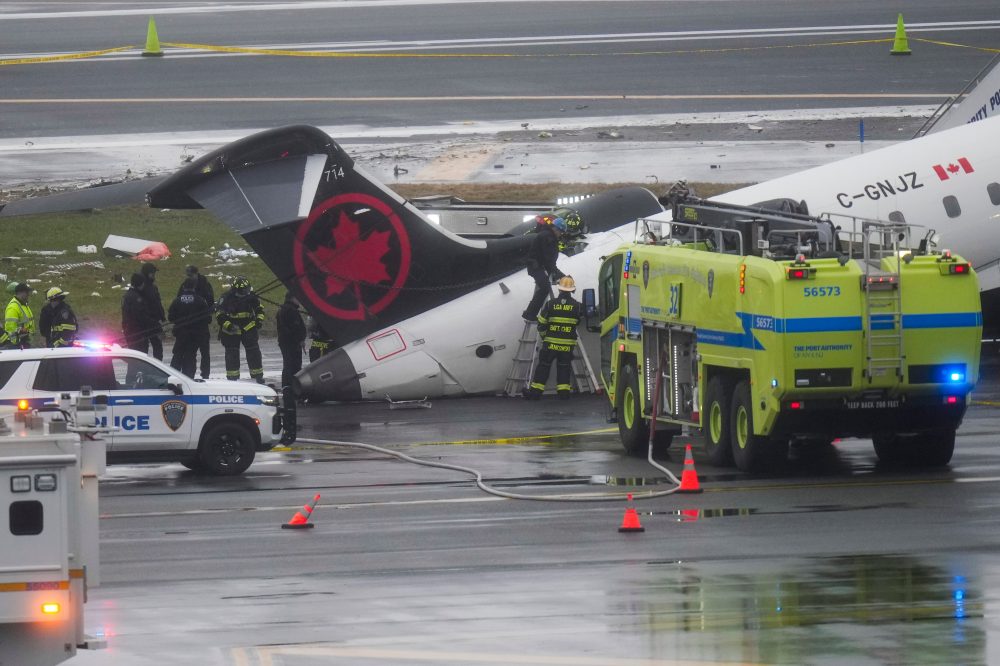

Air traffic controllers at LaGuardia Airport were managing a complex nighttime emergency when tragedy struck – an Air Canada aircraft collided with a fire truck on the runway, killing both pilots of the regional jet from Montreal.
The emergency began when a United Airlines plane had to abort takeoff twice due to a strange smell coming from the aircraft’s rear section. With no gate available for the troubled plane, controllers and the pilot engaged in urgent radio communications as officials scrambled to find solutions. Audio recordings reveal the escalating crisis as the cockpit reported increasing concern.
“Flight attendants in the back are feeling ill because of the odor,” the pilot can be heard saying. “We will need to go into any available gate at this time.”
Unable to find parking space for the aircraft, controllers sent emergency vehicles to the plane’s location and arranged for stairs to evacuate passengers while continuing to coordinate other airport operations. Then urgent radio traffic broke through: “Stop, stop, stop, Truck 1. Stop, stop, stop.”
Shortly afterward, the incoming Air Canada flight touched down and struck one of the fire trucks as it moved across the runway toward the United plane. Both pilots of the regional aircraft died in the late Sunday collision.
This tragic incident has brought renewed attention to the challenges facing America’s air traffic control system, which has struggled for years with personnel shortages, exhausting work schedules, aging technology, and disruptions from government shutdowns.
Approximately 40 passengers and crew aboard the Air Canada aircraft, plus two occupants of the fire truck, required hospital treatment, with some sustaining serious injuries. Medical officials reported that most patients were discharged by Monday morning.
As investigators begin examining what caused the runway collision, aviation specialists note the incident illustrates the complex environment controllers must navigate daily – coordinating arriving and departing flights, aircraft movement between terminals and runways, and various ground vehicles from emergency responders to maintenance crews.
“In the best of times, air traffic controls and air traffic controllers are under a great deal of stress,” said Alan Diehl, a former federal crash investigator. “These are people with very high cognitive levels. They’re carefully selected, extensively trained. And one of the problems is there is a shortage of 3,000 of them in this country right now.”
During a Monday press briefing, Transportation Secretary Sean Duffy, whose agency oversees the Federal Aviation Administration, refused to specify how many controllers were working at LaGuardia when the Canadian aircraft and fire truck carrying Port Authority of New York and New Jersey officers collided. However, he characterized the airport’s control tower as typically “well staffed” and slightly below its goal of 37 controllers. He noted the facility currently employs 33 controllers, with seven additional trainees.
Duffy received confirmation as President Donald Trump’s transportation secretary one day before an Army helicopter and commercial aircraft crashed over the Potomac River near Ronald Reagan Washington National Airport, resulting in 67 deaths. Since assuming office, he has committed to improving air controller staffing levels and modernizing traffic control systems.
The FAA has experienced chronic understaffing for years. Air traffic controllers regularly work extended hours and six-day schedules while operating aging equipment.
Former FAA air traffic control director Mike McCormick noted that while LaGuardia is “not a control tower that has perennial staffing problems,” the overnight period when the accident happened would normally have lighter staffing. Investigators plan to review local controllers’ overtime hours and consecutive work days to assess whether exhaustion might have contributed.
Such inquiries are routine following crashes. John Cox, CEO of aviation consulting firm Safety Operating Systems, said National Transportation Safety Board investigators would carefully study human factors related to tower operations.
“The staffing issue and the controller’s work schedule will certainly be something that they look at and only then can we determine if it’s a staffing or fatigue issue,” Cox said.
The National Air Traffic Controllers Association issued a Monday statement highlighting the profession’s responsibilities.
“Air traffic controllers work every day to keep passengers and cargo moving safely and efficiently,” the statement said. “We serve quietly, but moments like this remind us of the responsibility we carry — and how deeply it stays with us when tragedy occurs.”
About 20 minutes following the crash, a controller appears to accept responsibility.
“We were dealing with an emergency,” he said, “and I messed up.”
Workforce pressures have intensified over recent years. During a record 43-day U.S. government shutdown last fall, and a 35-day closure spanning December 2018 and January 2019, controllers had to continue working without compensation, prompting some to resign or retire early. Simultaneously, training and recruitment programs were suspended or delayed.
Since certification requires years to complete, experts, union representatives, and agency leaders have cautioned that consequences would persist long after funding restoration, worsening staff losses and complicating recruitment efforts. Shutdowns also damage workplace morale, Diehl explained.
Nevertheless, industry leaders highlight ongoing efforts to modernize controller technology and equipment. Chris Sununu, CEO of airline trade organization Airlines for America, said Congress has allocated billions for upgrading obsolete technology and enhancing the system.
“I think the air traffic control system has been under a lot of strain for 30 years,” Sununu said. “And that’s why Congress has put billions of dollars behind rebuilding the entire system. And we’ve already seen some pretty good successes.”
He cited the shift from paper flight progress strips to electronic systems at numerous airports, plus hundreds of new radar installations nationwide. A modernized traffic flow system with improved backend technology is scheduled for deployment later this year, he said.
“By and large, the air traffic controllers work really, really well with a very antiquated system and every day that goes by the system is now getting upgraded,” Sununu said.