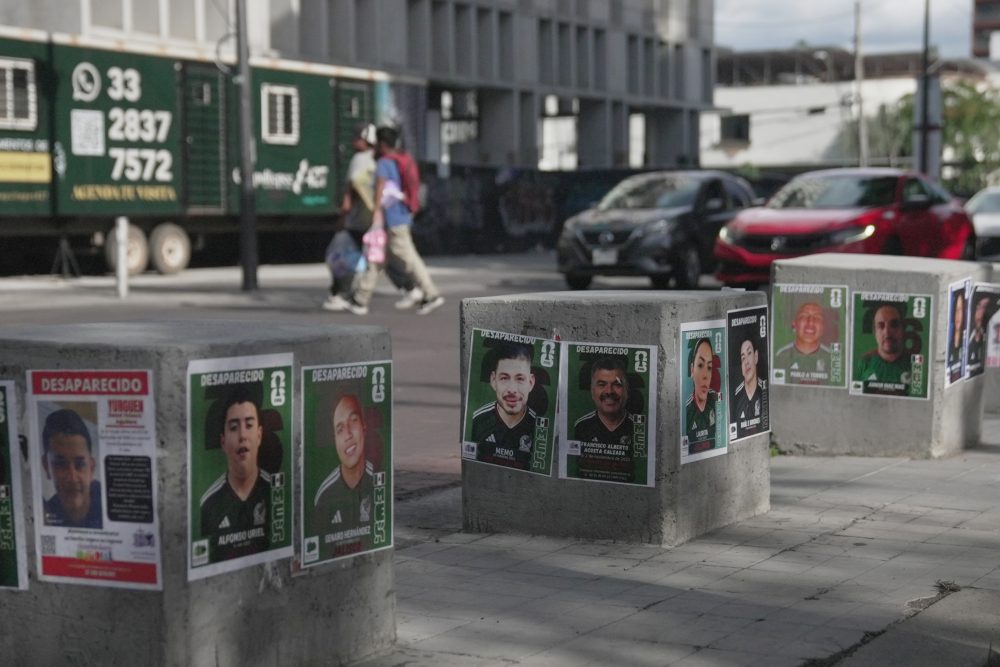

GUADALAJARA, Mexico — The images look familiar at first glance: young men dressed in Mexico’s green national team jersey, a FIFA-style logo in the corner, the layout mimicking the collectible Panini stickers that soccer fans around the world trade during every World Cup tournament.
But posted across downtown Guadalajara — taped to concrete benches, utility poles, and walls — each face carries a single word above it:
“DESAPARECIDO.”
Missing.
One poster features Christian Emmanuel Rivera, who disappeared in August 2023. Another shows Jaime Adrián Ramírez, gone since September 2020.
While Guadalajara serves as a host city for the 2026 World Cup, families desperately searching for missing relatives have turned one of soccer’s most recognizable images into a powerful awareness campaign. Their goal: to make Mexico’s 135,000 missing people visible to the enormous number of international visitors now filling the city’s streets.
The effort was organized by Luz de Esperanza, a search collective operating in the western state of Jalisco — the state with the highest number of disappearances in all of Mexico, with more than 16,000 people listed as missing in its official registry. Members of the collective say other groups have already reached out, interested in using the same approach.
“This is our way of drawing attention to the fact that we miss our children, that they are absent from our lives,” said María de Jesús Solís, 57, whose son Jaime Adrián vanished nearly six years ago.
Solís wears a pendant with her son’s photograph around her neck every day.
“This is my boy,” she said. “The difference is that now he’s wearing the World Cup shirt.”
Throughout Mexico, relatives of the missing have banded together into search collectives that comb through fields, ravines, abandoned buildings, and hidden graves — conducting investigations that families say the government has repeatedly failed to carry out on its own.
Members of Luz de Esperanza have fanned out across Guadalajara nearly every Sunday since 2021, distributing stacks of missing-person flyers in the hope that someone will recognize a face or offer a useful tip. The group refers to this ongoing effort as a “search for the living.”
This month, the collective swapped many of those standard flyers for hundreds of the new World Cup-inspired posters.
For Solís, the campaign reflects deep frustration over what she sees as misplaced priorities.
“We’re not against the World Cup,” she said. “But we’re against the excessive spending.”
She noted that authorities poured millions of dollars into preparing the city for the tournament, while search collectives frequently pay out of their own pockets for water, food, and transportation during their searches.
“The government is showing a beautiful face to the world,” Solís said. “But if you look around, the city is full of posters of our children.”
On a recent morning, Solís and Guadalupe Rivera joined fellow members of Luz de Esperanza at an abandoned property on the edge of the city. The women moved through darkened rooms and into a cluttered backyard filled with garbage, some carrying metal probes used to test the ground for signs of hidden graves.
Rivera pushed a steel rod into the soil as others combed through the property. Her son, Christian Emmanuel, disappeared nearly three years ago. She joined the collective almost right away.
“I thought that if I joined a group, the search would move faster,” she said. “Time keeps passing, and I’m still searching.”
Rivera takes part in searches for human remains to support other grieving families — but she holds onto the hope that she will never find her own son that way.
“I want to find him alive,” she said. “I want him to show up at my front door.”
The idea for the World Cup campaign, Rivera explained, came from a straightforward observation: if soccer is dominating every conversation in the city, perhaps it could also create an opening for people to notice those who are no longer there.
The members of the collective are sports fans themselves, Rivera said.
“When it’s the World Cup, even if you’re not really a fan, you sit down at home and watch it with your family,” she said. “But our family isn’t whole anymore.”
Some residents have welcomed the posters, Rivera said, while others have pushed back, arguing that the World Cup should be a time for celebration rather than a reminder of violence and grief.
But the families say they have no choice but to keep finding new ways to make their missing loved ones visible to the world.
“The government never pays attention to us,” Rivera said. “So we want to see whether, this way, the world will.”