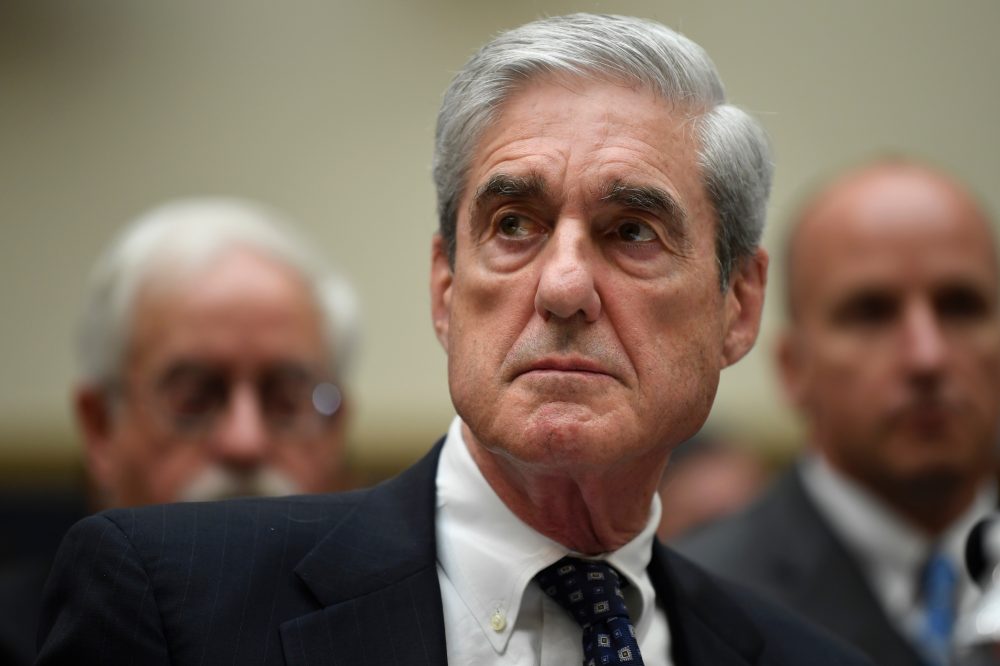

WASHINGTON — Robert S. Mueller III, the former FBI chief who reshaped America’s top law enforcement agency following the September 11 attacks and subsequently led the special counsel investigation into Russian interference in Donald Trump’s 2016 presidential campaign, passed away Friday evening. He was 81 years old.
Mueller’s family announced his passing in a Saturday statement, saying “With deep sadness, we are sharing the news that Bob passed away” on Friday night. “His family asks that their privacy be respected.”
During his time leading the FBI, Mueller immediately began restructuring the agency’s core mission to address 21st-century law enforcement challenges. He started his 12-year leadership role just seven days before the September 11 terrorist attacks, working under presidents from both major political parties after being appointed by Republican President George W. Bush.
The devastating attacks immediately transformed the bureau’s primary focus from investigating domestic crimes to preventing terrorist activities — a change that created an enormously challenging standard for Mueller and federal officials: stopping 99 out of 100 terrorist schemes wasn’t sufficient.
Years later, Mueller returned to public service as the Justice Department’s special counsel examining whether Trump’s campaign unlawfully collaborated with Russia to influence the 2016 election results.
Trump responded to news of Mueller’s death on social media, writing: “Robert Mueller just died. Good, I’m glad he’s dead.” The Republican former president continued, “He can no longer hurt innocent people!”
The FBI has not yet provided a response to requests for comment.
Mueller served as the FBI’s second-longest director in the agency’s history, trailing only J. Edgar Hoover. He remained in position until 2013 after accepting Democratic President Barack Obama’s invitation to extend his service beyond the standard 10-year term.
Following several years working in private legal practice, Deputy Attorney General Rod Rosenstein recruited Mueller back to government service to oversee the Trump-Russia investigation as special counsel.
Mueller’s serious expression and reserved personality reflected the gravity of his assignment, as his investigative team spent almost two years quietly pursuing one of the Justice Department’s most significant yet controversial inquiries. Throughout the investigation, he avoided press conferences and public events, staying silent despite criticism from Trump and his allies, which created an air of intrigue surrounding his work.
Mueller’s investigation resulted in criminal charges against six Trump associates, including his campaign manager and initial national security advisor.
His comprehensive 448-page report, published in April 2019, documented extensive communications between Trump’s campaign and Russian officials but stopped short of alleging criminal conspiracy. The report detailed concerning information about Trump’s attempts to control and potentially terminate the investigation, though Mueller chose not to determine whether Trump violated the law, partly due to Justice Department guidelines prohibiting charges against sitting presidents.
In what became the report’s most notable language, Mueller specifically stated: “If we had confidence after a thorough investigation of the facts that the president clearly did not commit obstruction of justice, we would so state. Based on the facts and the applicable legal standards, we are unable to reach that judgment.”
The ambiguous findings failed to deliver the decisive blow against the administration that Trump critics anticipated, and didn’t spark sustained Democratic efforts to impeach the president — although he later faced impeachment and acquittal on different charges involving Ukraine.
The uncertain conclusion allowed Attorney General William Barr to offer his own interpretation. Barr and his team concluded that Trump hadn’t obstructed justice, leading to private disagreements between Barr and Mueller over Barr’s four-page summary letter, which Mueller believed inadequately represented his report’s critical findings.
Mueller disappointed Democrats during a much-anticipated congressional hearing about his report, providing brief, single-word responses and appearing unsure during his testimony. He frequently seemed unclear about details from his investigation, delivering a far less commanding performance than many expected from someone with Mueller’s distinguished Washington reputation.
In subsequent months, Barr openly disagreed with the Russia investigation’s foundation, working to dismiss false-statement charges Mueller had filed against former national security advisor Michael Flynn, despite Flynn’s guilty plea.
Mueller’s role as special counsel represented the pinnacle of his government career.
His FBI leadership was shaped by the September 11 attacks and their consequences, as the bureau received extensive new surveillance and national security authority while working to confront al-Qaeda and disrupt terrorist plans before they could be executed.
This represented a new approach for an FBI traditionally focused on investigating crimes after they occurred.
When Mueller became FBI director, he told a group of attorneys in October 2012: “I had expected to focus on areas familiar to me as a prosecutor: drug cases, white-collar criminal cases and violent crime.”
Instead, “we had to focus on long-term, strategic change. We had to enhance our intelligence capabilities and upgrade our technology. We had to build upon strong partnerships and forge new friendships, both here at home and abroad.”
The FBI reassigned 2,000 of its 5,000 criminal program agents to national security work in response.
Looking back, the transformation proved successful, though Mueller acknowledged problems at the time. Near the end of his tenure, Mueller recalled “those days when we were under attack by the media and being clobbered by Congress; when the attorney general was not at all happy with me.”
Among the challenges: The Justice Department’s inspector general discovered the FBI violated legal procedures to obtain thousands of phone records for terrorism investigations.
Mueller established a policy preventing FBI participation in abusive interrogation methods against suspected terrorists, but this policy wasn’t properly communicated throughout the organization for nearly two years. Attempting to modernize the FBI’s operations, the bureau spent more than $600 million on two computer systems — one running 2½ years behind schedule and its predecessor only partially finished before being abandoned when consultants deemed it outdated and problematic.
For the nation’s premier law enforcement organization, it was a challenging journey through difficult circumstances.
However, there were numerous achievements, including prevented terrorist attacks and high-profile criminal prosecutions like the case against fraudster Bernie Madoff. The Republican also maintained a nonpartisan reputation, nearly resigning during a dispute with the Bush administration over a surveillance program he and his successor, James Comey, considered illegal.
Mueller notably supported Comey, then deputy attorney general, during a dramatic 2004 hospital confrontation over federal surveillance regulations. The two officials positioned themselves beside the sick Attorney General John Ashcroft to prevent Bush administration officials from circumventing proper procedures to obtain Ashcroft’s approval for reauthorizing a secret warrantless surveillance program.
In an unusual demonstration of trust, Congress approved a two-year extension for Mueller to continue his position at the Obama administration’s request.
Mueller was born in New York City and raised in an affluent Philadelphia suburb.
He earned an undergraduate degree from Princeton University and a graduate degree in international relations from New York University. He then enlisted in the Marines, serving three years as an officer during the Vietnam War. He commanded a rifle unit and received a Bronze Star, Purple Heart, and two Navy Commendation Medals. After military service, Mueller obtained a law degree from the University of Virginia.
Mueller became a federal prosecutor and enjoyed handling criminal cases. He advanced rapidly through leadership positions in U.S. attorneys’ offices in San Francisco and Boston from 1976 to 1988. Later, as director of the Justice Department’s criminal division in Washington, he supervised numerous prominent prosecutions that achieved convictions against diverse targets including Panamanian leader Manuel Noriega and New York crime leader John Gotti.
In a surprising mid-career decision that astonished colleagues, Mueller left a position at a respected Boston law firm to join the homicide unit of the U.S. attorney’s office in Washington. There, he worked as a senior prosecutor handling numerous unsolved drug-related killings in a violence-plagued city.
Mueller was motivated by a lifelong dedication to the detailed work of developing successful criminal prosecutions. Even as FBI director, he would examine investigation specifics, including major cases and smaller ones, sometimes surprising agents who unexpectedly received calls from the director.
“The management books will tell you that as the head of an organization, you should focus on the vision,” Mueller once explained. But “for me there were and are today those areas where one needs to be substantially personally involved,” particularly regarding “the terrorist threat and the need to know and understand that threat to its roots.”
Two terrorist incidents happened near the end of Mueller’s leadership: the Boston Marathon bombing and the Fort Hood shooting in Texas. Both events deeply affected him, as he acknowledged in an interview two weeks before leaving office.
“You sit down with victims’ families, you see the pain they go through and you always wonder whether there isn’t something more” that could have been done, he said.