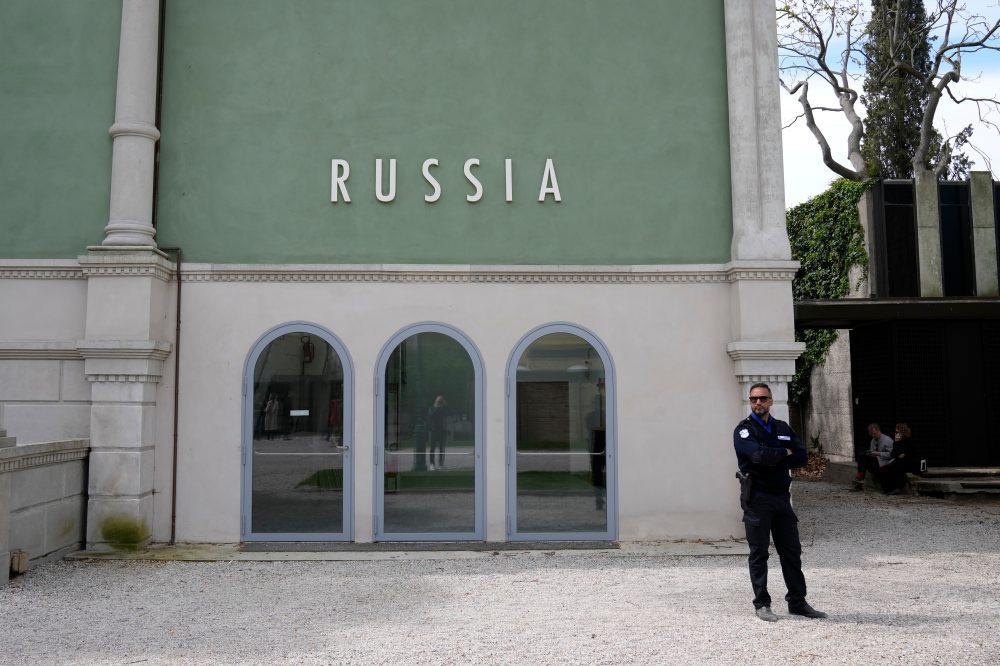

The European Union announced Thursday it is withdrawing 2 million euros ($2.4 million) in financial support from the Venice Biennale after Russia decided to participate in the renowned contemporary art exhibition for the first time since launching its invasion of Ukraine in 2022.
European Commission spokesperson Thomas Regnier confirmed Thursday that officials have notified the Biennale foundation about the funding withdrawal. The art organization now has 30 days to justify its choice to welcome Russia back to the 61st edition of the show, which opens May 9.
“We are strongly condemning the fact that the Fondazione di Biennale has allowed for the Russian Pavilion to open again,” Regnier stated.
Russian artists pulled out of the 2022 exhibition following their country’s attack on Ukraine, and Russia did not mount a display in 2024, instead allowing Bolivia to use its permanent pavilion space. The last time Russia took part in the International Art Exhibition was 2019.
In defending its position, the Biennale foundation issued a statement explaining that it “does not have the authority to prevent a country from participating. Any country recognized by the Italian Republic may request to participate.”
The organization noted that because Russia owns its pavilion, constructed in 1914 within the historic Giardini grounds, it only needed to notify organizers of its intention to take part.
“La Biennale di Venezia rejects any form of exclusion or censorship of culture and art. The Biennale, like the city of Venice, continues to be a place of dialogue, openness and artistic freedom, encouraging connections between peoples and cultures, with the constant hope for an end to conflicts and suffering,” the foundation stated.
The Venice Biennale stands as the globe’s most established and significant contemporary art showcase, featuring a central exhibition alongside individual country pavilions that participating nations curate independently. This year’s event will include presentations from 99 countries, with 29 housed in the Giardini and others distributed throughout the Arsenale and various city locations.
The Biennale has previously resisted calls to ban other nations, including Iran and Israel, from taking part in the exhibition.