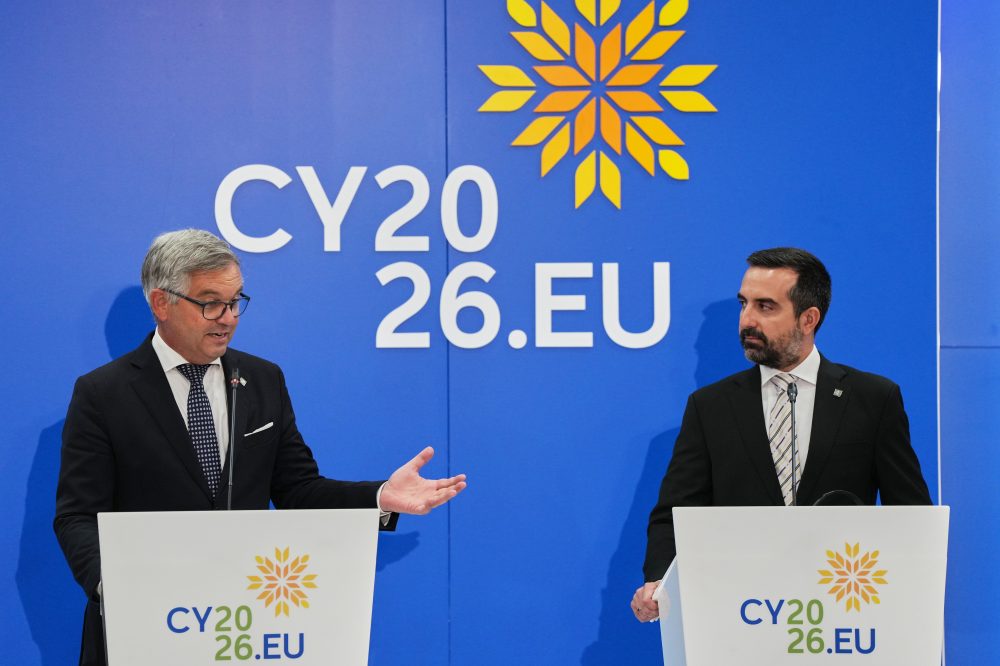

NICOSIA, Cyprus (AP) — European Union officials will oversee any agreements establishing return centers in countries outside the EU to ensure rejected asylum seekers transferred there maintain their legal protections, the bloc’s migration commissioner announced Friday.
Magnus Brunner stated that international organizations including the International Organization for Migration and the U.N. refugee agency will review any such agreements to guarantee adherence to legal protections.
“Human rights standards and international law is non-negotiable,” Brunner stated during a press briefing at a gathering of EU migration ministers marking the launch of the bloc’s updated migration and asylum framework.
This return center concept represents one element of the new framework that has drawn criticism from human rights organizations, who worry these facilities might become permanent detention sites filled with unsuccessful asylum applicants trapped in prolonged legal uncertainty.
On Friday, Greece confirmed it joins four other EU nations — Germany, Austria, Denmark and the Netherlands — in discussions with African nations about establishing these return facilities within their borders.
The Greek Migration Ministry reports that these five European countries plan to finalize agreements with the unidentified third nations this year, allowing the return centers to begin operations in 2027.
Brunner declined to identify which third countries are under consideration for hosting the return facilities, instead referring questions to the five nations conducting the discussions.
“We created the rules, we create the basis, but it’s up to the member state to negotiate agreements if they want to,” the EU commissioner stated. He noted that EU policy changes are showing results, with irregular migrant arrivals dropping 90% along the Western Balkan route during the past three years, plus a 67% decrease from Turkey to Greece’s Aegean islands during the first four months of this year.
Cypriot Deputy Minister for Migration Nicholas Ioannides announced the Mediterranean island country plans to participate in return hub discussions after its six-month EU leadership period concludes July 1.
Ioannides dismissed concerns from human rights organizations regarding the bloc’s updated migration and asylum framework, which critics claim might prevent legitimate asylum seekers from obtaining protection through accelerated evaluations.
He stated these organizations “disagree with the gist of this project, with the whole architecture,” noting that the EU’s focus was implementing updated regulations to avoid being unprepared for another large-scale migrant influx similar to 2015.
Brunner defended the updated framework as offering protection “to actually those in need” through “clearer and more effective rules” that target illegal migration pathways and human traffickers.
Additionally on Friday, Cyprus revealed an agreement with Lithuania regarding the relocation of migrants who received international protection to the Baltic nation.