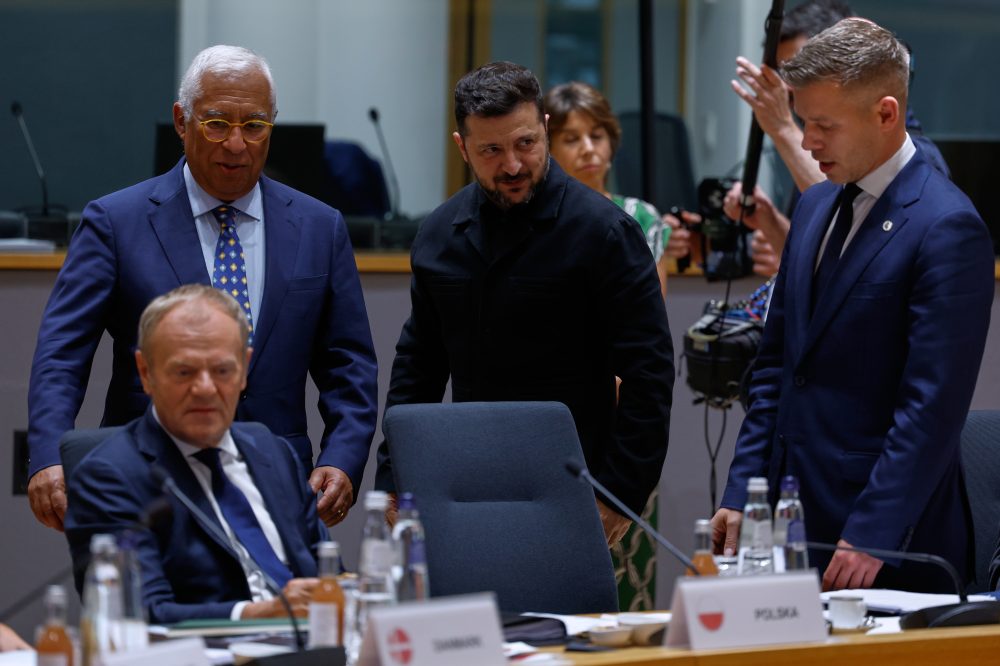

BRUSSELS (AP) — After a two-day summit, European Union leaders have left Brussels without reaching an agreement on whether to establish an informal communication line with the Kremlin, several of them acknowledged on Friday.
European Council President António Costa, who led the summit, had already taken steps through his office to make contact with Russia. He proposed sending a senior official to initiate that connection. Costa was clear that his intention was not to act as a mediator or to create a separate negotiating process running alongside the one currently being led by the United States — a process that itself has shown little sign of progress.
For months, European capitals have been debating whether to appoint someone to facilitate talks with Russia in hopes of jumpstarting a peace process. That idea has largely been dismissed, however, with many EU members skeptical that Russian President Vladimir Putin would come to the table regardless.
Rather than pursuing direct talks, the bloc’s 27 member nations have shifted their focus toward defining what concessions Russia must offer in exchange for any lasting peace agreement.
Czech Prime Minister Andrej Babiš told reporters after the overnight session that the leaders had not resolved their disagreements. “Europe is unable to agree even on whether there will be negotiations or who will lead them,” he said.
Irish Prime Minister Micheál Martin took a more supportive stance toward Costa’s outreach effort. “Opening up a channel is not a mistake in our view, and I trust António Costa,” he said. Martin also stressed that any formal negotiations would need to center on Ukraine and Russia directly, adding, “there are no indications that Russia is coming to the table at all.”
Putin has been working to sideline both Europe and Ukraine from discussions about the conflict’s future, preferring to engage directly with the United States. However, the Kremlin said Friday it would welcome dialogue with European leaders — provided Europe drops what it described as a confrontational posture.
Kremlin spokesperson Dmitry Peskov said, “We are ready for contact, we were not the ones who initiated cutting such contacts, terminating them completely. If forces emerge that realize the need to resume dialogue with Russia, not to lecturing it or, worse, to issue ultimatums … then President Putin and the Russian side would certainly be open to it.”
As leaders departed the summit, Belgian Prime Minister Bart De Wever made light of the situation, joking that Costa himself should be sent to Moscow. “I was just talking about you, António,” De Wever said with a laugh while shaking Costa’s hand. “I was full of praise, saying you are the only one who can represent us and that we will send you to Moscow.”
Not everyone was amused by the idea of Europe playing a neutral role. Margus Tsahkna, the foreign minister of Estonia — a country on the EU’s eastern border that has experienced drone incursions and was once under Soviet occupation — argued that “Europe must not assume the role of a neutral mediator.” Instead, he said, the EU should be strengthening Ukraine’s hand in order to “force the Kremlin into serious negotiations.”