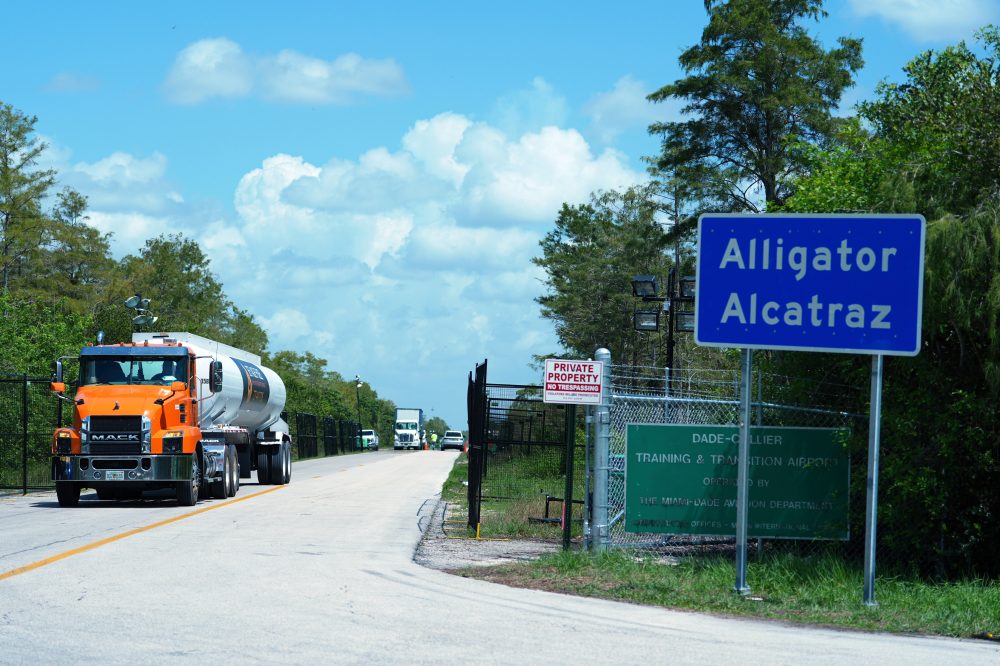

ORLANDO, Fla. — Conservation organizations requested Tuesday that a federal appeals court remove its temporary suspension of a ruling that would force Florida officials to shut down an immigration detention facility located deep within the Everglades, dubbed ‘Alligator Alcatraz.’
The Everglades detention center continues operating and housing immigrants because the appeals court paused the closure order in early September, accepting arguments from Florida officials and the Trump administration that the state hadn’t yet sought federal reimbursement and therefore didn’t need to comply with federal environmental regulations. State leaders established the detention facility last summer as part of President Donald Trump’s immigration enforcement efforts.
During oral arguments at a Miami courthouse, three appeals court judges focused their questions on determining the extent of federal oversight at the state-constructed facility and when environmental assessments become mandatory under federal law. The judges provided no timeline for their decision.
Jesse Panuccio, representing the Florida Department of Emergency Management, argued before the judges that federal funding and federal oversight of the facility were both necessary conditions for federal environmental law to take effect, and that federal agencies lacked control over the state-operated detention center.
In late September, Florida received notification that FEMA had granted $608 million in federal funding for the center’s construction and operations.
‘You need both,’ Panuccio stated. ‘Even with funding, I don’t think that would follow because they don’t have federal control.’
A lawyer representing the conservation groups argued that the law mandating environmental review covered the facility since the Department of Homeland Security had authorized the funding and immigration enforcement falls under federal, not state, jurisdiction.
‘What is different about this property is that immigration is constitutionally a federal function,’ said Paul Schwiep, representing the Friends of the Everglades and the Center for Biological Diversity. ‘The state has no role.’
A federal district judge in Miami ordered in mid-August that the facility cease operations within two months because officials had not conducted a required environmental impact assessment under federal law. That judge determined that a reimbursement decision had already been finalized. The appeals court suspended that order following an appeal.
This environmental lawsuit represents one of three federal court challenges targeting the Everglades facility since it began operations. In another case, a detainee claimed that Florida agencies and private contractors hired by the state lacked authority to run the center under federal law. That challenge concluded when the immigrant detainee who initiated the lawsuit agreed to deportation from the United States.
In the third case, a federal judge in Fort Myers, Florida, determined that the Everglades facility must give detainees improved access to their legal counsel, including private, unmonitored, and unrecorded outgoing calls to attorneys.