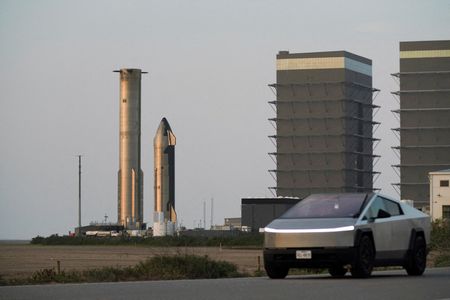

Elon Musk’s space exploration company is targeting an astronomical $1.75 trillion price tag for its upcoming public stock debut, according to financial analysts who examined the numbers behind what could become a record-breaking initial public offering.
The massive valuation would instantly place the rocket and satellite company among America’s top six most valuable publicly traded corporations, surpassing established giants like Meta Platforms and Berkshire Hathaway in market worth.
Despite the stratospheric pricing that far exceeds typical Wall Street benchmarks, investor appetite appears insatiable. The planned stock offering could generate $75 billion or more in capital, potentially setting new IPO records. Some eager investors are already purchasing shares through complicated private market deals just to secure early ownership stakes.
“It has almost no comparable listed peer to benchmark a valuation off of and would likely come at a significant premium to anything else that is listed in the space tech sector, given its size and market leadership,” said Samuel Kerr, global head of equity capital markets at Mergermarket.
The company’s financial foundation rests primarily on its thriving Starlink satellite internet service, which now serves more than 10 million customers worldwide, alongside a rocket launch operation that has revolutionized space access. The reusable Falcon 9 rocket, which achieved the first successful controlled landing after an orbital mission in December 2015, completed a record-breaking 165 launches during 2025.
Investment professionals are also factoring in Musk’s proven ability to transform entire industries, betting that current experimental ventures like the Starship deep-space rocket, artificial intelligence subsidiary xAI, and planned data center satellites will eventually generate substantial returns.
“This is a set of proven juggernaut, mega-cap businesses,” said Daniel Hanson, portfolio manager at Neuberger’s Quality Equity Fund, an existing SpaceX investor with close to 10% of its $2.6 billion in assets allocated to the company. “The launch business and the Starlink business are proven, here and now. xAI is about optionality,” he said, referring to businesses that could add value over time as they benefit from long-term shifts toward AI, data and global connectivity.
The space company maintains an overwhelming advantage in deploying low-Earth orbit satellites for its Starlink internet service, which generates between 50% and 80% of total company revenues and operates profitably. However, several major initiatives remain in development stages, including the delayed Starship program designed for lunar and Mars exploration, plus ambitious plans to deploy up to one million data-processing satellites connected to its currently unprofitable AI division.
According to PitchBook analyst Franco Granda, justifying the enormous valuation will require “investors will need to keep strict tabs on the timing of Starship coming to market and on the ramp-up of Starlink service direct to cellphones.”
The company’s operational tempo exceeds all competitors, launching rockets approximately every two days – faster than any government space program or private competitor in history. This rapid launch capability provides crucial advantages in a market where limited launch access has become a major obstacle for rivals like Amazon, which is developing competing satellite networks.
“It’s a one-of-a-kind for a start,” said Mark Boggett, CEO of venture capital fund Seraphim Space.
Financial data exclusively obtained by Reuters shows the company generated approximately $8 billion in operating profits and between $15-16 billion in revenues during 2025, with growth rates ranging from 51% in 2024 to 100% in 2021.
Using conservative projections that assume revenues and cash flows will double in 2026, the proposed $1.75 trillion valuation would result in a price-to-revenue ratio of 56 and a price-to-EBITDA multiple of 109 – extraordinary figures even for rapidly expanding technology companies.
For comparison, Tesla trades at 12 times projected revenues and 79 times EBITDA, while high-flying AI company Palantir commands ratios of 43 and 75 respectively after its stock price increased 500% over two years.
“Starlink is the only reason this valuation is defensible,” said Shay Boloor, chief market strategist at Futurum Equities. Its subscriber base “is just growing at crazy levels.”
The company’s February merger with Musk’s xAI artificial intelligence startup established a combined valuation of $1.25 trillion, with SpaceX valued at $1 trillion and the Grok chatbot developer at $250 billion. Current private market trading values the merged entity at $1.54 trillion.
“SpaceX is consistently one of the most actively traded names on our platform because there’s nothing else like it in the private markets today,” said Greg Martin, co-founder at Rainmaker Securities, a trading platform for private pre-IPO shares. “Demand has also almost always outpaced supply, and that’s been true even during periods where broader secondary market activity has been more muted.”