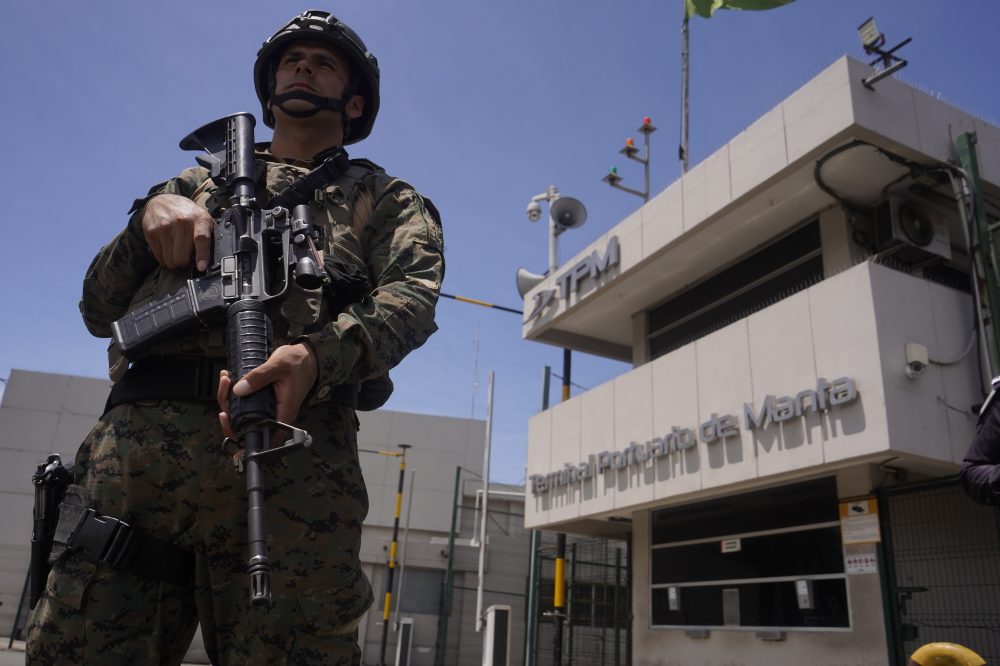

QUITO, Ecuador — Ecuador’s government announced Monday the mobilization of 75,000 military and law enforcement personnel across four violence-plagued provinces, where authorities have instituted nighttime curfews prohibiting residents from venturing outside between 11 p.m. and 5 a.m.
Authorities reported 253 arrests for curfew violations since the restrictions began Sunday evening in Guayas, El Oro, Los Rios and Santo Domingo de los Tsachilas provinces. The two-week emergency measure encompasses Guayaquil, the nation’s largest city, but excludes the capital Quito and the tourist destination of the Galápagos Islands.
Interior Minister John Reimberg announced Monday that military forces utilized approved artillery strikes against three designated targets, though he declined to elaborate on the specific nature of these operations. “Let whatever must fall, fall — and whoever must fall, fall,” he declared to reporters, emphasizing that no casualties were documented during these missions.
The South American nation faces an escalating battle against drug-fueled violence as competing criminal organizations wage war for dominance over Pacific coast shipping facilities crucial for transporting cocaine to American markets.
Government data from the Ministry of the Interior reveals Ecuador experienced its most deadly year on record in 2023, with homicides reaching 50 deaths per 100,000 inhabitants.
Murder rates have surged fivefold since the coronavirus pandemic began, driven by Colombian and Mexican trafficking networks fighting over smuggling corridors while forming alliances with domestic criminal groups.
President Daniel Noboa recently renewed emergency powers that authorize military forces to conduct joint operations with civilian police and search private residences without obtaining warrants.
The conservative president has pointed fingers at neighboring Colombia, claiming its administration fails to adequately combat criminal organizations operating across their shared border. This January, Noboa imposed import duties on Colombian goods, vowing to maintain these penalties until cross-border security conditions improve.
This month, Ecuador’s armed forces announced a collaborative strike with U.S. forces targeting a Colombian narcotics training facility, deploying unmanned aircraft, helicopters and naval vessels in the assault.
Military officials identified the compound as being situated within Ecuadorian territory and controlled by Comandos de la Frontera, a faction that broke away from FARC following the rebel group’s 2016 peace agreement with Colombia’s government.
Human rights organizations have criticized Noboa’s aggressive approach, arguing his hardline tactics have failed to decrease criminal activity while endangering innocent civilians.
A controversial incident last year highlighted concerns about the president’s anti-crime strategies when eleven military personnel received sentences exceeding 30 years for kidnapping four minors, whose remains were discovered near a Guayaquil-area military installation.