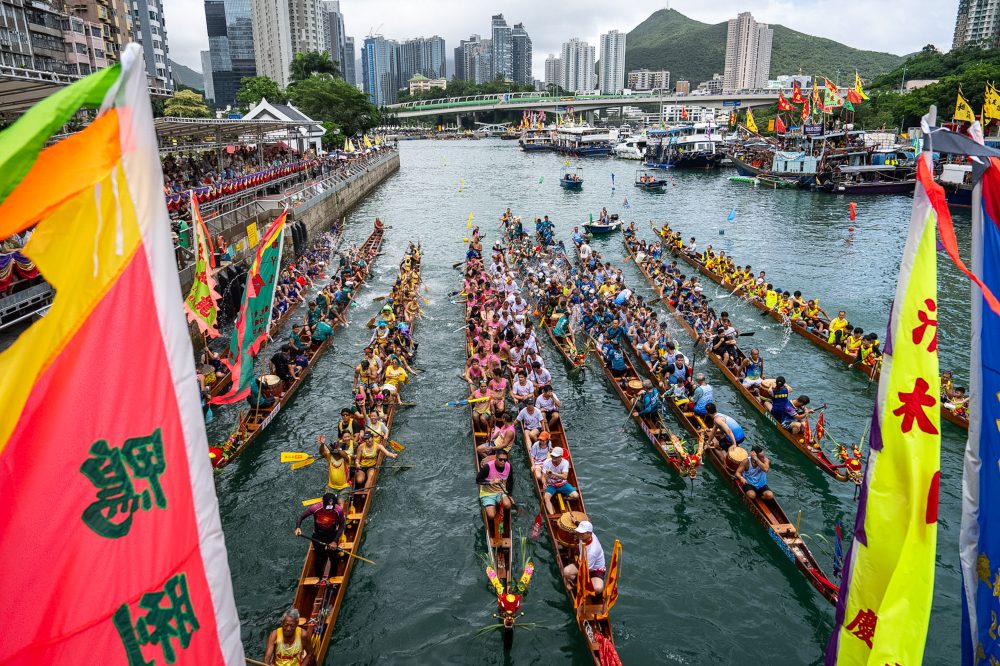

BEIJING (AP) — Vibrant dragon boat races, lion dances, and festive gatherings filled communities across mainland China, Hong Kong, and Taiwan on Friday as people celebrated the Dragon Boat Festival.
The holiday stretches back more than 2,000 years and, while best known for its athletic competitions, has deep roots in Chinese history and ancient beliefs surrounding health, protection, and living in harmony with nature.
“The Dragon Boat Festival is probably the richest and most diverse of all traditional Chinese festivals,” said Liu Xiaofeng, a history professor at Tsinghua University. “Across different regions, people developed a wide variety of traditions based on ideas connected to the summer solstice and the balance of yin and yang.”
Central to the festival’s story is the ancient poet Qu Yuan, who according to legend took his own life by drowning more than two millennia ago. The tradition of dragon boat racing grew from tales of people rushing out onto the water to search for him and tossing rice into the river to keep fish from consuming his body.
In Beijing, a three-day competition features men’s, women’s, and mixed-team races at distances of 100, 200, and 500 meters. Competitors from Beijing, Tianjin, Hebei, Shanxi, and Guangdong are taking part in the weekend-long event.
Crews moved their paddles in perfect unison, guided by the thundering beat of onboard drummers, as each boat drove hard toward the finish line while crowds of spectators cheered from the banks.
Many others followed the action from home, enjoying the holiday with family over “zongzi” — a traditional sticky rice dish prepared for the occasion.
The 2026 Beijing festivities are scheduled to run through June 21 at the city’s Grand Canal.
“The competition helped strengthen our team spirit,” said Li Maoshan, one of Friday’s race participants. “It also gave us an opportunity to demonstrate the spirit of perseverance and hard work.”
In Hong Kong, participants added a playful touch to the races by wearing costumes, including a cartoon depiction of Ne Zha, a figure from Chinese Taoist tradition.